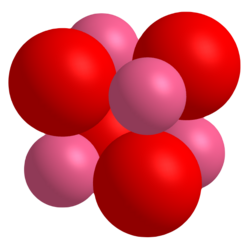
 | |
| Names | |
|---|---|
| IUPAC name
Cobalt(II) oxide
| |
| Other names
Cobaltous oxide
Cobalt monoxide | |
| Identifiers | |
3D model (JSmol)
|
|
| ChemSpider |
|
| ECHA InfoCard | 100.013.777 |
| EC Number |
|
PubChem CID
|
|
| RTECS number |
|
| UNII | |
| UN number | 3288 |
CompTox Dashboard (EPA)
|
|
| |
| |
| Properties | |
| CoO | |
| Molar mass | 74.9326 g/mol |
| Appearance | olive or gray powder |
| Odor | odorless |
| Density | 6.45 g/cm3 1 |
| Melting point | 1,933 °C (3,511 °F; 2,206 K) |
| insoluble in water2 | |
| +4900.0·10−6 cm3/mol | |
| Structure | |
| cubic, cF8 | |
| Fm3m, No. 225 | |
| Hazards | |
| GHS labelling: | |
 
| |
| Warning | |
| H302, H317, H410 | |
| P260, P280, P284, P301+P310+P330, P304+P340+P310, P342+P311, P403+P233 | |
| NFPA 704 (fire diamond) | |
| Flash point | Non-flammable |
| Lethal dose or concentration (LD, LC): | |
LD50 (median dose)
|
202 mg/kg |
| Safety data sheet (SDS) | ICSC 1551 |
| Related compounds | |
Other anions
|
Cobalt(II) sulfide Cobalt(II) hydroxide |
Other cations
|
Iron(II) oxide Nickel(II) oxide |
Related compounds
|
Cobalt(II,III) oxide Cobalt(III) oxide |
Except where otherwise noted, data are given for materials in their standard state (at 25 °C [77 °F], 100 kPa).
| |



Cobalt(II) oxide is an inorganic compound that has been described as an olive-green3 or gray4 solid. It is used extensively in the ceramics industry as an additive to create blue-colored glazes and enamels, as well as in the chemical industry for producing cobalt(II) salts. A related material is cobalt(II,III) oxide, a black solid with the formula Co3O4.
Structure and properties
CoO crystals adopt the periclase (rock salt) structure with a lattice constant of 4.2615 Å.5
It is antiferromagnetic below 289 K (16 °C; 61 °F).6
CoO has a band gap of 2.5 eV.7
Preparation
Cobalt(II) oxide is prepared by oxidation of cobalt powder with air or by thermal decomposition of cobalt(II) nitrate or the carbonate.34
Cobalt(II,III) oxide decomposes to cobalt(II) oxide at 950 °C:8
- 2 Co3O4 → 6 CoO + O2
It may also be prepared by precipitating the hydroxide, followed by thermal dehydration:
- CoX2 + 2 KOH → Co(OH)2 + 2 KX
- Co(OH)2 → CoO + H2O
Reactions
As can be expected, cobalt(II) oxide reacts with mineral acids to form the corresponding cobalt salts:
- CoO + 2 HX → CoX2 + H2O
Applications
Cobalt(II) oxide has for centuries been used as a coloring agent on kiln fired pottery. The additive provides a deep shade of blue named cobalt blue. It also is used in cobalt blue glass.
References
References
- Lide, David R., ed. (2006). CRC Handbook of Chemistry and Physics (87th ed.). Boca Raton, Florida: CRC Press. ISBN 0-8493-0487-3.
- Advanced Search – Alfa Aesar – A Johnson Matthey Company Archived 2011-07-19 at the Wayback Machine. Alfa.com. Retrieved on 2011-11-19.
- Greenwood, Norman N.; Earnshaw, Alan (1997). Chemistry of the Elements (2nd ed.). Butterworth-Heinemann. doi:10.1016/C2009-0-30414-6. ISBN 978-0-08-037941-8.
- Donaldson, John Dallas; Beyersmann, Detmar (2005). "Cobalt and Cobalt Compounds". Ullmann's Encyclopedia of Industrial Chemistry. Weinheim: Wiley-VCH. doi:10.1002/14356007.a07_281.pub2. ISBN 978-3-527-30673-2.
- Kannan, R.; Seehra, Mohindar S. (1987). "Percolation effects and magnetic properties of the randomly diluted fcc system CopMg1-pO". Physical Review B. 35 (13): 6847–6853. Bibcode:1987PhRvB..35.6847K. doi:10.1103/PhysRevB.35.6847. PMID 9940938.
- Silinsky, P. S.; Seehra, Mohindar S. (1981). "Principal magnetic susceptibilities and uniaxial stress experiments in CoO". Physical Review B. 24 (1): 419–423. Bibcode:1981PhRvB..24..419S. doi:10.1103/PhysRevB.24.419.
- van Elp, J.; Wieland, J. L.; Eskes, H.; Kuiper, P.; Sawatzky, G. A.; de Groot, F. M. F.; Turner, T. S. (1991-09-15). "Electronic structure of CoO, Li-doped CoO, and LiCoO 2". Physical Review B. 44 (12): 6090–6103. doi:10.1103/PhysRevB.44.6090. ISSN 0163-1829.
- US 4389339, James, Leonard E.; Crescentini, Lamberto & Fisher, William B., "Process for making a cobalt oxide catalyst", published 1983-06-21