Christian mysticism refers to the traditions of mysticism, mystical practices and mystical theology within Christianity which "concerns the preparation [of the person] for, the consciousness of, and the effect of [...] a direct and transformative presence of God"1 or divine love.2 Until the sixth century the practice of what is now called mysticism was referred to by the term contemplatio, c.q. theoria, from contemplatio (Latin; Greek θεωρία, theoria),3 "looking at", "gazing at", "being aware of" God or the divine.456 Christianity took up the use of both the Greek (theoria) and Latin (contemplatio, contemplation) terminology to describe various forms of prayer and the process of coming to know God.
Contemplative practices range from simple prayerful meditation of holy scripture (i.e. Lectio Divina) to contemplation on the presence of God, resulting in theosis (spiritual union with God) and ecstatic visions of the soul's mystical union with God. Three stages are discerned in contemplative practice, namely catharsis (purification),78 contemplation proper, and the vision of God.
Contemplative practices have a prominent place in Eastern Orthodoxy and Oriental Orthodoxy, and have gained a renewed interest in Western Christianity.
Etymology
Theoria
The Greek theoria (θεωρία) meant "contemplation, speculation, a looking at, things looked at", from theorein (θεωρεῖν) "to consider, speculate, look at", from theoros (θεωρός) "spectator", from thea (θέα) "a view" + horan (ὁρᾶν) "to see".9 It expressed the state of being a spectator. Both Greek θεωρία and Latin contemplatio primarily meant looking at things, whether with the eyes or with the mind.10
According to William Johnston, until the sixth century the practice of what is now called mysticism was referred to by the term contemplatio, c.q. theoria.4 According to Johnston, "[b]oth contemplation and mysticism speak of the eye of love which is looking at, gazing at, aware of divine realities."4
Several scholars have demonstrated similarities between the Greek idea of theoria and the Indian idea of darśana (darshan), including Ian Rutherford11 and Gregory Grieve.12
Mysticism
"Mysticism" is derived from the Greek μύω, meaning "to close, shut (the eyes, mouth)" which has the derivative form μυστικός, mystikos, meaning "connected with the mysteries, mystic, private, secret", which was also used in its plural form οἱ μυστικοί in place of the normal μύσται to mean "initiates" of one of the Greek mystery religions. In this original sense, μυστήρια, "mysteries", referred to secret religious rituals13 and use of the word lacked any direct references to the transcendental meaning found later in Christianity.14
In early Christianity the term mystikos referred to three dimensions, which soon became intertwined, namely the biblical, the liturgical and the spiritual or contemplative.15 The biblical dimension refers to "hidden" or allegorical interpretations of Scriptures.1315 The liturgical dimension refers to the liturgical mystery of the Eucharist, the presence of Christ at the Eucharist.1315 The third dimension is the contemplative or experiential knowledge of God.15
Definition of mysticism
Transformative presence of God
Bernard McGinn defines Christian mysticism as:
[T]hat part, or element, of Christian belief and practice that concerns the preparation for, the consciousness of, and the effect of [...] a direct and transformative presence of God.1
McGinn argues that "presence" is more accurate than "union," since not all mystics spoke of union with God, and since many visions and miracles were not necessarily related to union.1
Presence versus experience
McGinn also argues that we should speak of "consciousness" of God's presence, rather than of "experience", since mystical activity is not simply about the sensation of God as an external object, but more broadly about
...new ways of knowing and loving based on states of awareness in which God becomes present in our inner acts.1
William James popularized the use of the term "religious experience" in his 1902 book The Varieties of Religious Experience.16 It has also influenced the understanding of mysticism as a distinctive experience which supplies knowledge.13
Wayne Proudfoot traces the roots of the notion of religious experience further back to the German theologian Friedrich Schleiermacher (1768–1834), who argued that religion is based on a feeling of the infinite. The notion of religious experience was used by Schleiermacher to defend religion against the growing scientific and secular critique. It was adopted by many scholars of religion, of which William James was the most influential.17
Interpersonal transformation
McGinn's emphasis on the transformation that occurs through mystical activity relates to this idea of "presence" instead of "experience":
This is why the only test that Christianity has known for determining the authenticity of a mystic and her or his message has been that of personal transformation, both on the mystic's part and—especially—on the part of those whom the mystic has affected.1
Parsons points out that the stress on "experience" is accompanied by favoring the atomic individual, instead of the shared life of the community. It also fails to distinguish between episodic experience, and mysticism as a process that is embedded in a total religious matrix of liturgy, scripture, worship, virtues, theology, rituals and practices.18
Richard King also points to disjunction between "mystical experience" and social justice:19
The privatisation of mysticism – that is, the increasing tendency to locate the mystical in the psychological realm of personal experiences – serves to exclude it from political issues as social justice. Mysticism thus becomes seen as a personal matter of cultivating inner states of tranquility and equanimity, which, rather than seeking to transform the world, serve to accommodate the individual to the status quo through the alleviation of anxiety and stress.19
Social construction
Mystical experience is not simply a matter between the mystic and God, but is often shaped by cultural issues. For instance, Caroline Bynum has shown how, in the late Middle Ages, miracles attending the taking of the Eucharist were not simply symbolic of the Passion story, but served as vindication of the mystic's theological orthodoxy by proving that the mystic had not fallen prey to heretical ideas, such as the Cathar rejection of the material world as evil, contrary to orthodox teaching that God took on human flesh and remained sinless.20 Thus, the nature of mystical experience could be tailored to the particular cultural and theological issues of the time.
Origins
The idea of mystical realities has been widely held in Christianity since the second century AD, referring not simply to spiritual practices, but also to the belief that their rituals and even their scriptures have hidden ("mystical") meanings.1
The link between mysticism and the vision of the divine was introduced by the early Church Fathers, who used the term as an adjective, as in mystical theology and mystical contemplation.14
In subsequent centuries, especially as Christian apologetics began to use Greek philosophy to explain Christian ideas, Neoplatonism became an influence on Christian mystical thought and practice via such authors as Augustine of Hippo and Origen.21
Jewish antecedents
Jewish spirituality in the period before Jesus was highly corporate and public, based mostly on the worship services of the synagogues, which included the reading and interpretation of the Hebrew Scriptures and the recitation of prayers, and on the major festivals. Thus, private spirituality was strongly influenced by the liturgies and by the scriptures (e.g., the use of the Psalms for prayer), and individual prayers often recalled historical events just as much as they recalled their own immediate needs.22
Of special importance are the following concepts:
- Binah (understanding), and Chokmah (wisdom), which come from years of reading, praying and meditating the scriptures;
- Shekhinah, the presence of God in our daily lives, the superiority of that presence to earthly wealth, the pain and longing that come when God is absent; and the nurturing, feminine aspect of God;
- The hiddenness of God, which comes from our inability to survive the full revelation of God's glory and which forces us to seek to know God through faith and obedience;
- "Torah-mysticism", a view of God's laws as the central expression of God's will and therefore as worthy object not only of obedience but also of loving meditation and Torah study;
- Poverty, an ascetic value, based on the apocalyptic expectation of God's impending arrival, that characterized the Jewish people's reaction to being oppressed by a series of foreign empires.
In Christian mysticism, Shekhinah became mystery, Da'at (knowledge) became gnosis, and poverty became an important component of monasticism.23
Greek influences
The term theoria was used by the ancient Greeks to refer to the act of experiencing or observing, and then comprehending through nous.
The influences of Greek thought are apparent in the earliest Christian mystics and their writings. Plato (428–348 BC) is considered the most important of ancient philosophers, and his philosophical system provides the basis of most later mystical forms. Plotinus (c. 205 – 270 AD) provided the non-Christian, neo-Platonic basis for much Christian, Jewish and Islamic mysticism.24
Plato
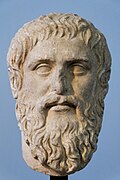
For Plato, what the contemplative (theoros) contemplates (theorei) are the Forms, the realities underlying the individual appearances, and one who contemplates these atemporal and aspatial realities is enriched with a perspective on ordinary things superior to that of ordinary people.25 Philip of Opus viewed theoria as contemplation of the stars, with practical effects in everyday life similar to those that Plato saw as following from contemplation of the Forms.25
Plotinus
In the Enneads of Plotinus (c.204/5–270 CE), a founder of Neoplatonism, everything is contemplation (theoria)26 and everything is derived from contemplation.27 The first hypostasis, the One, is contemplation2829 (by the nous, or second hypostasis) in that "it turns to itself in the simplest regard, implying no complexity or need"; this reflecting back on itself emanated (not created) the second hypostasis, Intellect (in Greek Νοῦς, Nous), Plotinus describes as "living contemplation", being "self-reflective and contemplative activity par excellence", and the third hypostatic level has theoria.30 Knowledge of the one is achieved through experience of its power, an experience that is contemplation (theoria) of the source of all things.31
Plotinus agreed with Aristotle's systematic distinction between contemplation (theoria) and practice (praxis): dedication to the superior life of theoria requires abstention from practical, active life. Plotinus explained: "The point of action is contemplation. ... Contemplation is therefore the end of action" and "Such is the life of the divinity and of divine and blessed men: detachments from all things here below, scorn of all earthly pleasures, the flight of the lone to the Alone."32
Early church
New Testament writings
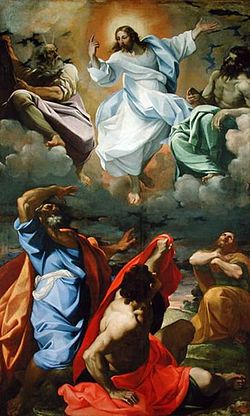
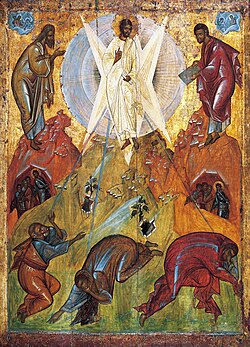
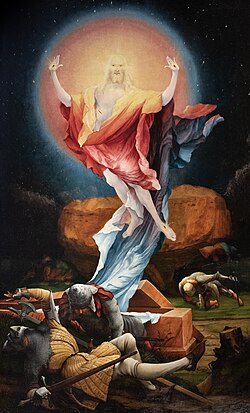
The Christian scriptures, insofar as they are the founding narrative of the Christian church, provide many key stories and concepts that become important for Christian mystics in all later generations: practices such as the Eucharist, baptism and the Lord's Prayer all become activities that take on importance for both their ritual and symbolic values. Other scriptural narratives present scenes that become the focus of meditation: the crucifixion of Jesus and his appearances after his resurrection are two of the most central to Christian theology; but Jesus' conception, in which the Holy Spirit overshadows Mary, and his transfiguration, in which he is briefly revealed in his heavenly glory, also become important images for meditation. Moreover, many of the Christian texts build on Jewish spiritual foundations, such as chokmah, shekhinah.33
But different writers present different images and ideas. The Synoptic Gospels (in spite of their many differences) introduce several important ideas, two of which are related to Greco-Judaic notions of knowledge/gnosis by virtue of being mental acts: purity of heart, in which we will to see in God's light; and repentance, which involves allowing God to judge and then transform us. Another key idea presented by the Synoptics is the desert, which is used as a metaphor for the place where we meet God in the poverty of our spirit.34
The Gospel of John focuses on God's glory in his use of light imagery and in his presentation of the cross as a moment of exaltation; he also sees the cross as the example of agape love, a love which is not so much an emotion as a willingness to serve and care for others. But in stressing love, John shifts the goal of spiritual growth away from knowledge/gnosis, which he presents more in terms of Stoic ideas about the role of reason as being the underlying principle of the universe and as the spiritual principle within all people. Although John does not follow up on the Stoic notion that this principle makes union with the divine possible for humanity, it is an idea that later Christian writers develop. Later generations will also shift back and forth between whether to follow the Synoptics in stressing knowledge or John in stressing love.35
In his letters, Paul also focuses on mental activities, but not in the same way as the Synoptics, which equate renewing the mind with repentance. Instead, Paul sees the renewal of our minds as happening as we contemplate what Jesus did on the cross, which then opens us to grace and to the movement of the Holy Spirit into peoples' hearts. Like John, Paul is less interested in knowledge, preferring to emphasize the hiddenness, the "mystery" of God's plan as revealed through Christ. But Paul's discussion of the Cross differs from John's in being less about how it reveals God's glory and more about how it becomes the stumbling block that turns our minds back to God. Paul also describes the Christian life as that of an athlete, demanding practice and training for the sake of the prize; later writers will see in this image a call to ascetical practices.36
Apostolic Fathers
The texts attributed to the Apostolic Fathers, the earliest post-Biblical texts we have, share several key themes, particularly the call to unity in the face of internal divisions and perceptions of persecution, the reality of the charisms, especially prophecy, visions, and Christian gnosis, which is understood as "a gift of the Holy Spirit that enables us to know Christ" through meditating on the scriptures and on the cross of Christ.37 (This understanding of gnosis is not the same as that developed by the Gnostics, who focused on esoteric knowledge that is available only to a few people but that allows them to free themselves from the evil world.3839) These authors also discuss the notion of the "two ways", that is, the way of life and the way of death; this idea has biblical roots, being found in both the Sermon on the Mount and the Torah. The two ways are then related to the notion of purity of heart, which is developed by contrasting it against the divided or duplicitous heart and by linking it to the need for asceticism, which keeps the heart whole/pure.4041 Purity of heart was especially important given perceptions of martyrdom, which many writers discussed in theological terms, seeing it not as an evil but as an opportunity to truly die for the sake of God—the ultimate example of ascetic practice.42 Martyrdom could also be seen as symbolic in its connections with the Eucharist and with baptism.43
Theoria enabled the Fathers to perceive depths of meaning in the biblical writings that escape a purely scientific or empirical approach to interpretation.44 The Antiochene Fathers, in particular, saw in every passage of Scripture a double meaning, both literal and spiritual.45note 1 As Frances Margaret Young notes, "Best translated in this context as a type of "insight", theoria was the act of perceiving in the wording and "story" of Scripture a moral and spiritual meaning,"47 and may be regarded as a form of allegory.48
Alexandrian mysticism
The Alexandrian contribution to Christian mysticism centers on Origen (c. 185 – c. 253) and Clement of Alexandria (150–215 AD). Clement was an early Christian humanist who argued that reason is the most important aspect of human existence and that gnosis (not something we can attain by ourselves, but the gift of Christ) helps us find the spiritual realities that are hidden behind the natural world and within the scriptures. Given the importance of reason, Clement stresses apatheia as a reasonable ordering of our passions in order to live within God's love, which is seen as a form of truth.49 Origen, who had a lasting influence on Eastern Christian thought, further develops the idea that the spiritual realities can be found through allegorical readings of the scriptures (along the lines of Jewish aggadah tradition), but he focuses his attention on the cross and on the importance of imitating Christ through the cross, especially through spiritual combat and asceticism. Origen stresses the importance of combining intellect and virtue (theoria and praxis) in our spiritual exercises, drawing on the image of Moses and Aaron leading the Israelites through the wilderness, and he describes our union with God as the marriage of our souls with Christ the Logos, using the wedding imagery from the Song of Songs.50 Alexandrian mysticism developed alongside Hermeticism and Neoplatonism and therefore share some of the same ideas, images, etc. in spite of their differences.51
Philo of Alexandria (20 BCE – c. 50 CE) was a Jewish Hellenistic philosopher who was important for connecting the Hebrew Scriptures to Greek thought, and thereby to Greek Christians, who struggled to understand their connection to Jewish history. In particular, Philo taught that allegorical interpretations of the Hebrew scriptures provides access to the real meanings of the texts. Philo also taught the need to bring together the contemplative focus of the Stoics and Essenes with the active lives of virtue and community worship found in Platonism and the Therapeutae. Using terms reminiscent of the Platonists, Philo described the intellectual component of faith as a sort of spiritual ecstasy in which our nous (mind) is suspended and God's spirit takes its place. Philo's ideas influenced the Alexandrian Christians, Clement, and Origen, and through them, Gregory of Nyssa.52
Monasticism
Desert Fathers
Inspired by Christ's teaching and example, men and women withdrew to the deserts of Sketes where, either as solitary individuals or communities, they lived lives of austere simplicity oriented towards contemplative prayer. These communities formed the basis for what later would become known as Christian monasticism.53
Early monasticism
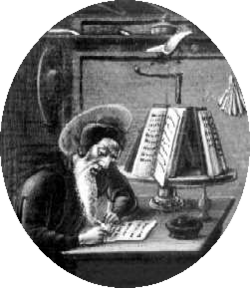
The Eastern church then saw the development of monasticism and the mystical contributions of Gregory of Nyssa, Evagrius Ponticus, and Pseudo-Dionysius. Monasticism, also known as anchoritism (meaning "to withdraw") was seen as an alternative to martyrdom, and was less about escaping the world than about fighting demons (who were thought to live in the desert) and about gaining liberation from our bodily passions in order to be open to the word of God. Anchorites practiced continuous meditation on the scriptures as a means of climbing the ladder of perfection—a common religious image in the Mediterranean world and one found in Christianity through the story of Jacob's ladder—and sought to fend off the demon of acedia ("un-caring"), a boredom or apathy that prevents us from continuing on in our spiritual training. Anchorites could live in total solitude ("hermits", from the word erēmitēs, "of the desert") or in loose communities ("cenobites", meaning "common life").54
Monasticism eventually made its way to the West and was established by the work of John Cassian and Benedict of Nursia. Meanwhile, Western spiritual writing was deeply influenced by the works of such men as Jerome and Augustine of Hippo.55
Neo-Platonism
Neo-Platonism has had a profound influence on Christian contemplative traditions. Neoplatonic ideas were adopted by Christianity,note 2 among them the idea of theoria or contemplation, taken over by Gregory of Nyssa for example.note 3 The Brill Dictionary of Gregory of Nyssa remarks that contemplation in Gregory is described as a "loving contemplation",58 and, according to Thomas Keating, the Greek Fathers of the Church, in taking over from the Neoplatonists the word theoria, attached to it the idea expressed by the Hebrew word da'ath, which, though usually translated as "knowledge", is a much stronger term, since it indicates the experiential knowledge that comes with love and that involves the whole person, not merely the mind.59 Among the Greek Fathers, Christian theoria was not contemplation of Platonic Ideas nor of the astronomical heavens of Pontic Heraclitus, but "studying the Scriptures", with an emphasis on the spiritual sense.10
Later, contemplation came to be distinguished from intellectual life, leading to the identification of θεωρία or contemplatio with a form of prayer10 distinguished from discursive meditation in both East60 and West.61 Some make a further distinction, within contemplation, between contemplation acquired by human effort and infused contemplation.6162
Mystical theology
In early Christianity the term "mystikos" referred to three dimensions, which soon became intertwined, namely the biblical, the liturgical and the spiritual or contemplative.63 The biblical dimension refers to "hidden" or allegorical interpretations of Scriptures.6463 The liturgical dimension refers to the liturgical mystery of the Eucharist, the presence of Christ at the Eucharist.6463 The third dimension is the contemplative or experiential knowledge of God.63
The 9th century saw the development of mystical theology through the introduction of the works of sixth-century theologian Pseudo-Dionysius the Areopagite, such as On Mystical Theology. His discussion of the via negativa was especially influential.65
Under the influence of Pseudo-Dionysius the Areopagite (late 5th to early 6th century) the mystical theology came to denote the investigation of the allegorical truth of the Bible,63 and "the spiritual awareness of the ineffable Absolute beyond the theology of divine names."66 Pseudo-Dionysius' apophatic theology, or "negative theology", exerted a great influence on medieval monastic religiosity.67 It was influenced by Neo-Platonism, and very influential in Eastern Orthodox Christian theology. In western Christianity it was a counter-current to the prevailing Cataphatic theology or "positive theology".
Practice
Cataphatic and apophatic mysticism
Within theistic mysticism two broad tendencies can be identified. One is a tendency to understand God by asserting what he is and the other by asserting what he is not. The former leads to what is called cataphatic theology and the latter to apophatic theology.
- Cataphatic (imaging God, imagination or words) – e.g., The Spiritual Exercises of St. Ignatius of Loyola, Julian of Norwich, Francis of Assisi; and
- Apophatic (imageless, stillness, and wordlessness) – inspired by the writings of Pseudo-Dionysius the Areopagite, which forms the basis of Eastern Orthodox mysticism and hesychasm, and became influential in western Catholic mysticism from the 12th century AD onward, as in The Cloud of Unknowing and Meister Eckhart.68
Urban T. Holmes III categorized mystical theology in terms of whether it focuses on illuminating the mind, which Holmes refers to as speculative practice, or the heart/emotions, which he calls affective practice. Combining the speculative/affective scale with the apophatic/cataphatic scale allows for a range of categories:69
- Rationalism = Cataphatic and speculative
- Pietism = Cataphatic and affective
- Encratism = Apophatic and speculative
- Quietism = Apophatic and affective
Meditation and contemplation
In discursive meditation, such as Lectio Divina, mind and imagination and other faculties are actively employed in an effort to understand Christians' relationship with God.7071 In contemplative prayer, this activity is curtailed, so that contemplation has been described as "a gaze of faith", "a silent love".note 4 There is no clear-cut boundary between Christian meditation and Christian contemplation, and they sometimes overlap. Meditation serves as a foundation on which the contemplative life stands, the practice by which someone begins the state of contemplation.72
John of the Cross described the difference between discursive meditation and contemplation by saying:
The difference between these two conditions of the soul is like the difference between working, and enjoyment of the fruit of our work; between receiving a gift, and profiting by it; between the toil of travelling and the rest of our journey's end".7374
Mattá al-Miskīn, an Oriental Orthodox monk has posited:
Meditation is an activity of one's spirit by reading or otherwise, while contemplation is a spontaneous activity of that spirit. In meditation, man's imaginative and thinking power exert some effort. Contemplation then follows to relieve man of all effort. Contemplation is the soul's inward vision and the heart's simple repose in God.72
Threefold path
According to the standard formulation of the process of Christian perfection, going back to Evagrius Ponticus (345–399 AD)75 and Dionysius the Pseudo-Areopagite (late 5th to early 6th century),7677 there are three stages:786177
- Katharsis or purification;
- Theoria or illumination, also called "natural" or "acquired contemplation;"
- Union or Theosis; also called "infused" or "higher contemplation"; indwelling in God; vision of God; deification; union with God
The three aspects later became purgative, illuminative, and unitive in the western churches and prayer of the lips, the mind, the heart in the eastern churches.75
Purification and illumination of the mind are preparations for the vision of God. Without these preparations it is impossible for man's selfish love to be transformed into selfless love. This transformation takes place during the higher level of the stage of illumination called theoria, literally meaning vision, in this case vision by means of unceasing and uninterrupted memory of God. Those who remain selfish and self-centered with a hardened heart, closed to God's love, will not see the glory of God in this life. However, they will see God's glory eventually, but as an eternal and consuming fire and outer darkness.79
Catharsis (purification)
In the Orthodox Churches, theosis results from leading a pure life, practicing restraint and adhering to the commandments, putting the love of God before all else. This metamorphosis (transfiguration) or transformation results from a deep love of God. Saint Isaac the Syrian says in his Ascetical Homilies that "Paradise is the love of God, in which the bliss of all the beatitudes is contained," and that "the tree of life is the love of God" (Homily 72). Theoria is thus achieved by the pure of heart who are no longer subject to the afflictions of the passions. It is a gift from the Holy Spirit to those who, through observance of the commandments of God and ascetic practices (see praxis, kenosis, Poustinia and schema), have achieved dispassion.note 5
Purification constitutes a turning away from all that is unclean and unwholesome. This is a purification of mind and body. As preparation for theoria, however, the concept of purification in this three-part scheme refers most importantly to the purification of nous. With a purified nous, clear vision and understanding become possible, making one fit for contemplative prayer.8182 After the nous has been cleansed, the faculty of discernment and knowledge (wisdom), whose awakening is essential to coming out of the state of delusion that is characteristic of the worldly-minded, may then begin to operate more consistently.
In the Eastern Orthodox ascetic tradition called hesychasm, humility, as a saintly attribute, is called holy wisdom or Sophia. Humility is the most critical component to humanity's salvation.note 6 Following Christ's instruction to "go into your room or closet and shut the door and pray to your father who is in secret" (Matthew 6:6), the hesychast withdraws into solitude in order that he or she may enter into a deeper state of contemplative stillness. By means of this stillness, the mind is calmed, and the ability to see reality is enhanced. The practitioner seeks to attain what the apostle Paul called 'unceasing prayer'.
Some Eastern Orthodox theologians object to what they consider an overly speculative, rationalistic, and insufficiently experiential nature of Roman Catholic theology.note 7 and confusion between different aspects of the Trinity.note 8
Theoria (illumination) – contemplative prayer
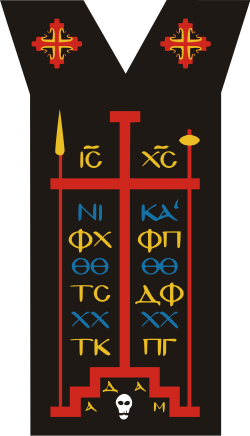
An exercise long used among Christians for acquiring contemplation, one that is "available to everyone, whether he be of the clergy or of any secular occupation",86 is that of focusing the mind by constant repetition of a phrase or word. Saint John Cassian recommended using the phrase "O God, make speed to save me: O Lord, make haste to help me".8788 Another formula for repetition is the name of Jesus,8990 or the Jesus Prayer: "Lord Jesus Christ, Son of God, have mercy on me, a sinner," which has been called "the mantra of the Orthodox Church",88 although the term "Jesus Prayer" is not found in the writings of the Fathers of the Church.91 The author of The Cloud of Unknowing recommended use of a monosyllabic word, such as "God" or "Love".92
Contemplative prayer in the Eastern Church
In the Eastern Church, noetic prayer is the first stage of theoria,93note 9 the vision of God, which is beyond conceptual knowledge,94 like the difference between reading about the experience of another, and reading about one's own experience.80 Noetic prayer is the first stage of the Jesus Prayer, a short formulaic prayer: "Lord Jesus Christ, Son of God, have mercy on me, a sinner." The second stage of the Jesus Prayer is the Prayer of the Heart (Καρδιακή Προσευχή), in which the prayer is internalized into 'the heart'.95
The Jesus Prayer, which, for the early Fathers, was just a training for repose,96 the later Byzantines developed into hesychasm, a spiritual practice of its own, attaching to it technical requirements and various stipulations that became a matter of serious theological controversy.96 Via the Jesus Prayer, the practice of the Hesychast is seen to cultivate nepsis, watchful attention. Sobriety contributes to this mental asceticism that rejects tempting thoughts; it puts a great emphasis on focus and attention. The practitioner of the hesychast is to pay extreme attention to the consciousness of his inner world and to the words of the Jesus Prayer, not letting his mind wander in any way at all. The Jesus Prayer invokes an attitude of humility believed to be essential for the attainment of theoria.97 The Jesus Prayer is also invoked to pacify the passions, as well as the illusions that lead a person to actively express these passions. It is believed that the worldly, neurotic mind is habitually accustomed to seek pleasant sensations and to avoid unpleasant ones. This state of incessant agitation is attributed to the corruption of primordial knowledge and union with God (the fall of man and the defilement and corruption of consciousness, or nous).note 10 According to St. Theophan the Recluse, though the Jesus Prayer has long been associated with the Prayer of the Heart, they are not synonymous.99
Contemplative prayer in the Roman Catholic Church
Methods of prayer in the Roman Catholic Church include recitation of the Jesus Prayer, which "combines the Christological hymn of Philippians 2:6–11 with the cry of the publican (Luke 18:13) and the blind man begging for light (Mark 10:46–52). By it the heart is opened to human wretchedness and the Saviour's mercy";100 invocation of the holy name of Jesus;100 recitation, as recommended by Saint John Cassian, of "O God, come to my assistance; O Lord, make haste to help me" or other verses of Scripture; repetition of a single monosyllabic word, as suggested by the Cloud of Unknowing, such as "God" or "Love";92 the method used in centering prayer; the use of Lectio Divina.101 The Congregation for Divine Worship's directory of popular piety and the liturgy emphasizes the contemplative characteristic of the Holy Rosary and states that the Rosary is essentially a contemplative prayer which requires "tranquility of rhythm or even a mental lingering which encourages the faithful to meditate on the mysteries of the Lord's life."102 Pope John Paul II placed the Rosary at the very center of Christian spirituality and called it "among the finest and most praiseworthy traditions of Christian contemplation."103 In modern times, centering prayer, which is also called "Prayer of the heart" and "Prayer of Simplicity,"note 11 has been popularized by Thomas Keating, drawing on Hesychasm and the Cloud of Unknowing.note 12 The practice of contemplative prayer has also been encouraged by the formation of associations like The Julian Meetings and the Fellowship of Meditation.
Unification
The third phase, starting with infused or higher contemplation (or Mystical Contemplative Prayer105) in the Western tradition, refers to the presence or consciousness of God. This presence or consciousness varies, but it is first and foremost always associated with a reuniting with divine love, the underlying theme being that God, the perfect goodness,2 is known or experienced at least as much by the heart as by the intellect since, in the words 1 John 4:16: "God is love, and he who abides in love abides in God and God in him." Some approaches to classical mysticism would consider the first two phases as preparatory to the third, explicitly mystical experience, but others state that these three phases overlap and intertwine.106
In the Orthodox Churches, the highest theoria, the highest consciousness that can be experienced by the whole person, is the vision of God.note 13 God is beyond being; He is a hyper-being; God is beyond nothingness. Nothingness is a gulf between God and man. God is the origin of everything, including nothingness. This experience of God in hypostasis shows God's essence as incomprehensible, or uncreated. God is the origin, but has no origin; hence, he is apophatic and transcendent in essence or being, and cataphatic in foundational realities, immanence and energies. This ontic or ontological theoria is the observation of God.107
A nous in a state of ecstasy or ekstasis, called the eighth day, is not internal or external to the world, outside of time and space; it experiences the infinite and limitless God.note 5note 14 Nous is the "eye of the soul" (Matthew 6:22–34).note 15 Insight into being and becoming (called noesis) through the intuitive truth called faith, in God (action through faith and love for God), leads to truth through our contemplative faculties. This theory, or speculation, as action in faith and love for God, is then expressed famously as "Beauty shall Save the World". This expression comes from a mystical or gnosiological perspective, rather than a scientific, philosophical or cultural one.110111112113
Alternate models
Augustine
In the advance to contemplation Augustine spoke of seven stages:114
- the first three are merely natural preliminary stages, corresponding to the vegetative, sensitive and rational levels of human life;
- the fourth stage is that of virtue or purification;
- the fifth is that of the tranquillity attained by control of the passions;
- the sixth is entrance into the divine light (the illuminative stage);
- the seventh is the indwelling or unitive stage that is truly mystical contemplation.
Meister Eckhart
Meister Eckhart did not articulate clear-cut stages,115 yet a number of divisions can be found in his works.116
Teresa of Avila
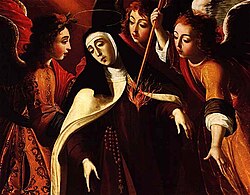
According to Jordan Aumann, Saint Teresa of Ávila distinguishes nine grades of prayer:
- vocal prayer,
- mental prayer or prayer of meditation,
- affective prayer,
- prayer of simplicity, or acquired contemplation or recollection,
- infused contemplation or recollection,
- prayer of quiet,
- prayer of union,
- prayer of conforming union, and
- prayer of transforming union.
According to Aumann, "The first four grades belong to the predominantly ascetical stage of spiritual life; the remaining five grades are infused prayer and belong to the mystical phase of spiritual life."117 According to Augustin Pulain, for Teresa, ordinary prayer "comprises these four degrees: first, vocal prayer; second, meditation, also called methodical prayer, or prayer of reflection, in which may be included meditative reading; third, affective prayer; fourth, prayer of simplicity, or of simple gaze."61
Prayer of simplicity – natural or acquired contemplation
For Teresa, in natural or acquired contemplation, also called the prayer of simplicitynote 11 there is one dominant thought or sentiment which recurs constantly and easily (although with little or no development) amid many other thoughts, beneficial or otherwise. The prayer of simplicity often has a tendency to simplify itself even in respect to its object, leading one to think chiefly of God and of his presence, but in a confused manner.61 Definitions similar to that of Saint Alphonsus Maria de Liguori are given by Adolphe Tanquerey ("a simple gaze on God and divine things proceeding from love and tending thereto") and Saint Francis de Sales ("a loving, simple and permanent attentiveness of the mind to divine things").118
In the words of Saint Alphonsus Maria de Liguori, acquired contemplation "consists in seeing at a simple glance the truths which could previously be discovered only through prolonged discourse": reasoning is largely replaced by intuition and affections and resolutions, though not absent, are only slightly varied and expressed in a few words. Similarly, Saint Ignatius of Loyola, in his 30-day retreat or Spiritual Exercises beginning in the "second week" with its focus on the life of Jesus, describes less reflection and more simple contemplation on the events of Jesus' life. These contemplations consist mainly in a simple gaze and include an "application of the senses" to the events,119: 121 to further one's empathy for Jesus' values, "to love him more and to follow him more closely."119: 104
Natural or acquired contemplation has been compared to the attitude of a mother watching over the cradle of her child: she thinks lovingly of the child without reflection and amid interruptions. The Catechism of the Catholic Church states:
What is contemplative prayer? St. Teresa answers: 'Contemplative [sic]note 16 prayer [oración mental] in my opinion is nothing else than a close sharing between friends; it means taking time frequently to be alone with him who we know loves us.' Contemplative prayer seeks him 'whom my soul loves'. It is Jesus, and in him, the Father. We seek him, because to desire him is always the beginning of love, and we seek him in that pure faith which causes us to be born of him and to live in him. In this inner prayer we can still meditate, but our attention is fixed on the Lord himself.123
Infused or higher contemplation
In the mystical experience of Teresa of Avila, infused or higher contemplation, also called intuitive, passive or extraordinary, is a supernatural gift by which a person's mind will become totally centered on God.124 It is a form of mystical union with God, a union characterized by the fact that it is God, and God only, who manifests himself.61 Under this influence of God, which assumes the free cooperation of the human will, the intellect receives special insights into things of the spirit, and the affections are extraordinarily animated with divine love.124 This union that it entails may be linked with manifestations of a created object, as, for example, visions of the humanity of Christ or an angel or revelations of a future event, etc. They include miraculous bodily phenomena sometimes observed in ecstatics.61
In Teresa's mysticism, infused contemplation is described as a "divinely originated, general, non-conceptual, loving awareness of God".125 According to Dubay:
It is a wordless awareness and love that we of ourselves cannot initiate or prolong. The beginnings of this contemplation are brief and frequently interrupted by distractions. The reality is so unimposing that one who lacks instruction can fail to appreciate what exactly is taking place. Initial infused prayer is so ordinary and unspectacular in the early stages that many fail to recognize it for what it is. Yet with generous people, that is, with those who try to live the whole Gospel wholeheartedly and who engage in an earnest prayer life, it is common.125
According to Thomas Dubay, infused contemplation is the normal, ordinary development of discursive prayer (mental prayer, meditative prayer), which it gradually replaces.125 Dubay considers infused contemplation as common only among "those who try to live the whole Gospel wholeheartedly and who engage in an earnest prayer life". Other writers view contemplative prayer in its infused supernatural form as far from common. John Baptist Scaramelli, reacting in the 17th century against quietism, taught that asceticism and mysticism are two distinct paths to perfection, the former being the normal, ordinary end of the Christian life, and the latter something extraordinary and very rare.126 Jordan Aumann considered that this idea of the two paths was "an innovation in spiritual theology and a departure from the traditional Catholic teaching".127 And Jacques Maritain proposed that one should not say that every mystic necessarily enjoys habitual infused contemplation in the mystical state, since the gifts of the Holy Spirit are not limited to intellectual operations.128
Mystical union
According to Charles G. Herbermann, in the Catholic Encyclopedia (1908), Teresa of Avila described four degrees or stages of mystical union:
- incomplete mystical union, or the prayer of quiet or supernatural recollection, when the action of God is not strong enough to prevent distractions, and the imagination still retains a certain liberty;
- full or semi-ecstatic union, when the strength of the divine action keeps the person fully occupied but the senses continue to act, so that by making an effort, the person can cease from prayer;
- ecstatic union, or ecstasy, when communications with the external world are severed or nearly so, and one can no longer at will move from that state; and
- transforming or deifying union, or spiritual marriage (properly) of the soul with God.
The first three are weak, medium, and the energetic states of the same grace.
The Prayer of Quiet
For Teresa of Ávila, the Prayer of Quiet is a form of contemplative prayer in which the soul experiences an extraordinary peace and rest, accompanied by delight or pleasure in contemplating God as present.129130131132133 In Teresian spirituality it is commonly treated as an early stage of infused contemplation, distinct from ordinary mental prayer, in which the will is peacefully and lovingly absorbed in God while the understanding, memory, and imagination may remain only partially recollected or may continue to wander.134135 Teresa therefore distinguishes the Prayer of Quiet from the more complete prayer of union, in which the faculties are more fully suspended.136
Teresa describes this state especially in the Life, Way of Perfection, and Interior Castle. In the Life, she explains it through the image of the four ways of watering a garden: the laborious drawing of water from a well represents discursive meditation, while the second method, using a water-wheel and buckets, represents the Prayer of Quiet as a more passive and grace-filled form of prayer.137138 In the Interior Castle, it belongs chiefly to the Fourth Mansions, where the soul begins to pass from predominantly active prayer to forms of prayer marked by divine initiative, interior recollection, and spiritual delight.139140
The Prayer of Quiet is closely related to the wider Spanish tradition of recogimiento, or recollection, associated with writers such as Francisco de Osuna, Bernardino de Laredo, and other sixteenth-century authors of interior prayer.141 Teresa inherited this vocabulary of inward gathering, silence, and affective love, but gave it a distinctively experiential and pastoral form.142 In her account, the state should not be confused with self-induced stillness, emotional repose, bodily languor, or a forced suspension of thought. Rather, the soul is to remain gently attentive to God without violently attempting to suppress the faculties that have not been drawn into quiet.143144
Later Carmelite and Catholic spiritual writers systematized Teresa's teaching by distinguishing active or acquired recollection from passive or supernatural recollection, and by identifying the Prayer of Quiet especially with the loving captivity of the will.145146 They also emphasized that it should be judged by its fruits rather than by sensible consolation. In this interpretation, authentic quiet leads to humility, detachment, charity, obedience, and a greater readiness for service, rather than to inertia or indifference.147148 Teresa's teaching is also explicitly Christocentric: she warns against abandoning the humanity of Christ in favour of an abstract or purely imageless contemplation.149
Because of its language of repose, silence, and passivity, the Prayer of Quiet was sometimes associated polemically with Quietism in later controversies over interior prayer. Classical Carmelite writers, however, distinguished Teresa's doctrine from quietist passivism by stressing its integration with virtue, spiritual direction, ecclesial obedience, meditation on Christ, and active love of neighbour.150151 The Prayer of Quiet is also discussed in the writings of Francis de Sales, Thomas Merton and others.152153
Evelyn Underhill
Author and mystic Evelyn Underhill recognizes two additional phases to the mystical path. First comes the awakening, the stage in which one begins to have some consciousness of absolute or divine reality. Purgation and illumination are followed by a fourth stage which Underhill, borrowing the language of St. John of the Cross, calls the dark night of the soul. This stage, experienced by the few, is one of final and complete purification and is marked by confusion, helplessness, stagnation of the will, and a sense of the withdrawal of God's presence. This dark night of the soul is not, in Underhill's conception, the Divine Darkness of the pseudo-Dionysius and German Christian mysticism. It is the period of final "unselfing" and the surrender to the hidden purposes of the divine will. Her fifth and final stage is union with the object of love, the one Reality, God. Here the self has been permanently established on a transcendental level and liberated for a new purpose.154
Eastern Orthodox Christianity
Eastern Christianity has preserved a mystical emphasis in its theology155 and retains in hesychasm a tradition of mystical prayer dating back to Christianity's beginnings. Hesychasm concerns a spiritual transformation of the egoic self, the following of a path designed to produce more fully realized human persons, "created in the Image and Likeness of God" and as such, living in harmonious communion with God, the Church, the rest of the world, and all creation, including oneself. The Eastern Christian tradition speaks of this transformation in terms of theosis or divinization, perhaps best summed up by an ancient aphorism usually attributed to Athanasius of Alexandria: "God became human so that man might become god."note 17
According to John Romanides, in the teachings of Eastern Orthodox Christianity the quintessential purpose and goal of the Christian life is to attain theosis or 'deification', understood as 'likeness to' or 'union with' God.note 18 Theosis is expressed as "Being, union with God" and having a relationship or synergy between God and man.note 19 God is the Kingdom of Heaven.
Theosis or unity with God is obtained by engaging in contemplative prayer, the first stage of theoria,93note 9 which results from the cultivation of watchfulness (Gk: nepsis). In theoria, one comes to see or "behold" God or "uncreated light," a grace which is "uncreated."note 20note 21 In the Eastern Christian traditions, theoria is the most critical component needed for a person to be considered a theologian; however it is not necessary for one's salvation.163 An experience of God is necessary to the spiritual and mental health of every created thing, including human beings.79 Knowledge of God is not intellectual, but existential. According to eastern theologian Andrew Louth, the purpose of theology as a science is to prepare for contemplation,164 rather than theology being the purpose of contemplation.
Theoria is the main aim of hesychasm, which has its roots in the contemplative practices taught by Evagrius Ponticus (345–399), John Climacus (6th–7th century), Maximus the Confessor (c. 580–662), and Symeon the New Theologian (949–1022).165 John Climacus, in his influential Ladder of Divine Ascent, describes several stages of contemplative or hesychast practice, culminating in agape. Symeon believed that direct experience gave monks the authority to preach and give absolution of sins, without the need for formal ordination. While Church authorities also taught from a speculative and philosophical perspective, Symeon taught from his own direct mystical experience,166 and met with strong resistance for his charismatic approach, and his support of individual direct experience of God's grace.166 According to John Romanides, this difference in teachings on the possibility to experience God or the uncreated light is at the very heart of many theological conflicts between Eastern Orthodox Christianity and Western Christianity, which is seen to culminate in the conflict over hesychasm.84note 22
According to John Romanides, following Vladimir Lossky167 in his interpretation of St. Gregory Palamas, the teaching that God is transcendent (incomprehensible in ousia, essence or being), has led in the West to the (mis)understanding that God cannot be experienced in this life.note 23 Romanides states that Western theology is more dependent upon logic and reason, culminating in scholasticism used to validate truth and the existence of God, than upon establishing a relationship with God (theosis and theoria).note 24note 25
False spiritual knowledge
In the Orthodox Churches, theoria is regarded to lead to true spiritual knowledge, in contrast to the false or incomplete knowledge of rational thought (c.q. conjecture, speculation,note 14 dianoia, stochastic and dialectics).173 After illumination or theoria, humanity is in union with God and can properly discern, or have holy wisdom. Hence theoria, the experience or vision of God, silences all humanity.
The most common false spiritual knowledge is derived not from an experience of God, but from reading another person's experience of God and subsequently arriving at one's own conclusions, believing those conclusions to be indistinguishable from the actual experienced knowledge.
False spiritual knowledge can also be iniquitous, generated from an evil rather than a holy source. The gift of the knowledge of good and evil is then required, which is given by God. Humanity, in its finite existence as created beings or creatures, can never, by its own accord, arrive at a sufficiently objective consciousness. Theosis is the gradual submission of a person to the good, who then with divine grace from the person's relationship or union with God, attains deification. Illumination restores humanity to that state of faith existent in God, called noesis, before humanity's consciousness and reality was changed by their fall.98
Spiritual somnolence
In the orthodox Churches, false spiritual knowledge is regarded as leading to spiritual delusion (Russian prelest, Greek plani), which is the opposite of sobriety. Sobriety (called nepsis) means full consciousness and self-realization (enstasis), giving true spiritual knowledge (called true gnosis).174 Prelest or plani is the estrangement of the person to existence or objective reality, an alienation called amartía. This includes damaging or vilifying the nous, or simply having a non-functioning noetic and neptic faculty.note 26
Evil is, by definition, the act of turning humanity against its creator and existence. Misotheism, a hatred of God, is a catalyst that separates humanity from nature, or vilifies the realities of ontology, the spiritual world and the natural or material world. Reconciliation between God (the uncreated) and man is reached through submission in faith to God the eternal, i.e. transcendence rather than transgressionnote 27 (magic).
The Trinity as Nous, Word and Spirit (hypostasis) is, ontologically, the basis of humanity's being or existence. The Trinity is the creator of humanity's being via each component of humanity's existence: origin as nous (ex nihilo), inner experience or spiritual experience, and physical experience, which is exemplified by Christ (logos or the uncreated prototype of the highest ideal) and his saints. The following of false knowledge is marked by the symptom of somnolence or "awake sleep" and, later, psychosis.176 Theoria is opposed to allegorical or symbolic interpretations of church traditions.177
False asceticism or cults
In the Orthodox practice, once the stage of true discernment (diakrisis) is reached (called phronema), one is able to distinguish false gnosis from valid gnosis and has holy wisdom. The highest holy wisdom, Sophia, or Hagia Sophia, is cultivated by humility or meekness, akin to that personified by the Theotokos and all of the saints that came after her and Christ, collectively referred to as the ecclesia or church. This community of unbroken witnesses is the Orthodox Church.98
Wisdom is cultivated by humility (emptying of oneself) and remembrance of death against thymos (ego, greed and selfishness) and the passions. Vlachos of Nafpaktos wrote:175
But let him not remain in this condition. If he wishes to see Christ, then let him do what Zacchaeus did. Let him receive the Word in his home, after having previously climbed up into the sycamore tree, 'mortifying his limbs on the earth and raising up the body of humility'.
— Metropolitan Hierotheos of Nafpaktos (1996), Life after Death
Practicing asceticism is being dead to the passions and the ego, collectively known as the world.
God is beyond knowledge and the fallen human mind, and, as such, can only be experienced in his hypostases through faith (noetically). False ascetism leads not to reconciliation with God and existence, but toward a false existence based on rebellion to existence.note 27
Latin Catholic mysticism
Contemplatio
In the Latin Church terms derived from the Latin word contemplatio such as, in English, "contemplation" are generally used in languages largely derived from Latin, rather than the Greek term theoria. The equivalence of the Latin and Greek terms178 was noted by John Cassian, whose writings influenced the whole of Western monasticism,179 in his Conferences.180 However, Catholic writers do sometimes use the Greek term.181
Middle ages
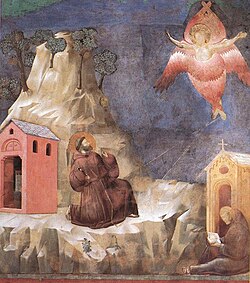
The Early Middle Ages in the West includes the work of Gregory the Great and Bede, as well as developments in Celtic Christianity and Anglo-Saxon Christianity, and comes to fulfillment in the work of Johannes Scotus Eriugena and the Carolingian Renaissance.182
The High Middle Ages saw a flourishing of mystical practice and theorization corresponding to the flourishing of new monastic orders, with such figures as Guigo II, Hildegard of Bingen, Bernard of Clairvaux, the Victorines, all coming from different orders, as well as the first real flowering of popular piety among the laypeople.
The Late Middle Ages saw the clash between the Dominican and Franciscan schools of thought, which was also a conflict between two different mystical theologies: on the one hand that of Dominic de Guzmán and on the other that of Francis of Assisi, Anthony of Padua, Bonaventure, Jacopone da Todi, Angela of Foligno. Moreover, there was the growth of groups of mystics centered on geographic regions: the Beguines, such as Mechthild of Magdeburg and Hadewijch (among others); the Rhenish-Flemish mystics Meister Eckhart, Johannes Tauler, Henry Suso, and John of Ruysbroeck; and the English mystics Richard Rolle, Walter Hilton and Julian of Norwich. This period also saw such individuals as Catherine of Siena and Catherine of Genoa, the Devotio Moderna, and such books as the Theologia Germanica, The Cloud of Unknowing and The Imitation of Christ.
Counter-reformation
The Reformation brought about the Counter-Reformation and, with it, a new flowering of mystical literature, often grouped by nationality.183
Spanish mysticism
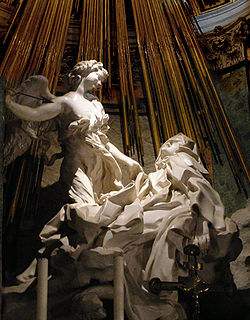
The Spanish had Ignatius Loyola, whose Spiritual Exercises were designed to open people to a receptive mode of consciousness in which they can experience God through careful spiritual direction and through understanding how the mind connects to the will and how to weather the experiences of spiritual consolation and desolation;184 Teresa of Ávila, who used the metaphors of watering a garden and walking through the rooms of a castle to explain how meditation leads to union with God;185 and John of the Cross, who used a wide range of biblical and spiritual influences both to rewrite the traditional "three ways" of mysticism after the manner of bridal mysticism and to present the two "dark nights": the dark night of the senses and the dark night of the soul, during which the individual renounces everything that might become an obstacle between the soul and God and then experiences the pain of feeling separated from God, unable to carry on normal spiritual exercises, as it encounters the enormous gap between its human nature and God's divine wisdom and light and moves up the 10-step ladder of ascent towards God.186 Another prominent mystic was Miguel de Molinos, the chief apostle of the religious revival known as Quietism. No breath of suspicion arose against Molinos until 1681, when the Jesuit preacher Paolo Segneri, attacked his views, though without mentioning his name, in his Concordia tra la fatica e la quiete nell' orazione. The matter was referred to the Inquisition. A report got abroad that Molinos had been convicted of moral enormities, as well as of heretical doctrines; and it was seen that he was doomed. On September 3, 1687 he made public profession of his errors, and was sentenced to imprisonment for life. Contemporary Protestants saw in the fate of Molinos nothing more than a persecution by the Jesuits of a wise and enlightened man, who had dared to withstand the petty ceremonialism of the Italian piety of the day. Molinos died in prison in 1696 or 1697.187
Italy
Lorenzo Scupoli, from Otranto in Apulia, was an Italian mystic best known for authoring The Spiritual Combat, a key work in Catholic mysticism.188
France
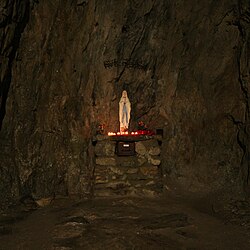
French mystics included Francis de Sales, Jeanne Guyon, François Fénelon, Brother Lawrence and Blaise Pascal.189
Protestant mysticism
Reformation
The Protestant Reformation downplayed mysticism, although it still produced a fair amount of spiritual literature. Even the most active reformers can be linked to Medieval mystical traditions. Martin Luther, for instance, was a monk who was influenced by the German Dominican mystical tradition of Eckhart and Tauler as well by the Dionysian-influenced Wesenmystik ("essence mysticism") tradition. He also published the Theologia Germanica, which he claimed was the most important book after the Bible and Augustine for teaching him about God, Christ, and humanity.190 Even John Calvin, who rejected many Medieval ascetic practices and who favored doctrinal knowledge of God over affective experience, has Medieval influences, namely, Jean Gerson and the Devotio Moderna, with its emphasis on piety as the method of spiritual growth in which the individual practices dependence on God by imitating Christ and the son-father relationship. Meanwhile, his notion that we can begin to enjoy our eternal salvation through our earthly successes leads in later generations to "a mysticism of consolation".191 Nevertheless, Protestantism was not devoid of mystics. Several leaders of the Radical Reformation had mystical leanings such as Caspar Schwenckfeld and Sebastian Franck. The Magisterial traditions also produced mystics, notably Peter Sterry (Calvinist) and Johann Arndt (Lutheran). An original thinker, formally in the Lutheran tradition but a forerunner of Christian theosophy, was Jakob Böhme.
As part of the Protestant Reformation, theologians turned away from the traditions developed in the Middle Ages and returned to what they consider to be biblical and early Christian practices. Accordingly, they were often skeptical of Catholic mystical practices, which seemed to them to downplay the role of grace in redemption and to support the idea that human works can play a role in salvation. Thus, Protestant theology developed a strong critical attitude, oftentimes even an animosity towards Christian mysticism.192 However, Quakers, Methodists, Episcopalians, Lutherans, Presbyterians, Local Churches, Pentecostals, Adventists, and Charismatics have in various ways remained open to the idea of mystical experiences.193
England
The English had a denominational mix, from Catholic Augustine Baker and Julian of Norwich (the first woman whose English writings survive), to Anglicans William Law, John Donne, and Lancelot Andrewes, to Puritans Richard Baxter and John Bunyan (The Pilgrim's Progress), to the first Quaker, George Fox and the cofounder of the Methodist movement, John Wesley, who was well-versed in the continental mystics.194
An example of "scientific reason lit up by mysticism in the Church of England"195is seen in the work of Sir Thomas Browne, a Norwich physician and scientist whose thought often meanders into mystical realms, as in his self-portrait, Religio Medici, and in the "mystical mathematics" of The Garden of Cyrus, whose full running title reads, Or, The Quincuncial Lozenge, or Network Plantations of the ancients, Naturally, Artificially, Mystically considered. Browne's highly original and dense symbolism frequently involves scientific, medical, or optical imagery to illustrate a religious or spiritual truth, often to striking effect, notably in Religio Medici, but also in his posthumous advisory Christian Morals.196
Browne's latitudinarian Anglicanism, hermetic inclinations, and Montaigne-like self-analysis on the enigmas, idiosyncrasies, and devoutness of his own personality and soul, along with his observations upon the relationship between science and faith, are on display in Religio Medici. His spiritual testament and psychological self-portrait thematically structured upon the Christian virtues of Faith, Hope and Charity, also reveal him as "one of the immortal spirits waiting to introduce the reader to his own unique and intense experience of reality".197 Though his work is difficult and rarely read, he remains, paradoxically, one of England's perennial, yet first, "scientific" mystics.
Germany
Similarly, well-versed in the mystic tradition was the German Johann Arndt, who, along with the English Puritans, influenced such continental Pietists as Philipp Jakob Spener, Gottfried Arnold, Nicholas Ludwig von Zinzendorf of the Moravians, and the hymnodist Gerhard Tersteegen. Arndt, whose book True Christianity was popular among Protestants, Catholics and Anglicans alike, combined influences from Bernard of Clairvaux, John Tauler and the Devotio Moderna into a spirituality that focused its attention away from the theological squabbles of contemporary Lutheranism and onto the development of the new life in the heart and mind of the believer.198 Arndt influenced Spener, who formed a group known as the collegia pietatis ("college of piety") that stressed the role of spiritual direction among lay-people—a practice with a long tradition going back to Aelred of Rievaulx and known in Spener's own time from the work of Francis de Sales. Pietism as known through Spener's formation of it tended not just to reject the theological debates of the time, but to reject both intellectualism and organized religious practice in favor of a personalized, sentimentalized spirituality.199
Pietism
This sentimental, anti-intellectual form of pietism is seen in the thought and teaching of Zinzendorf, founder of the Moravians; but more intellectually rigorous forms of pietism are seen in the teachings of John Wesley, which were themselves influenced by Zinzendorf, and in the teachings of American preachers Jonathan Edwards, who restored to pietism Gerson's focus on obedience and borrowed from early church teachers Origen and Gregory of Nyssa the notion that humans yearn for God,200 and John Woolman, who combined a mystical view of the world with a deep concern for social issues; like Wesley, Woolman was influenced by Jakob Böhme, William Law and The Imitation of Christ.201 The combination of pietistic devotion and mystical experiences that are found in Woolman and Wesley are also found in their Dutch contemporary Tersteegen, who brings back the notion of the nous ("mind") as the site of God's interaction with our souls; through the work of the Spirit, our mind is able to intuitively recognize the immediate presence of God in our midst.202
Scientific research
Fifteen Carmelite nuns allowed scientists to scan their brains with fMRI while they were meditating, in a state known as Unio Mystica or Theoria.203 The results showed that multiple regions of the brain were activated when they considered themselves to be in mystical union with God. These regions included the right medial orbitofrontal cortex, right middle temporal cortex, right inferior and superior parietal lobules, caudate, left medial prefrontal cortex, left anterior cingulate cortex, left inferior parietal lobule, left insula, left caudate, left brainstem, and extra-striate visual cortex.203
Further research in 2008 utilized electroencephalography (EEG) to examine the electrical activity of the brain during mystical experiences. This study found increased theta and gamma band power, as well as enhanced coherence between various brain regions, indicating a state of heightened neural integration during mystical experiences.204
Modern philosophy
In modern times theoria is sometimes treated as distinct from the meaning given to it in Christianity, linking the word not with contemplation but with speculation. Boethius (c. 480–524 or 525) translated the Greek word theoria into Latin, not as contemplatio but as speculatio, and theoria is taken to mean speculative philosophy.205 A distinction is made, more radical than in ancient philosophy, between theoria and praxis, theory and practice.206
Influential Christian mystics and texts
Early Christians
- Justin Martyr (c. 105 – c. 165) used Greek philosophy as the stepping-stone to Christian theology. The mystical conclusions at which some Greeks arrived pointed to Christ. He was influenced by Pythagoras, Plato, and Aristotle, as well as by Stoicism.
- Origen (c. 185–254) wrote On the First Principles and Against Celsus. Studied under Clement of Alexandria, and probably also Ammonius Saccus (Plotinus' teacher). He Christianized and theologized Neoplatonism.
- Athanasius of Alexandria (c. 296/8–373) wrote The Life of Antony (c. 360).207
- Gregory of Nyssa (c. 335–after 394) focused on the stages of spiritual growth, the need for constant progress, and the "divine darkness" as seen in the story of Moses.
- Augustine (354–430) wrote On the Trinity and Confessions. Important source for much mediaeval mysticism. He brings Platonism and Christianity together. Influenced by: Plato and Plotinus.
- Pseudo-Dionysius the Areopagite (c. 500) wrote Mystical Theology.
- Abba Or (c. 400 – c. 490) was an early Egyptian Christian ascetic and mystic. See also Anoub of Scetis.
Eastern Orthodox Christianity
- Philokalia, a collection of texts on prayer and solitary mental ascesis written from the 4th to the 15th centuries, which exists in a number of independent redactions;
- the Ladder of Divine Ascent;
- the collected works of St. Symeon the New Theologian (949–1022);
- the works of St. Isaac the Syrian (7th century), as they were selected and translated into Greek at the Monastery of St. Savas near Jerusalem about the 10th century.
Western European Middle Ages and Renaissance
- John Scotus Eriugena (c. 810 – c. 877): Periphyseon. Eriugena translated Pseudo-Dionysius from Greek into Latin. Influenced by: Plotinus, Augustine, Pseudo-Dionysius.
- Bernard of Clairvaux (1090–1153): Cistercian theologian, author of The Steps of Humility and Pride, On Loving God, and Sermons on the Song of Songs; strong blend of scripture and personal experience.
- Hildegard of Bingen (1098–1179): Benedictine abbess and reformist preacher, known for her visions, recorded in such works as Scivias (Know the Ways) and Liber Divinorum Operum (Book of Divine Works). Influenced by: Pseudo-Dionysius, Gregory the Great, Rhabanus Maurus, John Scotus Eriugena.
- Victorines: fl. 11th century; stressed meditation and contemplation; helped popularize Pseudo-Dionysius; influenced by Augustine
- Hugh of Saint Victor (d. 1141): The Mysteries of the Christian Faith, Noah's Mystical Ark, etc.
- Richard of Saint Victor (d. 1173): The Twelve Patriarchs and The Mystical Ark (e.g. Benjamin Minor and Benjamin Major). Influenced Dante, Bonaventure, Cloud of Unknowing.
- Franciscans:
- Francis of Assisi (c.1182 – 1226): founder of the order, stressed simplicity and penitence; first documented case of stigmata
- Anthony of Padua (1195–1231): priest, Franciscan friar and theologian; visions; sermons
- Bonaventure (c. 1217 – 1274): The Soul's Journey into God, The Triple Way, The Tree of Life and others. Influenced by: Pseudo-Dionysius, Augustine, Bernard, Victorines.
- Jacopone da Todi (c. 1230 – 1306): Franciscan friar; prominent member of "The Spirituals"; The Lauds
- Angela of Foligno (c. 1248 – 1309): tertiary anchoress; focused on Christ's Passion; Memorial and Instructions.
- Amadeus of Portugal (c. 1420 – 1482): Franciscan friar; revelations; Apocalypsis nova
- Thomas Aquinas (1225–1274): priest, Dominican friar and theologian.
- Beguines (fl. 13th century):
- Mechthild of Magdeburg (c. 1212 – c. 1297): visions, bridal mysticism, reformist; The Flowing Light of the Godhead
- Hadewijch of Antwerp (13th century): visions, bridal mysticism, essence mysticism; writings are mostly letters and poems. Influenced John of Ruysbroeck.
- Rhineland mystics (fl. 14th century): sharp move towards speculation and apophasis; mostly Dominicans
- Meister Eckhart (1260–1327): sermons
- Johannes Tauler (d. 1361): sermons
- Henry Suso (c. 1295 – 1366): Life of the Servant, Little Book of Eternal Wisdom
- Theologia Germanica (anon.). Influenced: Martin Luther
- John of Ruysbroeck (1293–1381): Flemish, Augustinian; The Spiritual Espousals and many others. Similar themes as the Rhineland Mystics. Influenced by: Beguines, Cistercians. Influenced: Geert Groote and the Devotio Moderna.
- Catherine of Siena (1347–1380): Letters
- The English Mystics (fl. 14th century):
- Anonymous – The Cloud of the Unknowing (c. 1375)—Intended by ascetic author as a means of instruction in the practice of mystic and contemplative prayer.
- Richard Rolle (c. 1300 – 1349): The Fire of Love, Mending of Life, Meditations on the Passion
- Walter Hilton (c. 1340 – 1396): The Ladder of Perfection (a.k.a., The Scale of Perfection) – suggesting familiarity with the works of Pseudo-Dionysius (see above), the author provides an early English language seminal work for the beginner.
- Julian of Norwich (1342 – c. 1416): Revelations of Divine Love (a.k.a. Showing of Love)
- Margery Kempe (1373 - c. 1438): The Book of Margery Kempe
Renaissance, Reformation and Counter-Reformation
- The Spanish Mystics (fl. 16th century):
- Ignatius of Loyola (1491–1556): St. Ignatius had a number of mystical experiences in his life, the most significant was an experience of enlightenment by the river Cardoner, in which, he later stated, he learnt more in that one occasion than he did in the rest of his life. Another significant mystical experience was in 1537, at a chapel in La Storta, outside Rome, in which he saw God the Father place him with the Son, who was carrying the Cross. This was after he had spent a year praying to Mary for her to place him with her Son (Jesus), and was one of the reasons why he insisted that the group that followed his 'way of proceeding' be called the Society of Jesus.208
- Teresa of Ávila (1515–1582): Two of her works, The Interior Castle and The Way of Perfection, were intended as instruction in (profoundly mystic) prayer based upon her experiences. Influenced by: Augustine.
- John of the Cross (Juan de Yepes) (1542–1591): Wrote three related instructional works, with Ascent of Mount Carmel as a systematic approach to mystic prayer; together with the Spiritual Canticle and the Dark Night of the Soul, these provided poetic and literary language for the Christian Mystical practice and experience. Influenced by and collaborated with Teresa of Ávila.
- Joseph of Cupertino (1603–1663): An Italian Franciscan friar who is said to have been prone to miraculous levitation and intense ecstatic visions that left him gaping.209
- Jakob Böhme (1575–1624): German theosopher; author of The Way to Christ.
- Johann Arndt (1555–1621): German Lutheran theologian and mystic, author of True Christianity.
- Valentin Weigel (1533–1588): German theologian, in his lifetime a Lutheran priest but because of his unorthodox views in his writings (published after his death) considered a forerunner of Christian theosophy.
- Thomas Browne (1605–1682): English physician and philosopher, author of Religio Medici.
- Brother Lawrence (1614–1691): Author of The Practice of the Presence of God.
- Isaac Ambrose (1604–1664): Puritan, author of Looking Unto Jesus.
- Angelus Silesius (1624–1677): German Catholic priest, physician, and religious poet.
- George Fox (1624–1691): Founder of the Religious Society of Friends.
- Madame Jeanne Guyon (1648–1717): Visionary and Writer.
- William Law (1686–1761): English mystic interested in Jakob Böhme who wrote several mystical treatises.
- Gerhard Tersteegen (1697–1769): German pietistic writer, hymnist and mystic, known for several influential writings of a spiritual and mystical nature.
- Emanuel Swedenborg (1688–1772): Influential and controversial Swedish writer and visionary.
- Rosa Egipcíaca (1719–1771): Afro-Brazilian mystic who wrote Sagrada Teologia do Amor Divino das Almas Peregrinas – the first religious text (or book of any kind) to be written by a black woman in colonial Brazil.
Modern era
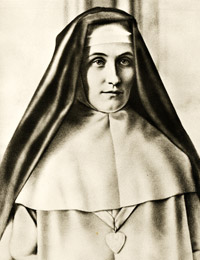
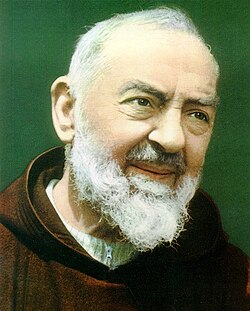
- Domenico da Cese (1905–1978): Stigmatist Capuchin friar.
- Maria Valtorta (1898–1963): Visionary and writer.
- Mary of Saint Peter (1816–1848): Carmelite nun.
- Marie Lataste (1822–1899): Visionary, nun and writer.
- Andrew Murray (1828–1917): Evangelical Missionary and Writer, Author of over 240 books.
- Marie Martha Chambon (1841–1907): Nun and visionary.
- Marie Julie Jahenny (1850–1941): Stigmatist.
- Mary of the Divine Heart Droste zu Vischering (1863–1899): Sister of the Good Shepherd.
- Réginald Garrigou-Lagrange (1877–1964): French Dominican friar, philosopher and neo-Thomist theologian. His magnum opus The Three Ages of the Interior Life (Les trois âges de la vie intérieure) is a synthesis of previous theological thought of Catholic saints and Church Fathers.
- Frank Laubach (1884–1970): Evangelical missionary, author of Letters by a Modern Mystic.
- Padre Pio of Pietrelcina (1887–1968): Capuchin friar, priest, stigmatic.
- Sadhu Sundar Singh (1889–1929): Evangelical Indian missionary, ascetic.
- Maria Pierina De Micheli (1890–1945): Italian nun and visionary.
- Thomas Raymond Kelly (1893–1941): Quaker.
- Alexandrina of Balazar (1904–1955): Visionary and writer.
- Dag Hammarskjöld (1905–1961): Swedish diplomat (Second Secretary General of the United Nations). His posthumously published spiritual diary "Vägmärken" (Markings) gave him the reputation of having been one of the few mystics in the political arena.
- Mary Faustina Kowalska (1905–1938): Polish nun and visionary.
- Eugenia Ravasio (1907–1990): Italian nun and visionary of God the Father.
- Simone Weil (1909–1943): French writer, political activist and ecstatic visionary.
- Flower A. Newhouse (1909–1994): American clairvoyant.
- Carmela Carabelli (1910–1978): Italian writer.
- Pierina Gilli (1911–1991): Italian visionary.
- A. W. Tozer (1897–1963): Christian and Missionary Alliance; author of The Pursuit of God.
- Thomas Merton (1915–1968): Trappist monk and writer.
- Watchman Nee (1903–1972): visionary and writer.
- Witness Lee (1905–1997): Local Churches Visionary and writer, author of over 400 books.
- Sister Lúcia (1907–2005): Portuguese participant in the 1917 Fátima apparitions, nun, and prophetess.
- Bernadette Roberts (1931–2017): Carmelite nun and writer, focusing on no-self states.
- Richard J. Foster (b. 1942): Quaker theologian; author of Celebration of Discipline and Prayer.
- Richard Rohr (b. 1943): Franciscan priest, writer and prophet; author of "Falling upward" and "Universal Christ".
- Anneliese Michel (1952–1976): young German Catholic who claims she was possessed to convert sinners; claimed to receive religious visions and bring the stigmata.212
See also
See also
- Ambrose of Optina
- Anchorite
- Apodicticity
- Apotheosis
- Argument from beauty
- Aseity
- Beatific vision
- Bridal theology
- Chaplet in Honour of the Holy Spirit and His Seven Gifts
- Christian mythology
- Christian theosophy
- Christian views on astrology
- Christian views on magic
- Desert Fathers
- Diodorus of Tarsus
- Divine illumination
- Entire sanctification
- Esoteric Christianity
- George Gurdjieff
- Gnosiology
- H. Tristram Engelhardt, Jr.
- John Meyendorff
- Kenosis
- List of Christian mystics
- Michael Pomazansky
- Mind's eye
- Open theism
- Participation in Christ
- Pentecostalism
- Sacred mysteries
- Sobornost
- Sophrony
- Soteriology
- Soul flight
- Spiritism
- Tacit knowledge
- Thomas Merton
- Watchfulness (Christian)
- World Community for Christian Meditation
Notes
Notes
Subnotes
- "We have a culture that creates saints, holy people. Our people's ideal is not to create wisemen. Nor was this the ideal of ancient Hellenic culture and civilization. Hellenic anthropocentric (human-centered) Humanism is transformed into Theanthropism (God-humanism) and its ideal is now the creation of Saints, Holy people who have reached the state of theosis (deification)."172
References
References
- McGinn 2006.
- Anon. 1857.
- Andrew Louth, "Theology of the Philokalia" in Abba: The Tradition of Orthodoxy in the West (St Vladimir's Seminary Press 2003 ISBN 0-88141-248-1), p. 358
- William Johnson, The Inner Eye of Love: Mysticism and Religion (HarperCollins 1997 ISBN 0-8232-1777-9), p. 24
- Liddell and Scott: θεωρία
- Lewis and Short: contemplatio
- Egan, Harvey D. (September 16, 1998). Christian Mysticism: The Future of a Tradition. Wipf and Stock Publishers. ISBN 9781579101534 – via Google Books.
- Watts, Joel L. (March 10, 2014). Praying in God's Theater: Meditations on the Book of Revelation. Wipf and Stock Publishers. ISBN 9781625641939 – via Google Books.
- "t | Search Online Etymology Dictionary". www.etymonline.com.
- Oxford Dictionary of the Christian Church (Oxford University Press 2005 ISBN 978-0-19-280290-3), article contemplation, contemplative life
- Ian Rutherford, Theoria and Darshan: Pilgrimage as Gaze in Greece and India, Classical Quarterly, Vol. 50, 2000, pp. 133–146
- Re-theorizing Politics, Culture and Religion in Nepal: A conversation with Frederick Young and Gregory Grieve
- Gellman 2011.
- Parsons 2011, p. 3.
- King 1999, p. 15.
- Hori 1999, p. 47.
- Sharf 2000, p. 271.
- Parsons 2011, p. 4-5.
- King 1999, p. 21.
- Bynum 1987, pp. 64, 253.
- Stępień, Tomasz; Kochańczyk-Bonińska, Karolina. "Unknown God, Known in His Activities" (PDF). Peter Lang. European Studies in T heolog y, Philosophy and History of Religions. Retrieved 24 October 2021.
- Barton 1986, pp. 47–57.
- Holmes 2002, p. 15.
- Janz 2009.
- Andrea Wilson Nightingale, Spectacles of Truth in Classical Greek Philosophy: Theoria in Its Cultural Context (Cambridge University Press 2004 ISBN 0-521-83825-8), p. 5
- "Everything is contemplation" (Cambridge Companion to Plotinus, p. 32).
- "Everything comes from contemplation" (Cambridge Companion to Plotinus, p. 32).
- "According to his (Plotinus) metaphysical conception, everything was endowed with this supreme activity (contemplation), beginning with the One, which turns to itself in the simplest regard, implying no complexity of need" (Cambridge Companion to Plotinus, p. 32)
- "Plotinus suggests that the One subsists by thinking itself as itself" (Internet Encyclopedia of Philosophy: A Peer-Reviewed Academic Resource: Neoplatonism).
- Lloyd P. Gerson, The Cambridge Companion to Plotinus (Cambridge University Press 1996 ISBN 0-521-47093-5), p. 32
- "Plotinus | Internet Encyclopedia of Philosophy".
- Quoted in Jorge M. Ferrer, Jacob H. Sherman (editors), The Participatory Turn: Spirituality, Mysticism, Religious Studies (State University of New York Press 2008 ISBN 978-0-7914-7601-7), p. 353
- Holmes 2002, pp. 14–16.
- Holmes 2002, p. 17.
- Holmes 2002, pp. 19–20.
- Holmes 2002, pp. 18–19.
- Healey 1999, p. 2.
- Healey 1999, pp. 8–9.
- Holmes 2002, pp. 20–21.
- Healey 1999, pp. 3–4.
- Holmes 2002, p. 21.
- Healey 1999, pp. 4–6.
- Holmes 2002, p. 22.
- John Breck, Scripture in Tradition: The Bible and Its Interpretation in the Orthodox Church, St Vladimir's Seminary Press 2001, p. 11.
- Breck, Scripture in Tradition, p. 37).
- Montague, George T. (December 31, 2007). Understanding the Bible: A Basic Introduction to Biblical Interpretation. Paulist Press. ISBN 9780809143443 – via Google Books.
- Frances Margaret Young, Biblical exegesis and the Formation of Christian Culture (Cambridge University Press 1997 ISBN 0-521-58153-2), p. 175
- John J. O'Keefe, Russell R. Reno, Sanctified Vision (JHU Press 2005 ISBN 978-0-8018-8088-9), p. 15).
- Holmes 2002, pp. 25–26.
- Holmes 2002, pp. 26–28.
- Holmes 2002, pp. 23–25.
- Holmes 2002, p. 16.
- "Monasticism | Encyclopedia.com". www.encyclopedia.com. Retrieved 29 September 2021.
- Holmes 2002, pp. 29–31.
- OGLIARI, Donato (2000). "The Conciliation of Grace and Free Will. Cassian's "Conlatio" 13 Revisited". Augustiniana. 50 (1/4): 141–173. ISSN 0004-8003. JSTOR 44991731. Retrieved 24 October 2021.
- Dominic J. O'Meara (editor), Neoplatonism and Christian Thought (State University of New York Press 1982 ISBN 0-87395-492-0), p. x).
- (Werner Jaeger, Two Rediscovered Works of Ancient Christian Literature: Gregory of Nyssa and Macarius (Brill, Leiden 1954), pp. 21–22).
- The Brill Dictionary of Gregory of Nyssa (Brill, Leiden 2010 ISBN 978-90-04-16965-4), p. 528
- Thomas Keating, Open Mind, Open Heart: The Contemplative Dimension of the Gospel (Continuum International 1986 ISBN 0-8264-0696-3), p. 19
- Mattá al-Miskīn, Orthodox Prayer Life: The Interior Way (St Vladimir's Seminary Press 2003 ISBN 0-88141-250-3), pp. 55–56
- "Augustin Poulain, "Contemplation", in The Catholic Encyclopedia 1908". Archived from the original on 2012-01-13. Retrieved 2011-11-24.
- al-Miskīn, Mattá (December 31, 2003). Orthodox Prayer Life: The Interior Way. St. Vladimir's Seminary Press. ISBN 9780881412505 – via Google Books.
- King 2002, p. 15.
- "Gellman, Jerome, "Mysticism", The Stanford Encyclopedia of Philosophy (Summer 2011 Edition), Edward N. Zalta (ed.)". Plato.stanford.edu. Retrieved 2013-11-06.
- "Pseudo-Dionysius the Areopagite | Biography, Works, & Facts". Encyclopedia Britannica. Retrieved 6 October 2021.
- Dupré 2005, p. 6341.
- King 2002, p. 195.
- McBrien 1995, p. 901.
- Holmes 2002, pp. 4–5.
- Ignatius, Br. (2024-03-07). "The Soul's Resonance: Deepening Faith through Benedictine Contemplative Prayer". The Lay Monastic. Retrieved 2024-03-09.
- "Meditation is a prayerful quest engaging thought, imagination, emotion, and desire. Its goal is to make our own in faith the subject considered, by confronting it with the reality of our own life"(Catechism of the Catholic Church, 2723).
- Mattá al-Miskīn, Orthodox Prayer Life: The Interior Way (St Vladimir's Seminary Press 2003 ISBN 0-88141-250-3), p. 56
- Cross, John Of the (July 31, 2009). The Ascent of Mount Carmel. BiblioBazaar. ISBN 9781113187048 – via Google Books.
- Frost, Reverend Bede (November 30, 2008). The Art of Mental Prayer. Read Books. ISBN 9781443733106 – via Google Books.
- Holmes 2002, p. 37.
- Oxford Reference, purgative, illuminative, and unitive ways
- Réginald Garrigou-Lagrange (1938/1939), The Three Ages of the Interior Life, chapter Christian Perfection
- "Arthur Devine, "State or Way" in Catholic Encyclopedia". Archived from the original on 2012-11-03. Retrieved 2017-04-05.
- Romanides 1981b, "Diagnosis and Therapy".
- Vlachos, Hierotheos (1994). "VI. Orthodox Epistemology [Section 2: The Knowledge of God according to St. Gregory Palamas]". Orthodox psychotherapy (2005 reissued ed.). Levadia, Greece: Birth of the Theotokos Monastery. ISBN 978-960-7070-27-2. By Metropolitan Hierotheos Vlachos. Archived from the original on January 5, 2009. Retrieved September 12, 2010.
- Corrigan, Kevin. "Pseudo-Dionysius the Areopagite". The Stanford Encyclopedia of Philosophy. Retrieved 22 May 2026.
- Dysinger, Luke. "Dysinger's translation of the Gnostikos". Evagrius Ponticus. Retrieved 22 May 2026.
- The Forgotten Desert Mothers: Sayings, Lives, and Stories of Early Christian Women By Laura Swan p. 67 Published by Paulist Press, 2001 ISBN 978-0-8091-4016-9
- Romanides 1981b.
- Orthodox Dogmatic Theology Michael Pomazansky [1]
- Orthodox Prayer Life: The Interior Way, p. 59
- "CHURCH FATHERS: Conference 10 (John Cassian)". www.newadvent.org.
- "canadian christian meditation community". wccm.
- Cabasilas, Nicolaus (December 31, 1974). The Life in Christ. St. Vladimir's Seminary Press. ISBN 9780913836125 – via Google Books.
- James W. Skehan, Place Me with Your Son (Georgetown University Press 1991 ISBN 0-87840-525-9), p. 89
- Romanides, John. "Some underlying positions of this ['Romanity'] website reflecting the studies herein included". www.romanity.org.
- The Cloud of Unknowing (Wordsworth Classics of World Literature 2005 ISBN 1-84022-126-7), p. 18
- Metropolitan Hierotheos Vlachos, The Difference Between Orthodox Spirituality and Other Traditions
- V Lossky Vision of God p. 123: "Knowledge is limited to what exists: now, as the cause of all being (The Divine Names, I, 1, col.588) or rather He is superior to all oppositions between being and non-being."
- "What is the "Jesus Prayer", the "Prayer of the mind" and the "Prayer of the heart"?". October 8, 2019. Archived from the original on December 6, 2022. Retrieved December 17, 2022.
- Orthodox Prayer Life: The Interior Way, p. 58
- The Forgotten Desert Mothers: Sayings, Lives, and Stories of Early Christian Women, By Laura Swan p. 67 Published by Paulist Press, 2001 ISBN 978-0-8091-4016-9
- Vlachos, Hierotheos (1993). "2. The illness of the soul". The illness and cure of the soul in the Orthodox tradition. Levadia, Greece: Birth of the Theotokos Monastery Press. ISBN 978-960-7070-18-0. By Metropolitan Hierotheos of Nafpaktos. Archived from the original on 2009-03-26.
- "People say: attain the Jesus Prayer, for that is inner prayer. This is not correct. The Jesus Prayer is a good means to arrive at inner prayer but in itself it is not inner but outer prayer" – St Theophan_the_Recluse, 'What Is Prayer?' cited in The Art of Prayer: An Orthodox Anthology p.98 by Igumen_Chariton ISBN 978-0-571-19165-9
- "Catechism of the Catholic Church – IntraText". www.vatican.va.
- "Magid | Safety at work". www.washington-state.net. Archived from the original on March 10, 2012.
- Directory of popular piety and the liturgy, §197, Congregation of Divine Worship, Vatican, 2001.
- "Rosarium Virginis Mariae on the Most Holy Rosary (October 16, 2002) | John Paul II". www.vatican.va.
- "Thomas Keating, Centering Prayer and the Christian Contemplative Tradition" (PDF). Archived from the original (PDF) on 2016-05-09. Retrieved 2022-12-17.
- Lehodey 1982.
- Hunt, Harry T. (2000). "Experiences of Radical Personal Transformation in Mysticism, Religious Conversion, and Psychosis: A Review of the Varieties, Processes, and Consequences of the Numinous". The Journal of Mind and Behavior. 21 (4): 353–397. ISSN 0271-0137. JSTOR 43853939. Retrieved 24 October 2021.
- Vlachos, Hierotheos (1994). "VI. Orthodox Epistemology". Orthodox psychotherapy (2005 reissued ed.). Levadia, Greece: Birth of the Theotokos Monastery. ISBN 978-960-7070-27-2. By Metropolitan Hierotheos Vlachos. Archived from the original on January 5, 2009. Retrieved September 12, 2010.
- Mystical Theology of the Eastern Church by Vladimir Lossky, p. 27)
- Faith And Science In Orthodox Gnosiology and Methodology by George Metallinos [2]
- Saint Symeon the New Theologian On Faith Palmer, G.E.H; Sherrard, Philip; Ware, Kallistos (Timothy). The Philokalia, Vol. 4
- Nikitas Stithatos (Nikitas Stethatos) On the Practice of the Virtues: One Hundred Texts
- Nikitas Stithatos (Nikitas Stethatos) On the Inner Nature of Things and on the Purification of the Intellect: One Hundred Texts
- Nikitas Stithatos (Nikitas Stethatos) On Spiritual Knowledge, Love and the Perfection of Living: One Hundred Texts
- Jordan Aumann, Christian Spirituality in the Catholic Tradition (Ignatius Press 1985 ISBN 978-0-89870068-8), p. 64
- James Clark, as cited in Forman (1987), Eckhart's Stages of Mystical Progression
- Zarrabi-Zadeh, Saeed (2016). "Conclusion". Practical Mysticism in Islam and Christianity. Routledge. doi:10.4324/9781315657790. ISBN 978-1-315-65779-0.
- "St". www.catholic-church.org.
- William Johnston, The Inner Eye of Love: Mysticism and Religion (Harper Collins 2004 ISBN 0-8232-1777-9), p. 24
- "Louis J. Puhl, S.J. Translation – The Spiritual Exercises". Ignatian Spirituality. Retrieved 7 March 2017.
- Wallenfang & Wallenfang (2021), p. "B. Mental Prayer or the Prayer of meditation".
- Hollenback (1996), p. 535.
- Wyhe (2008), p. 174.
- "Catechism of the Catholic Church, 2709". Archived from the original on August 1, 2016.
- "Dictionary : INFUSED CONTEMPLATION". www.catholicculture.org.
- Thomas Dubay, Fire Within (Ignatius Press 1989 ISBN 0-89870-263-1), chapter 5
- Jordan Aumann, Christian Spirituality in the Catholic Tradition (Sheed & Ward 1985 ISBN 0-89870-068-X), p. 247 and p. 273
- Aumann, Christian Spirituality in the Catholic Tradition, p. 248
- Aumann, Christian Spirituality in the Catholic Tradition, p. 276
- St Teresa of Ávila (2007). "31. Prayer of Quiet". The Way of Perfection. Translated by Benedictines of Stanbrook Abbey. Cosimo, Inc. p. 177. ISBN 978-1-60206-261-0.
- St Teresa of Ávila (1921). "The Fourth Mansions: Chapter III. Prayer of Quiet". In Benedict Zimmerman (ed.). The Interior Castle. Translated by The Benedictines of Stanbrook. London: Thomas Baker. p. 104.
- Grade 6: Prayer of the Quiet Archived 2019-12-18 at the Wayback Machine catholic-church.org.
- Thouless, Robert Henry (1971). An introduction to the psychology of religion. CUP Archive. p. 125. ISBN 0-521-09665-0.
- Liguori, Alfonso Maria de' (1999). "14. Prayer of Quiet". In Frederick M. Jones (ed.). Selected writings. New York: Paulist Press. p. 176. ISBN 0-8091-3771-2.
- Adolphe Tanquerey, The Spiritual Life: A Treatise on Ascetical and Mystical Theology, trans. Herman Branderis (Tournai: Desclée & Co., 1930), §1299.
- Marie-Eugène de l’Enfant-Jésus, I Want to See God, trans. A Sister of Notre Dame de Vie (Westminster, Maryland: Newman Press, 1953), pp. 61–63.
- Teresa of Ávila, The Collected Works of St. Teresa of Ávila, trans. Kieran Kavanaugh and Otilio Rodriguez, 3 vols. (Washington, D.C.: ICS Publications, 1976–1985), vol. 1, Life, chs. 14–16.
- Teresa of Ávila, The Collected Works of St. Teresa of Ávila, vol. 1, Life, ch. 11.
- Marie-Eugène de l’Enfant-Jésus, I Want to See God, pp. 61–63.
- Teresa of Ávila, The Collected Works of St. Teresa of Ávila, vol. 2, Interior Castle, Fourth Mansions.
- Réginald Garrigou-Lagrange, The Three Ages of the Interior Life, vol. 2 (St. Louis: Herder, 1948), pp. 37–41.
- Bernard McGinn, Mysticism in the Golden Age of Spain (1500–1650), vol. 6, part 2 of The Presence of God: A History of Western Christian Mysticism (New York: Crossroad, 2017), pp. 24–52.
- McGinn, Mysticism in the Golden Age of Spain, pp. 191–197.
- Teresa of Ávila, The Collected Works of St. Teresa of Ávila, vol. 1, Life, ch. 15.
- Marie-Eugène de l’Enfant-Jésus, I Am a Daughter of the Church, trans. A Benedictine of Stanbrook (Westminster, Maryland: Newman Press, 1955), pp. 90–91.
- Marie-Eugène de l’Enfant-Jésus, I Am a Daughter of the Church, pp. 6–11.
- Marie-Eugène de l’Enfant-Jésus, I Want to See God, pp. 140–164.
- Teresa of Ávila, The Collected Works of St. Teresa of Ávila, vol. 3, Foundations, ch. 5.
- John of the Cross, The Collected Works of St. John of the Cross, trans. Kieran Kavanaugh and Otilio Rodriguez (Washington, D.C.: ICS Publications, 1991), Dark Night, bk. 2.
- Teresa of Ávila, The Collected Works of St. Teresa of Ávila, vol. 1, Life, ch. 22.
- Louis Bouyer, Introduction to Spirituality (New York: Desclée, 1961), pp. 321–325.
- Patricia A. Ward, Experimental Theology in America: Madame Guyon, Fénelon, and Their Readers (Waco, Texas: Baylor University Press, 2009), pp. 17–42.
- Bielecki, Tessa (2008). "15. Prayer of Quiet". Teresa of Ávila: The Book of My Life. Translated by Mirabai Starr. Shambhala Publications. p. 102. ISBN 978-1-59030-573-7.
- Merton, Thomas (1976). "14. Intelligence in the Prayer of Quiet". The ascent to truth. Continuum International Publishing Group. p. 161. ISBN 0-86012-024-4.
- Greene 1987, pp. 22–38.
- Lossky 1976.
- "The ARTFL Project | The ARTFL Project". artfl-project.uchicago.edu.
- "Theosis - Deification As The Purpose Of Man's Life". greekorthodoxchurch.org.
- "On Union With God and Life of Theoria by Kallistos Katafygiotis (Kallistos Angelikoudis)". www.greekorthodoxchurch.org.
- Fellow Workers With God: Orthodox Thinking on Theosis (Foundations) by Normal Russell p.
- Kapsanēs 2006.
- The Difference Between Orthodox Spirituality and Other Traditions by Metropolitan Hierotheos Vlachos [3]
- Theophan the Recluse, What Is prayer?. Cited in The Art of Prayer: An Orthodox Anthology, p.73, compiled by Igumen Chariton of Valamo, trans, E. Kadloubovsky and E.M. Palmer, ed. Timothy Ware, 1966, Faber & Faber, London.
- The Vision of God, SVS Press, 1997. (ISBN 0-913836-19-2)
- Louth, Andrew (April 2004). "Andrew Louth, Theology, Contemplation and the University (abstract)". Studies in Christian Ethics. 17 (1): 69–79. doi:10.1177/095394680401700105.
- Ware (1995), p. 5.
- deCatanzaro 1980, pp. 9–10.
- The mystical theology of the Eastern Church By Vladimir Lossky pp. 237–238 [4]
- monachos.net, Gregory Palma Archived 2009-11-19 at the Wayback Machine
- Romanides 1981a.
- The Difference Between Orthodox Spirituality and Other Traditions by Metropolitan Hierotheos Vlachos [5]
- "St. Nicholas Orthodox Church » Mysticism, Women and the Christian Orient". Stnicholaspdx.org. Archived from the original on July 28, 2011. Retrieved September 4, 2013.
- George D. Metallinos (1995), Orthodox and European Civilization: The struggle between Hellenism and Frankism, [Excerpts from the speech of Fr. Georgios Metallinos, Professor at the University of Athens, during the February 1995 Theological Conference in Pirgos, Greece.] – via www.romanity.org
- "Those who speak from their own thoughts, before having acquired purity, are seduced by the spirit of self-esteem." St. Gregory of Sinai
- *History of Russian Philosophy «История российской Философии »(1951) by N. O. Lossky [section on V. Lossky] p. 400. Allen & Unwin: London. International Universities Press Inc: New York. ASIN B000H45QTY ISBN 978-0-8236-8074-0 sponsored by Saint Vladimir's Orthodox Theological Seminary
- Vlachos 1996.
- Vlachos 2005.
- Hall 1998, p. 158.
- Cf. Josef Pieper, An Anthology (Ignatius Press 1989 ISBN 978-0-89870226-2), 43; Eugene Victor Walter, Placeways (UNC Press Books 1988 ISBN 978-0-80784200-3), p. 218; Thomas Hibbs, Aquinas, Ethics and Philosophy of Religion (Indiana University Press 2007 ISBN 978-0-25311676-5), pp. 8, 89; Steven Chase, Angelic Spirituality (Paulist Press 2002 ISBN 978-0-80913948-4), p. 63
- "Saint John Cassian | Biography, Theology, & Facts | Britannica". www.britannica.com. 21 February 2024.
- John Cassian, The Conferences (English translation by Boniface Ramsey, Newman Press 1997 ISBN 978-0-80910484-0), p. 47
- Christopher A. Dustin, "The Liturgy of Theory" in Bruce T. Morrill et al. (editors), Practicing Catholic (Palgrave Macmillan 2005) ISBN 978-1-40398296-4), pp. 257–274;
- Thomas Bénatouïl, Mauro Bonazzi, Theoria, Praxis, and the Contemplative Life after Plato and Aristotle (Brill 2012) ISBN 978-9-00422532-9;
- Frans Jozef van Beeck, God Encountered: A Contemporary Catholic Systematic Theology (Liturgical Press 2001) ISBN 978-0-81465877-2; and in books dealing with Antiochene exegesis
- LADNER, GERHART B. (1953). "The History of Ideas in the Christian Middle Ages: From the Fathers to Dante in American and Canadian Publications of the Years 1940–1952". Traditio. 9: 439–514. doi:10.1017/S0362152900003822. ISSN 0362-1529. JSTOR 27830285. S2CID 152099684. Retrieved 14 October 2021.
- "Counter-Reformation | Definition, Summary, Outcomes, Jesuits, Facts, & Significance". Encyclopedia Britannica. Retrieved 14 October 2021.
- Holmes 2002, pp. 94–97.
- Holmes 2002, pp. 98–99.
- Holmes 2002, pp. 99–102.
- "Christian Mystics Full Library Part Two Revelations of Divine Love in..." 1 October 2015. Retrieved 6 October 2021.
- Gardner 1910.
- "A medieval mystic untimely born? | Christian History Magazine". Christian History Institute. Retrieved 6 October 2021.
- Holmes 2002, pp. 125–127.
- Holmes 2002, pp. 127–128.
- Cornuz 2003, p. 149.
- Fremantle 1964.
- Sheldrake, Philip (2007). A Brief History of Spirituality. Blackwell. pp. 116–121, 143–146. ISBN 9781405117715.
- Sencourt 1925, p. 126.
- Coulehan, Jack (May 2010). "Everything in Its Proper Season: Sir Thomas Browne's Religio Medici". Journal of General Internal Medicine. 25 (5): 478–479. doi:10.1007/s11606-010-1307-z. PMC 2855008. PMID 20229138.
- Huxley 1929.
- Holmes 2002, pp. 136–137.
- Holmes 2002, pp. 136–138.
- Holmes 2002, pp. 138–139.
- Holmes 2002, pp. 139–140.
- Holmes 2002, pp. 143–144.
- Beauregard, M.; Paquette, V. (2006). "Neural correlates of a mystical experience in Carmelite nuns". Neuroscience Letters. 405 (3). Elsevier: 186–90. doi:10.1016/j.neulet.2006.06.060. ISSN 0304-3940. PMID 16872743. S2CID 13563460.
- Beauregard, Mario; Paquette, Vincent (11 August 2008). "EEG activity in Carmelite nuns during a mystical experience" (PDF). Institute Psychoneuro. Retrieved 26 September 2025.
- Olga Taxidou, Tragedy, Modernity and Mourning (Edinburgh University Press 2004 ISBN 978-0-74861987-0), pp. 34, 79
- Donald Phillip Verene, Speculative Philosophy (Lexington Books 2009 ISBN 978-0-73913661-4), p. 15
- Schaff 1892, p. 194.
- "Life of St. Ignatius – Founder of the Society of Jesus". Loyola Jesuit College. Archived from the original on 2011-02-11. Retrieved 2011-04-18.
- Pastrovicchi 1918.
- Chasle 1906.
- Kelly 2009, pp. 79, 86.
- Anneliese Michel—A unrecognized and misunderstood victim soul. A closer look at her possession, exorcism and death
- catholicculture.org, Catholic Dictionary: Prayer of simplicity
- Lossky, N. O. (1970). History of Russian Philosophy. Intl Universities Press. p. 262. ISBN 978-0-8236-8074-0.
Sources
Sources
- Anon. (1857). Theologia Germanica: Which Setteth Forth Many Fair Lineaments of Divine Truth, and Saith Very Lofty and Lovely Things Touching a Perfect Life. Translated by Susanna Winkworth. Andover: W.F. Draper.
- Barton, John (1986). "The Old Testament". In Jones, Cheslyn; Wainwright, Geoffrey; Yarnold, Edward (eds.). The Study of Spirituality. Oxford: University Press.
- Bynum, Caroline Walker (1987). Holy Feast and Holy Fast: The Religious Significance of Food to Medieval Women. University of California Press. ISBN 978-0-520-06329-7.
- Chasle, Louis (1906), Sister Mary of the Divine Heart, Droste zu Vischering, religious of the Good Shepherd, 1863–1899, London: Burns & Oates
- Cornuz, Michel (2003). Le protestantisme et la mystique: entre répulsion et fascination [Protestantism and mysticism: between repulsion and fascination] (in French). Labor et Fides. ISBN 978-2-8309-1097-1.
- Dupré, Louis (2005), "Mysticism (first edition)", in Jones, Lindsay (ed.), MacMillan Encyclopedia of Religion, MacMillan
- Fremantle, Anne Jackson (1964). The Protestant Mystics. Little, Brown.
- Gardner, Edmund Garratt (1910). . In Herbermann, Charles (ed.). Catholic Encyclopedia. Vol. 8. New York: Robert Appleton Company.
- Gellman, Jerome (Summer 2011). "Mysticism". In Zalta, Edward N. (ed.). The Stanford Encyclopedia of Philosophy. Metaphysics Research Lab, Stanford University.
- Green, Ronald (26 August 2011). Nothing Matters: A Book about Nothing. John Hunt Publishing.
- Greene, Dana (Spring 1987). "Adhering to God: The Message of Evelyn Underhill for Our Times". Spirituality Today. Vol. 39. pp. 22–38.
- Hall, Christopher A. (1998). Reading Scripture with the Church Fathers. InterVarsity Press. ISBN 978-0-8308-1500-5.
- Healey, Charles J. (1999). Christian Spirituality: An Introduction to the Heritage. Alba House. ISBN 978-0-8189-0820-0.
- Hollenback, Jess Byron (1996), Mysticism: Experience, Response, and Empowerment, Penn State Press
- Holmes, Urban Tigner (2002). A History of Christian Spirituality: An Analytical Introduction. Church Publishing. ISBN 978-0-8192-1914-5.
- Hori, Victor Sogen (1999), "Translating the Zen Phrase Book" (PDF), Nanzan Bulletin, 23
- Huxley, J.S. (1929). Religion without revelation. Harper and Brothers.
- Jacobs, Henry Eyster; Haas, John Augustus William (1899). The Lutheran Cyclopedia. Scribner. p. 334.
- Janz, Bruce B. (2009). "Who's Who in the History of Western Mysticism". Archived from the original on 2011-07-27. Retrieved 2010-11-30.
- Kapsanēs, Geōrgios (2006). Theosis: The True Purpose of Human Life (4th ed.). Asprobalta, Greece: Holy Monastery of Saint Gregorios, Mount Athos. ISBN 960-7553-26-8.
- Kelly, Elizabeth M. (2009). The Rosary: A Path into Prayer. Loyola Press. ISBN 978-0-8294-3068-4.
- King, Richard (1999), Orientalism and Religion: Post-Colonial Theory, India and "The Mystic East", Routledge
- King, Richard (2002), Orientalism and Religion: Post-Colonial Theory, India and "The Mystic East", Routledge
- Lehodey, Domitry V. (1982). The Ways of Mental Prayer. Tan. ISBN 978-0-89555-178-8.
- Lossky, Vladimir (1976). The Mystical Theology of the Eastern Church. St Vladimir's Seminary Press. ISBN 978-0-913836-31-6.
- Lossky, Vladimir (1983). The Vision of God. Crestwood, N.Y. (USA): SVS Press. ISBN 0-913836-19-2.
- McBrien, Richard P., ed. (1995). "Mysticism". The HarperCollins Encyclopedia of Catholicism. San Francisco: HarperCollins. ISBN 978-0-06-065338-5.
- McGinn, Bernard (2006), The Essential Writings of Christian Mysticism, New York: Modern Library
- Parsons, William B. (2011), Teaching Mysticism, Oxford University Press
- Pastrovicchi, Angelo (1918). St. Joseph of Copertino. B. Herder.
- Schaff, Philip (1892). "The Life of Antony". A Select library of Nicene and post-Nicene fathers of the Christian church Second Series. Vol. IV. New York: The Christian Literature Company.
- Romanides, Ioannis Savvas (John) (1981a). "Part 1: Roman Revolutions and the Rise of Frankish Feudalism and Doctrine" (PDF). Franks, Romans, feudalism, and doctrine: An interplay between theology and society. Brookline, Mass (USA): Holy Cross Orthodox Press. ISBN 9780916586546. OCLC 718257155. Archived from the original (PDF) on 7 April 2022.
- "Part 2: Empirical Theology versus Speculative Theology". Franks, Romans, feudalism, and doctrine: An interplay between theology and society. Brookline, Mass (USA): Holy Cross Orthodox Press. 1981b. ISBN 9780916586546. OCLC 718257155.
- "Part 3: The Filoque". Franks, Romans, feudalism, and doctrine: An interplay between theology and society. Brookline, Mass (USA): Holy Cross Orthodox Press. 1981c. ISBN 9780916586546. OCLC 718257155.
- Sencourt, Robert (1925). Outflying philosophy: a literary study of the religious element in the poems and letters of John Donne and in the works of Sir Thomas Browne and of Henry Vaughan the Silurist, etc. Simpkin, Marshall, Hamilton, Kent.
- Sharf, Robert H. (2000). "The Rhetoric of Experience and the Study of Religion" (PDF). Journal of Consciousness Studies. 7 (11–12): 267–87. Archived from the original (PDF) on 2013-05-13. Retrieved 2013-05-10.
- Solovyof, Vladimir (1950), "The Jews", A Solovyof Anthology, SCM Press
- Trigg, Joseph W. (2012). Origen. The Early Church Fathers. London and New York: Routledge. ISBN 978-1-134-81525-8.
- Underhill, Evelyn (1911). Mysticism: A Study in Nature and Development of Spiritual Consciousness. London: Methuen.
- Vlachos, Hierotheos (2005). The illness and cure of the soul in the Orthodox tradition. Levadia, Greece: Birth of the Theotokos Monastery Press. ISBN 978-960-7070-18-0.
- Vlachos, Hierotheos (1996). "7. Paradise and Hell". Life after Death. Birth of the Theotokos Monastery Birth of the Theotokos Monastery (Pelagia). ISBN 9789607070869. (by Metropolitan Hierotheos of Nafpaktos). Archived from the original on 1 February 2009. Retrieved 1 December 2008.
- Wallenfang, Donald; Wallenfang, Megan (2021), Shoeless: Carmelite Spirituality in a Disquieted World, Wipf and Stock Publishers
- Ware, Kallistos (1995). Sahas, Daniel J. (ed.). Act out of Stillness: The Influence of Fourteenth-Century Hesychasm on Byzantine and Slav Civilization. Toronto: The Hellenic Canadian Association of Constantinople and the Thessalonikean Society of Metro Toronto.
- Wyhe, Cordula van (2008), Female Monasticism in Early Modern Europe: An Interdisciplinary View, Ashgate Publishing, Ltd
Further reading
Further reading
General
- Bernard McGinn: The Foundations of Mysticism: Origins to the Fifth Century, 1991, reprint 1994, ISBN 0-8245-1404-1
- Bernard McGinn: The Growth of Mysticism: Gregory the Great through the 12th Century, 1994, paperback ed. 1996, ISBN 0-8245-1628-1
Eastern Orthodox
- Vladimir Lossky (1997), The Vision of God SVS Press. ISBN 0-913836-19-2
- Louth, Andrew. The Origins of the Christian Mystical Tradition: From Plato to Denys. Oxford, 1983 (repr. 2003). ISBN 0191608777.
- Mattá al-Miskīn, Orthodox Prayer Life: The Interior Way (St Vladimir's Seminary Press 2003 ISBN 0-88141-250-3
- Aristotle Papanikolaou, Being With God (University of Notre Dame Press February 24, 2006 ISBN 0-268-03830-9)
- Marcus Plested, The Macarian Legacy: The Place of Macarius-Symeon in the Eastern Christian Tradition (Oxford Theological Monographs 2004 ISBN 0-19-926779-0)
- Tomáš Špidlík, The Spirituality of the Christian East: A Systematic Handbook (Cistercian Publications Inc Kalamazoo Michigan 1986 ISBN 0-87907-879-0)
- Dumitru Staniloae, The Experience of God : Revelation and Knowledge of the Triune God: Orthodox Dogmatic Theology, Volume 1 : Revelation and Knowledge of the Triune God (Holy Cross Orthodox Press May 17, 2005 ISBN 0-917651-70-7)
- Dumitru Staniloae, The Experience of God : Orthodox Dogmatic Theology Volume 2: The World, Creation and Deification (Holy Cross Orthodox Press June 16, 2005 ISBN 1-885652-41-0)
- Metropolitan Hierotheos of Nafpaktos (2005), The illness and cure of the soul in the Orthodox tradition. Levadia, Greece: Birth of the Theotokos Monastery Press. ISBN 978-960-7070-18-0 (Hierotheos Vlachos)
Catholicism
- Aumann, Jordan. Christian Spirituality in the Catholic Tradition. Sheed & Ward, 1985; p. 247. ISBN 0-89870-068-X.
- Dubay, Thomas. Fire Within: Teresa of Avila, John of the Cross and the Gospel on Prayer. Ignatius Press, 1989. ISBN 0-89870-263-1.
Centering prayer
- Keating, Thomas. Active Meditations for Contemplative Prayer. Continuum International Publishing Group, 1997. ISBN 0-8264-1061-8.
- Keating, Thomas. Foundations for Centering Prayer and the Christian Contemplative Life. Continuum International Publishing Group, 2002. ISBN 0-8264-1397-8.
- Keating, Thomas. Open Mind, Open Heart: The Contemplative Dimension of the Gospel. Continuum International Publishing Group, 2002. ISBN 0-8264-1420-6.
- Merton, Thomas. Contemplative Prayer. Image Books, 1996. ISBN 0-385-09219-9.
- Underhill, Evelyn. Practical Mysticism: A Little Book for Normal People. Read Books, 2006. ISBN 1406796328.
- The Catechism of the Catholic Church has a subsection on contemplative prayer within its section on prayer in the Christian life.
Other
- Yungen, Ray. A Time of Departing: How Ancient Mystical Practices Are Uniting Christians with the World's Religions. Lighthouse Trails Publishing, 2006, 2nd edition. ISBN 978-0-9721512-7-6.
Diverse
- Tito Colliander: Way of the Ascetics, 1981, ISBN 0-06-061526-5
- Samuel Fanous and Vincent Gillespie, eds. The Cambridge Companion to Medieval English Mysticism, Cambridge University Press, 2011
- Richard Foster: Celebration of Discipline: The Path to Spiritual Growth, 1978, ISBN 0-06-062831-6
- Patrick Grant. 1983. Literature of Mysticism in Western Tradition. London: MacMillan. ISBN 0333287983
- Patrick Grant. ed, A Dazzling Darkness: An Anthology of Western Mysticism. Grand Rapids, MI: Eerdmans. ISBN 0-8028-0088-2
- Kathleen Lyons: Mysticism and Narcissism. Cabbridge Scholars, 2016, ISBN 978-1-4438-8043-5
- Cheslyn Jones, Geoffrey Wainwright and Edward Yarnold, eds.: The Study of Spirituality, Oxford University Press, 1986, ISBN 0-19-504170-4
- Tarjei Park, The English Mystics, SPCK, 1998, ISBN 0-281-05110-0
- Thomas E. Powers: Invitation to a Great Experiment: Exploring the Possibility that God can be Known, 1979, ISBN 0-385-14187-4
- Ryan Stark, "Some Aspects of Christian Mystical Rhetoric, Philosophy, and Poetry," Philosophy & Rhetoric 41 (2008): 260–77.
- William Thiele: "Monks in the World: Seeking God in a Frantic Culture", 2014, ISBN 978-1-62564-540-1
- Evelyn Underhill: The Spiritual Life: Four Broadcast Talks, Hodder & Stoughton, 1937, x, 141 p.
External links
External links
- Encyclopedia Britannica: Christian mysticism
- Evelyn Underhill: Christian Mysticism: A Study in Nature and Development of Spiritual Consciousness
- Christian Mystics: An online library of Christian Mysticism: Current Topics and Public Books
- Christian Mysticism Post on the Realization and Consciousness of Christian Enlightenment
Ancient Greek
- Aristotle: Why the Contemplative Life is the Happiest (Nicomachean Ethics 10.7). English and Greek.
Eastern Orthodox
- Differences between Orthodoxy and other religions
- Eastern Orthodoxy – GOA
- Eastern Orthodoxy – OCA
- Gregory Palamas' fight for the Vision of God
- Theoria, Tabor Light as Vision
- What is the Human Nous? by John Romanides
Catholic
- Ignatius Loyola, Contemplation to Gain Love of God. From the Spiritual Exercises of Ignatius of Loyola.