| Alpha conotoxin precursor | |||||||
|---|---|---|---|---|---|---|---|
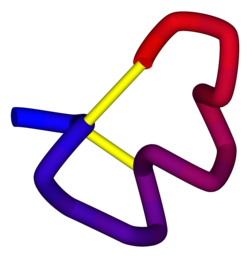 α-Conotoxin PnIB from C. pennaceus, disulfide bonds shown in yellow. From the University of Michigan's Orientations of Proteins in Membranes database, PDB: 1AKG. | |||||||
| Identifiers | |||||||
| Symbol | Toxin_8 | ||||||
| Pfam | PF07365 | ||||||
| InterPro | IPR009958 | ||||||
| PROSITE | PDOC60004 | ||||||
| SCOP2 | 1mii / SCOPe / SUPFAM | ||||||
| OPM superfamily | 148 | ||||||
| OPM protein | 1akg | ||||||
| |||||||
| Omega conotoxin | |||||||
|---|---|---|---|---|---|---|---|
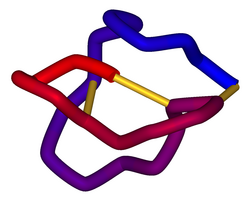 Schematic diagram of the three-dimensional structure of ω-conotoxin MVIIA (ziconotide). Disulfide bonds are shown in gold. From PDB: 1DW5. | |||||||
| Identifiers | |||||||
| Symbol | Conotoxin | ||||||
| Pfam | PF02950 | ||||||
| InterPro | IPR004214 | ||||||
| SCOP2 | 2cco / SCOPe / SUPFAM | ||||||
| OPM superfamily | 112 | ||||||
| OPM protein | 1fyg | ||||||
| |||||||
A conotoxin is one of a group of neurotoxic peptides isolated from the venom of the marine cone snail, genus Conus.
Conotoxins, which are peptides consisting of 10 to 30 amino acid residues, typically have one or more disulfide bonds. Conotoxins have a variety of mechanisms of actions, most of which have not been determined. However, it appears that many of these peptides modulate the activity of ion channels.1 Over the last few decades conotoxins have been the subject of pharmacological interest.2
The LD50 of conotoxin ranges from 5-25 μg/kg.345
Hypervariability
Conotoxins are hypervariable even within the same species. They do not act within a body where they are produced (endogenously) but act on other organisms.6 Therefore, conotoxin genes experience less selection against mutations (like gene duplication and nonsynonymous substitution), and mutations remain in the genome longer, allowing more time for potentially beneficial novel functions to arise.7 Variability in conotoxin components reduces the likelihood that prey organisms will develop resistance; thus cone snails are under constant selective pressure to maintain polymorphism in these genes because failing to evolve and adapt will lead to extinction (Red Queen hypothesis).8
Disulfide connectivity
Types of conotoxins also differ in the number and pattern of disulfide bonds.9 The disulfide bonding network, as well as specific amino acids in inter-cysteine loops, provide the specificity of conotoxins.10
Types and biological activities
As of 2005, five biologically active conotoxins have been identified. Each of the five conotoxins attacks a different target:
- α-conotoxin inhibits nicotinic acetylcholine receptors at nerves and muscles.11
- δ-conotoxin inhibits fast inactivation of voltage-dependent sodium channels.12
- κ-conotoxin inhibits potassium channels.13
- μ-conotoxin inhibits voltage-dependent sodium channels in muscles.14
- ω-conotoxin inhibits N-type voltage-dependent calcium channels.15 Because N-type voltage-dependent calcium channels are related to algesia (sensitivity to pain) in the nervous system, ω-conotoxin has an analgesic effect: the effect of ω-conotoxin M VII A is 100 to 1000 times that of morphine.16 Therefore, a synthetic version of ω-conotoxin M VII A has found application as an analgesic drug ziconotide (Prialt).17
Characterization
Considering conotoxins have become an area of interest for pharmaceutical leads, there has been an increased drive to characterize newly founded conotoxins.18 There are 3 ways: gene superfamily, cysteine framework, and pharmaceutical family.18 Much of the research on them before was focused on isolating the venom directly, which works for classifying the conotoxins for pharmacological family and cysteine framework.18 Pharmacological family classification is based on the receptor target and interaction of the conotoxin while the cysteine residues are the primary structure, which 26 main frameworks have been found as of present18.
Alpha- Super Family
Alpha conotoxins have two types of cysteine arrangements,19 and are competitive nicotinic acetylcholine receptor antagonists. Alpha-GI is a peptide of 13 amino acids with two disulfide bonds which is a nicotinic-acetylcholine receptor antagonist that inhibits neuromuscular transmission.18. This is a part of a diverse group of conotoxins which share a single peptide sequence and have a type 1 cysteine framework which tend to target an array of neuromuscular subtypes.18.
α-conotoxin PnIB
A conotoxin which consists of 16 residual peptides isolated from the molluscivorous snail Conus pennaceus20. a-conotoxin PnIA inhibits neuronal nicotinic acetylcholine receptor (nAChR) with two disulfide bonds2021.It is present in the mixture of neuro toxins produced in the venom duct and injected into prey via the radular tooth connected to the venom bulb22.
B-Conotoxin Superfamily
Conantokin-G, also known as the sleeper peptide, was isolated from the venom of Conus geographus18. It has the ability to induce a sleep like phenomenon and was the first conotoxin to not have any cysteine residues, which is unusual because this is one of the key characteristics of conotoxin classification.
Delta, kappa, and omega
Omega, delta and kappa families of conotoxins have a knottin or inhibitor cystine knot scaffold. The knottin scaffold is a very special disulfide-through-disulfide knot, in which the III-VI disulfide bond crosses the macrocycle formed by two other disulfide bonds (I-IV and II-V) and the interconnecting backbone segments, where I-VI indicates the six cysteine residues starting from the N-terminus. The cysteine arrangements are the same for omega, delta and kappa families, even though omega conotoxins are calcium channel blockers, whereas delta conotoxins delay the inactivation of sodium channels, and kappa conotoxins are potassium channel blockers.9
| Mu-conotoxin | |||||||
|---|---|---|---|---|---|---|---|
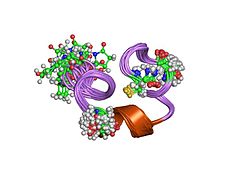 nmr solution structure of piiia toxin, nmr, 20 structures | |||||||
| Identifiers | |||||||
| Symbol | Mu-conotoxin | ||||||
| Pfam | PF05374 | ||||||
| Pfam clan | CL0083 | ||||||
| InterPro | IPR008036 | ||||||
| SCOP2 | 1gib / SCOPe / SUPFAM | ||||||
| OPM superfamily | 112 | ||||||
| OPM protein | 1ag7 | ||||||
| |||||||
Mu
Mu-conotoxins have two types of cysteine arrangements, but the knottin scaffold is not observed.23 Mu-conotoxins target the muscle-specific voltage-gated sodium channels,9 and are useful probes for investigating voltage-dependent sodium channels of excitable tissues.2324 Mu-conotoxins target the voltage-gated sodium channels, preferentially those of skeletal muscle,9 and are useful probes for investigating voltage-dependent sodium channels of excitable tissues.25
Different subtypes of voltage-gated sodium channels are found in different tissues in mammals, e.g., in muscle and brain, and studies have been carried out to determine the sensitivity and specificity of the mu-conotoxins for the different isoforms.26
ConoServer
A database that has the structures and sequences of peptides expressed in conopeptides, also known as conotoxins. Considering conotoxins target human ion channels the three classifications that ConoServer uses are the gene super families, cystine frameworks, and the pharmacological families27. The database also has information about post-translational modifications considering conotoxins are extremely post-translationally modified, the server has both naturally and artificially introduced modifications27. To help understand conotoxins further, the database provides statistics about relationships between conopeptide classifications, the sequence between signal peptides and the super family, the number of entries for each of the snail species studied27.
Genus Conus

This snail is found in reef in the Indo-pacific, along the shores of Australia. It hunts small fish by injecting prey with its proboscis28. The snail hunts by injecting conotoxin through the proboscis and hollow radular tooth29. The venom is created in the snails venom glands where it also makes digestive enzymes29.
Conotoxin Effects
Divers handle cone snails without knowing their mechanisms of envenomation. The some causes of envenomation of a cone snail are paralysis, respiratory failure, and muscle pains30. At the envenomation site there could be numbness, ischemia, cyanosis, and necrosis in either localized or entire regions of the body30 Due to the complexity and multitude of conotoxins that block different pathways, little progress has been made to make an anti-venom 30.
Treatment
Intervention for a cone snail envenomation involves seeking care at a hospital to ensure the patient's airway and circulation is working properly. Methods like pressure immobilization could prevent venom from spreading into other areas of the body to prevent further injury. 30
Other applications
Considering conotoxins affect so many ion channels, they are currently being explored to provide pain relief for intractable pain30.
See also
See also
- Conolidine
- Contryphan, members of "conotoxin O2"
- Conantokins, also known as "conotoxin B"
References
References
- Terlau H, Olivera BM (2004). "Conus venoms: a rich source of novel ion channel-targeted peptides". Physiol. Rev. 84 (1): 41–68. Bibcode:2004PhyRv..84...41T. doi:10.1152/physrev.00020.2003. PMID 14715910.
- Olivera BM, Teichert RW (2007). "Diversity of the neurotoxic Conus peptides: a model for concerted pharmacological discovery". Molecular Interventions. 7 (5): 251–60. doi:10.1124/mi.7.5.7. PMID 17932414.
- "PEAC Hazard Analysis & Emergency Response Resources" (PDF). Archived (PDF) from the original on 2017-08-29. Retrieved 2017-03-31.
- "Biological Agent Reference Sheet - Conotoxin" (PDF). Emory University.
- Baker, A.L. "toxin ld50 list". PhycoKey.
- Olivera BM, Watkins M, Bandyopadhyay P, Imperial JS, de la Cotera EP, Aguilar MB, Vera EL, Concepcion GP, Lluisma A (September 2012). "Adaptive radiation of venomous marine snail lineages and the accelerated evolution of venom peptide genes". Ann. N. Y. Acad. Sci. 1267 (1): 61–70. Bibcode:2012NYASA1267...61O. doi:10.1111/j.1749-6632.2012.06603.x. PMC 3488454. PMID 22954218.
- Wong ES, Belov K (March 2012). "Venom evolution through gene duplications". Gene. 496 (1): 1–7. doi:10.1016/j.gene.2012.01.009. PMID 22285376.
- Liow LH, Van Valen L, Stenseth NC (July 2011). "Red Queen: from populations to taxa and communities". Trends Ecol. Evol. 26 (7): 349–58. Bibcode:2011TEcoE..26..349L. doi:10.1016/j.tree.2011.03.016. PMID 21511358.
- Jones RM, McIntosh JM (2001). "Cone venom--from accidental stings to deliberate injection". Toxicon. 39 (10): 1447–1451. Bibcode:2001Txcn...39.1447M. doi:10.1016/S0041-0101(01)00145-3. PMID 11478951.
- Sato K, Kini RM, Gopalakrishnakone P, Balaji RA, Ohtake A, Seow KT, Bay BH (2000). "lambda-conotoxins, a new family of conotoxins with unique disulfide pattern and protein folding. Isolation and characterization from the venom of Conus marmoreus". J. Biol. Chem. 275 (50): 39516–39522. doi:10.1074/jbc.M006354200. PMID 10988292.
- Nicke A, Wonnacott S, Lewis RJ (2004). "Alpha-conotoxins as tools for the elucidation of structure and function of neuronal nicotinic acetylcholine receptor subtypes". Eur. J. Biochem. 271 (12): 2305–2319. doi:10.1111/j.1432-1033.2004.04145.x. PMID 15182346.
- Leipold E, Hansel A, Olivera BM, Terlau H, Heinemann SH (2005). "Molecular interaction of delta-conotoxins with voltage-gated sodium channels". FEBS Lett. 579 (18): 3881–3884. Bibcode:2005FEBSL.579.3881L. doi:10.1016/j.febslet.2005.05.077. PMID 15990094.
- Shon KJ, Stocker M, Terlau H, Stühmer W, Jacobsen R, Walker C, Grilley M, Watkins M, Hillyard DR, Gray WR, Olivera BM (1998). "kappa-Conotoxin PVIIA is a peptide inhibiting the shaker K+ channel". J. Biol. Chem. 273 (1): 33–38. doi:10.1074/jbc.273.1.33. PMID 9417043.
- Li RA, Tomaselli GF (2004). "Using the deadly mu-conotoxins as probes of voltage-gated sodium channels". Toxicon. 44 (2): 117–122. Bibcode:2004Txcn...44..117L. doi:10.1016/j.toxicon.2004.03.028. PMC 2698010. PMID 15246758.
- Nielsen KJ, Schroeder T, Lewis R (2000). "Structure-activity relationships of omega-conotoxins at N-type voltage-sensitive calcium channels" (abstract). J. Mol. Recognit. 13 (2): 55–70. doi:10.1002/(SICI)1099-1352(200003/04)13:2<55::AID-JMR488>3.0.CO;2-O. PMID 10822250.
{{cite journal}}: CS1 maint: deprecated archival service (link) - Bowersox SS, Luther R (1998). "Pharmacotherapeutic potential of omega-conotoxin MVIIA (SNX-111), an N-type neuronal calcium channel blocker found in the venom of Conus magus". Toxicon. 36 (11): 1651–1658. Bibcode:1998Txcn...36.1651B. doi:10.1016/S0041-0101(98)00158-5. PMID 9792182.
- Prommer E (2006). "Ziconotide: a new option for refractory pain". Drugs Today. 42 (6): 369–78. doi:10.1358/dot.2006.42.6.973534. PMID 16845440.
- Robinson, Samuel D.; Norton, Raymond S. (2014-12-17). "Conotoxin gene superfamilies". Marine Drugs. 12 (12): 6058–6101. doi:10.3390/md12126058. ISSN 1660-3397. PMC 4278219. PMID 25522317.
- Gray WR, Olivera BM, Zafaralla GC, Ramilo CA, Yoshikami D, Nadasdi L, Hammerland LG, Kristipati R, Ramachandran J, Miljanich G (1992). "Novel alpha- and omega-conotoxins from Conus striatus venom". Biochemistry. 31 (41): 11864–11873. doi:10.1021/bi00156a009. PMID 1390774.
- Hu, Shu-Hong; Gehrmann, John; Alewood, Paul F.; Craik, David J.; Martin, Jennifer L. (1997-09-01). "Crystal Structure at 1.1 Å Resolution of α-Conotoxin PnIB: Comparison with α-Conotoxins PnIA and GI". Biochemistry. 36 (38): 11323–11330. doi:10.1021/bi9713052. ISSN 0006-2960. PMID 9298951.
- Hogg, Ron C.; Miranda, Les P.; Craik, David J.; Lewis, Richard J.; Alewood, Paul F.; Adams, David J. (December 1999). "Single Amino Acid Substitutions in α-Conotoxin PnIA Shift Selectivity for Subtypes of the Mammalian Neuronal Nicotinic Acetylcholine Receptor". Journal of Biological Chemistry. 274 (51): 36559–36564. doi:10.1074/jbc.274.51.36559. PMID 10593955.
- Olivera, Baldomero M. (November 2002). "Conus Venom Peptides: Reflections from the Biology of Clades and Species". Annual Review of Ecology and Systematics. 33 (1): 25–47. Bibcode:2002AnRES..33...25O. doi:10.1146/annurev.ecolsys.33.010802.150424. ISSN 0066-4162.
- Nielsen KJ, Watson M, Adams DJ, Hammarström AK, Gage PW, Hill JM, Craik DJ, Thomas L, Adams D, Alewood PF, Lewis RJ (July 2002). "Solution structure of mu-conotoxin PIIIA, a preferential inhibitor of persistent tetrodotoxin-sensitive sodium channels" (PDF). J. Biol. Chem. 277 (30): 27247–55. doi:10.1074/jbc.M201611200. PMID 12006587.
- Zeikus RD, Gray WR, Cruz LJ, Olivera BM, Kerr L, Moczydlowski E, Yoshikami D (1985). "Conus geographus toxins that discriminate between neuronal and muscle sodium channels". J. Biol. Chem. 260 (16): 9280–8. doi:10.1016/S0021-9258(17)39364-X. PMID 2410412.
- Cruz LJ, Gray WR, Olivera BM, Zeikus RD, Kerr L, Yoshikami D, Moczydlowski E (August 1985). "Conus geographus toxins that discriminate between neuronal and muscle sodium channels". J. Biol. Chem. 260 (16): 9280–8. doi:10.1016/S0021-9258(17)39364-X. PMID 2410412.
- Floresca CZ (2003). "A comparison of the mu-conotoxins by [3H]saxitoxin binding assays in neuronal and skeletal muscle sodium channel". Toxicol Appl Pharmacol. 190 (2): 95–101. doi:10.1016/s0041-008x(03)00153-4. PMID 12878039.
- "ConoServer". www.conoserver.org. Retrieved 2026-04-28.
- "Conus geographus (geography cone snail) | INFORMATION | Animal Diversity Web". animaldiversity.org. Retrieved 2026-04-21.
- "Conus geographus (geography cone snail) | INFORMATION | Animal Diversity Web". animaldiversity.org. Retrieved 2026-04-21.
- Kapil, Sasha; Hendriksen, Stephen; Cooper, Jeffrey S. (2026), "Cone Snail Toxicity", StatPearls, Treasure Island (FL): StatPearls Publishing, PMID 29262115, retrieved 2026-04-21
External links
External links
- Conotoxins at the U.S. National Library of Medicine Medical Subject Headings (MeSH)
- Baldomero "Toto" Olivera's Short Talk. "Conus Peptides".
- Kaas Q, Westermann JC, Halai R, Wang CK, Craik DJ. "ConoServer". Institute of Molecular Bioscience, The University of Queensland, Australia. Retrieved 2009-06-02.
A database for conopeptide sequences and structures