| Computer Bismarck | |
|---|---|
 Cover art designed by Louis Saekow featuring the eponymous battleship | |
| Developer | Strategic Simulations |
| Publisher | Strategic Simulations |
| Designers |
|
| Platforms | Apple II, TRS-8023 |
| Release | February 19801 |
| Genre | Wargame |
| Modes | Single-player, multiplayer |
Computer Bismarck is a computer wargame developed and published by Strategic Simulations (SSI) in 1980. The game is based on the last battle of the battleship Bismarck, in which British Armed Forces pursue the German Bismarck in 1941. Computer Bismarck is SSI's first game and features turn-based gameplay on a two-dimensional map of the Atlantic Ocean.
The development staff consisted of two programmers, Joel Billings and John Lyons, who programmed the game in BASIC. Originally developed for the TRS-80, an Apple II version was also created two months into the process. After meeting with other wargame developers, Billings decided to publish the game as well. To help accomplish this, he hired Louis Saekow to create the box art.
The first commercially published computer wargame, Computer Bismarck sold well and contributed to SSI's success. Though it received a mixed reception, the game is credited in part for legitimizing wargames and computer games.
Synopsis
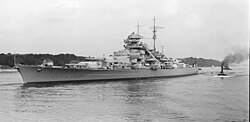
The game is a simulation of the German battleship Bismarck's last battle in the Atlantic Ocean during World War II.4 On May 24, 1941, Bismarck and Prinz Eugen sank the British HMS Hood and damaged HMS Prince of Wales at the Battle of the Denmark Strait. Following the battle, British Royal Navy ships and aircraft pursued Bismarck for two days. After being crippled by a torpedo bomber on the evening of May 26, Bismarck was sunk the following morning.5
Gameplay

Computer Bismarck is a turn-based computer wargame in which players control British forces against the battleship Bismarck and other German units. The German forces can be controlled by either a computer opponent named "Otto von Computer" or a second player.46 The game takes place on a map of the North Atlantic Ocean on which letters from the English alphabet represent military units and facilities (airfields and ports).7 Computer Bismarck includes six scenarios: two for a single player and four competitive scenarios for two players.8 Units have different capabilities, as well as statistics that determine their mobility, firepower, vulnerability and other factors. Turns take the form of phases, and players alternate inputting orders to maneuver their respective units.9 Phases facilitate different functions, such as informing players of status changes, unit movement, and battles.7 Players earn points by destroying opposing units. The game ends after the Bismarck is sunk or a number of turns have occurred. The British or German forces are declared the victor based on the number of accumulated points.9
Development


During college, Joel Billings used computers for econometrics, mathematical modeling and forecasting. This experience convinced him that computers could handle recreational wargames and remove tedious paperwork from gameplay;10 he had been a fan of board wargames since childhood.1112 While between his undergraduate and graduate education in summer 1979, Billings met an IBM programmer and discussed computers.1410 Billings suggested starting a software company with him, but the programmer was not interested in wargames, stating that they were too difficult and complicated to be popular.10 Billings posted flyers at hobby shops in the Santa Clara, California area to attract wargame enthusiasts with a background in programming. John Lyons was the first to reply and joined Billings after quickly developing a good rapport.12410 The two founded Strategic Simulations using US$1,000 (equivalent to $4,436.04 in 2025) as startup money.111
Billings chose the Bismarck's last battle because he felt it would be easier to develop than other wargames;212 he believed that the artificial intelligence for the hunting/chasing style of gameplay would require less development time.1213 The developers drew inspiration from common conventions in historical simulation games when designing the gameplay.14 In retrospect, Billings noted that a computer would handle the gameplay better because it could withhold information about player moves from the opponent player to simulate the fog of war, whereas playing a board game required the two players to openly announce their moves.13

In August 1979, Billings borrowed a North Star Horizon computer from his work so Lyons could write the program.21215 At the time, the two were working full-time and programmed at Billings' apartment during the night. Lyons did the bulk of the programming, while Billings focused on design and assisted with data entry and minor programming tasks.2 Dave Cook assisted with game design while Billings' father, Robert Billings, helped with historical information.16
Computer Bismarck was written in BASIC and compiled to increase its processing speed.210 Lyons began programming a simplified version similar to a fox and hounds game—he had "hounds" search a playing field for a "fox".24 After determining a map size suitable for home computer displays, Lyons programmed the movement of the naval and air units before creating the combat mechanisms for two-player gameplay. The computer-controlled German opponent for the single-player mode was made afterward, which Lyons considered the most complex aspect of the game.14 In designing Otto von Computer, the developers had the computer pick different paths based on the possible scenarios and relied on their wargame expertise to determine the optimal move.4 During development, he struggled to implement game saving. After the game grew larger, Lyons placed the initial data for the military units into a separate file in order to reduce the game's file size. The developers then realized the same technique for loading the data could apply to information for an in-progress game and allowed the player create a save file.14

The game was originally developed for the Tandy Corporation's TRS-80.2410 When starting up SSI, Billing's uncle introduced him to venture capitalists.12 Two months into development, a venture capitalist connected Billings with Trip Hawkins, then a marketing manager at Apple Computer, who convinced Billings to develop the game for the Apple II.2410 Hawkins commented that the computer's capacity for color graphics made it the best platform for strategy games and could reach a wider audience.115 Hawkins joined SSI's board of directors soon after.12 In October 1979, Billings' uncle gave him an Apple II. Billings and Lyons then converted their existing code to work on the Apple II and used a graphics software package to generate the game's map.2 Lyons considered the graphics the most challenging part of development.14
Marketing and release
After Lyons began programming, Billings started to study the video games market. He visited local game stores and attended a San Francisco gaming convention. Billings approached Tom Shaw from Avalon Hill—the company produced many wargames that Billings played as a child—and one of the founders of Automated Simulations to share market data but aroused no interest. The lukewarm responses made Billings believe he would have to publish SSI's games. After Computer Bismarck was finished in January 1980, he searched for a graphic designer to handle the game's packaging.2
Billings met Louis Saekow through a string of friends but was hesitant to hire him. Inspired by Avalon Hill's games, Billings wanted SSI's games to look professional and include maps, detailed manuals, and excellent box art.2 Since he saw Computer Bismarck as an electronic wargame rather than a video game, Billings felt that wargame enthusiasts would expect presentation similar to board games.13 Two months prior, Saekow had postponed medical school to pursue his dream of becoming a graphic designer. To secure the job, Saekow told Billings that he could withhold pay if the work was unsatisfactory. In creating the box art, Saekow used a stat camera; his roommate worked for a magazine company and helped him sneak in to use its camera after hours. Saekow's cousin then handled printing the packaging.2 Without any storage for the complete products, Billings stored the first 2,000 boxes in his bedroom.1212

Through Hawkins, Apple Computer provided SSI a mailing list of Apple users.12 In February 1980, Billings distributed 30,000 flyers to Apple II owners, and displayed the game at the Applefest exposition a month later.112 SSI purchased a full-page advertisement for the Apple II version in the March 1980 issue of BYTE magazine, which mentioned the ability to save a game in progress as well as play against the computer or another person. The advertisement also promised future support for the TRS-80 and other computers.6
Billings initially sold the game for $60 (equivalent to $234.45 in 2025), well above the $15–20 price ($58.61–78.15 in 2025) of other computer games as well as the $30 (equivalent to $117.23 in 2025) price of board games. He reasoned that the niche target market required a higher price; if potential buyers did not already own a home computer and the funds to do so, they would be unlikely to purchase his game.1213 Billings initially planned to sell the game via mail order. However, the volume of orders during the first month prompted him to switch distribution to retail stores. To help with the switch, Hawkins provided Billings a list of Apple distributors.12 The game was later re-released as part of the company's "SSI classics" line of popular games at discounted prices.17 By 1990, the game had sold 7,000 units.11
Reception
In 1980, Peter Ansoff of BYTE magazine called Computer Bismarck a "milestone in the development of commercial war games", and approved of the quality of the documentation and the option to play against the computer, but disapproved of the game. Acknowledging that "it is perhaps unfair to expect the first published [computer wargame] to be a fully developed product", he criticized Computer Bismarck for overly faithfully copying the mechanics of the Bismarck board game, including those that worked efficiently on a board but less so on a computer. Ansoff also noted that the computer game "perpetuates the [board game's] irritating system of ship-movement rates", and concluded that "the failings of Computer Bismarck can be summarized by saying that it does not take advantage of the possibilities offered by the computer".9 Moves magazine reviewer Ian Chadwick called it "engrossing" and praised the simulation's accuracy. While noting the excessive amount of time required to play a single game, Chadwick noted that Computer Bismarck requires patience and some gameplay changes could have reduced this time. He called the graphics "poorly drawn", but conceded that good visuals are not necessary.8
The game was better received by other critics. Neil Shapiro of Popular Mechanics that year praised the game's detail and ability to recreate the complex maneuvering involved in the real battle. He referred to it as unique and "fantastic".18 In Creative Computing, Randy Heuer cautioned that the game "is probably not for everyone. The point which I probably cannot emphasize enough is that it is an extremely complex simulation ... However, for those ready for a [challenge] ... I enthusiastically recommend Computer Bismarck".7 Reviewing Computer Bismarck in The Space Gamer magazine, Joseph T. Suchar called the game "superb" and stated that "it has so many strategic options for both sides that it is unlikely to be optimized."19 United States Navy defense researcher Peter Perla in 1990 considered wargames like Computer Bismarck a step above earlier war-themed video games that relied on arcade-style action. He praised the addition of a computer-controlled opponent that such games provide to solitaire players. 20
Legacy
Commentators have ascribed SSI's early growth and success to Computer Bismarck. Perla attributes the company's success to the release of its early wargames, specifically citing Computer Bismarck.20 Computer Gaming World's Bob Proctor agreed that Computer Bismarck contributed to SSI's success, commenting that it earned the company a good profit. He also stated that it encouraged game enthusiasts to submit their own games to SSI, which he believed helped further the company's success.1 For example, the 1981 Computer Quarterback originated as a submission from Danielle Bunten Berry, who created other games for SSI afterward. Similarly, Jack Avery connected with the corporation by submitting an air combat game and then developed Computer Baseball for SSI in 1981.113 SSI reused the computer opponent, Otto von Computer, for its 1981 Torpedo Fire.4 One of the company's later games, the 1982 Pursuit of the Graf Spee, uses an altered version of Computer Bismarck's core system.102122
Describing it as the first "serious wargame for a microcomputer", Proctor credited Computer Bismarck with helping to legitimize wargames and computer games in general. He stated that the professional packaging demonstrated SSI's seriousness to produce quality products;1 prior to Computer Bismarck, most computer games were packaged in zipper storage bags.12 Billings noted that about half a year after Computer Bismarck's release, other publishers began to package games in boxes.12 Following the game's success, Saekow became a permanent SSI employee and designed artwork for most of its products.2
Ansoff and Chadwick noted the similarity of the game's mechanics to Avalon Hill's Bismarck board game.89 Ansoff stated that "it would seem proper as a matter of courtesy to acknowledge that the game was based on an Avalon Hill design."9 Computer Gaming World staff believe that Computer Bismarck's success spurred Avalon Hill to enter the computer game market; the same year, the game company began releasing wargames for home computers.15 In 1983, Avalon Hill took legal action against SSI for copying game mechanics from its board games; Computer Bismarck, among other titles, was involved in the case.415 The two companies settled the issue out of court.4 The International Center for the History of Electronic Games received a software donation of several SSI games in December 2013, including Computer Bismarck with the source code for preservation.2324
See also
See also
- Bismarck - 1987 video game based on the Bismarck's last battle developed by Personal Software Services
References
References
- Proctor, Bob (March 1988). "Titans of the Computer Gaming World" (PDF). Features. Computer Gaming World. No. 45. Anaheim, California, United States: Golden Empire Publications. p. 36. ISSN 0744-6667. Retrieved September 23, 2025.
- Ritchie, Craig (October 2007). "Developer Lookback: Strategic Simulations Inc". Retro Gamer. No. 42. Bournemouth, Dorset, England, United Kingdom: Imagine Publishing. pp. 34–39. ISSN 1742-3155.
- Lee, Ernest, ed. (December 1983). "Software". Bowker/Bantam 1984 Complete Sourcebook of Personal Computing. New York, New York, United States: R. R. Bowker Company and Bantam Books. p. 251. ISBN 0-8352-1765-5 – via Internet Archive.
- DeMaria, Rusel; Wilson, Johnny L. (2003). High Score!: The Illustrated History of Electronic Games (2nd ed.). Berkeley, California, United States: McGraw-Hill Osborne Media. pp. 158–159. ISBN 0-07-223172-6 – via Internet Archive.
- Kennedy, Ludovic (1974). Pursuit: The Chase and Sinking of the Bismarck. New York, New York, United States: Viking Press. ISBN 0670583146 – via Internet Archive.
- SSI Staff (March 1980). "Sink the Bismarck with your Apple!". Advertisement. BYTE. Vol. 5, no. 3. Peterborough, New Hampshire, United States: McGraw Hill. p. 165. ISSN 0360-5280. Retrieved October 18, 2013 – via Internet Archive.
- Heuer, Randy (August 1980). "Computer Bismarck". Evaluations & Profiles. Creative Computing. Vol. 6, no. 8. Morristown, New Jersey, United States: Creative Computing. p. 31. ISSN 0097-8140. Retrieved October 18, 2013 – via Internet Archive.
- Chadwick, Ian (April 1981). "Computer Bismarck" (PDF). Moves. No. 56. New York, New York, United States: Simulations Publications, Inc. pp. 28–29. Archived from the original (PDF) on September 30, 2024. Retrieved September 24, 2025.
- Ansoff, Peter A (December 1980). "Computer Bismarck". BYTE. Vol. 5, no. 12. Peterborough, New Hampshire, United States: McGraw Hill. pp. 262–266. ISSN 0360-5280. Retrieved October 18, 2013 – via Internet Archive.
- Powell, Jack (July 1985). "War Games: The story of S.S.I." Antic. Vol. 4, no. 3. San Francisco, California, United States: Antic Publishing. p. 28. ISSN 0745-2527 – via Internet Archive.
- Staff (July 5, 1990). "Computer war games put players in command and test strategic skills". The Philadelphia Inquirer. Philadelphia, Pennsylvania, United States: Knight Ridder. p. 60. ISSN 0885-6613. Retrieved February 24, 2026 – via Newspapers.com.
- Rigby, Paul (November 1989). "Muskets and Magic". Profile. The Games Machine. No. 24. Ludlow, Shropshire, England, United Kingdom: Newsfield Publications. pp. 69–70. ISSN 0954-8092 – via Internet Archive.
- Barnes, Adam (2015). "From the Archives: Strategic Simulations Inc". Retro Gamer. No. 140. Bournemouth, Dorset, England, United Kingdom: Imagine Publishing. pp. 51–52. ISSN 1742-3155.
- Swanson, Lee; Mellen, Dave. "Designer's Notes". Computer Bismarck Rule Book. Stanford, California, United States: Strategic Simulations. p. 11 – via Internet Archive.
- Sipe, Russell, ed. (November 1991). "A History of Computer Games". Features. Computer Gaming World. No. 88. Anaheim Hills, California, United States: Golden Empire Publications. p. 19. ISSN 0744-6667 – via Internet Archive.
- Swanson, Lee; Mellen, Dave. "Credits". Computer Bismarck Rule Book. Stanford, California, United States: Strategic Simulations. p. 11 – via Internet Archive.
- Friedland, Nat, ed. (February 1987). "New Products". Antic. Vol. 5, no. 10. San Francisco, California, United States: Antic Publishing. p. 31. ISSN 0745-2527 – via Internet Archive.
- Shapiro, Neil (August 1980). "PM Electronics Monitor: Have your own war room". Popular Mechanics. Vol. 154, no. 2. New York, New York, United States: Hearst Corporation. p. 13. ISSN 0032-4558 – via Google Books.
- Suchar, Joseph T. (July 1980). "Capsule Reviews". The Space Gamer. No. 29. Austin, Texas, United States: Steve Jackson Games. pp. 29–30. ISSN 0194-9977. Retrieved September 23, 2025 – via Internet Archive.
- Perla, Peter P. (1990). The Art of Wargaming. Naval Institute Press. pp. 151–152. ISBN 0-87021-050-5 – via Internet Archive.
- Murphy, Brian J. (July 1983). "Warfare in the Atlantic". Creative Computing. Vol. 9, no. 7. Morristown, New Jersey, United States: Ziff Davis. p. 76. ISSN 0097-8140. Retrieved September 23, 2025 – via Internet Archive.
- Staff (January–February 1982). "Hobby and Industry News" (PDF). Computer Gaming World. Vol. 2, no. 1. Anaheim, California, United States: Golden Empire Publications. p. 2. ISSN 0744-6667. Retrieved September 23, 2025.
- Nutt, Christian (December 16, 2013). "Strategic Simulations, Inc. founder donates company collection to ICHEG". Gamasutra. Retrieved December 22, 2013.
- Dyson, Jon-Paul C. (December 16, 2013). "The Strategic Simulations, Inc. Collection". International Center for the History of Electronic Games. Archived from the original on December 24, 2013. Retrieved December 22, 2013.