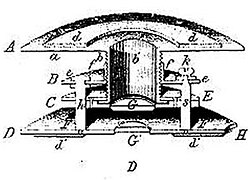
The compressorium (plural: compressoria) is a scientific apparatus for applying pressure to a sample for examination with a microscope.
Widely used by microscopists in the 19th century,123 they were produced by companies such as Bausch and Lomb.4
Many versions of compressoria were developed over the years, with one of the first attributed to the famous histologist Jan Evangelista Purkyně,5 see picture.
Compressoria were still used in the twenty-first century for the identification of Trichinella worms in samples.6
References
References
- Bedwell, F. A. (June 1878). "Hints to Workers with the Microscope". Nature. 18 (449): 141. Bibcode:1878Natur..18..141B. doi:10.1038/018141b0. ISSN 1476-4687.
- Smith, Gilbert Morgan (1915). "The Development of Botanical Microtechnique". Transactions of the American Microscopical Society. 34 (2): 71–129. doi:10.2307/3221940. ISSN 0003-0023. JSTOR 3221940.
- "Microscope No. 315 accessories". golubcollection.berkeley.edu. Retrieved 2024-03-23.
- "Compressorium, by Bausch and Lomb, American, 1901–1920". Science Museum Group. Retrieved 25 March 2024.
- "compressors or compressoria". www.microscope-antiques.com. Retrieved 2024-03-28.
- Forbes, Lorry B.; Parker, Sarah; Scandrett, W.Brad (2003-06-01). "Comparison of a Modified Digestion Assay with Trichinoscopy for the Detection of Trichinella Larvae in Pork". Journal of Food Protection. 66 (6): 1043–1046. doi:10.4315/0362-028X-66.6.1043. PMID 12801007.