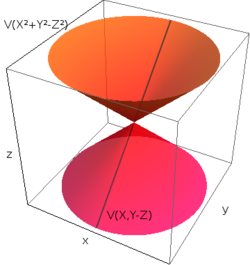
In mathematics, particularly differential geometry and complex geometry, a complex analytic varietynote 1 or complex analytic space is a generalization of a complex manifold that allows the presence of singularities. Complex analytic varieties are locally ringed spaces that are locally isomorphic to local model spaces, where a local model space is an open subset of the vanishing locus of a finite set of holomorphic functions.
Complex analytic varieties are analogous to algebraic varieties. Roughly speaking, a complex analytic variety is a zero locus of a set of a complex analytic function, while an algebraic variety is a zero locus of a set of a polynomial function.
Definition
Denote the constant sheaf on a topological space with value by . A -space is a locally ringed space , whose structure sheaf is an algebra over .
Choose an open subset of some complex affine space , and fix finitely many holomorphic functions in . Let be the common vanishing locus of these holomorphic functions, that is, . Define a sheaf of rings on by letting be the restriction to of , where is the sheaf of holomorphic functions on . Then the locally ringed -space is a local model space.
A complex analytic variety is a locally ringed -space that is locally isomorphic to a local model space.
Morphisms of complex analytic varieties are defined to be morphisms of the underlying locally ringed spaces, they are also called holomorphic maps. A structure sheaf may have nilpotent elements;1 if the structure sheaf is reduced, then the complex analytic space is called reduced.
An associated complex analytic space (variety) is such that:1
- Let X be a scheme of finite type over , and cover X with open affine subsets () (Spectrum of a ring). Then each is an algebra of finite type over , and , where are polynomials in , which can be regarded as a holomorphic functions on . Therefore, their set of common zeros is the complex analytic subspace . Here, the scheme X is obtained by glueing the data of the sets , and then the same data can be used for glueing the complex analytic spaces into a complex analytic space , so we call an associated complex analytic space with X. The complex analytic space X is reduced if and only if the associated complex analytic space is reduced.2
See also
See also
- Analytic space
- Complex algebraic variety
- GAGA – Two closely related mathematical subjectsPages displaying short descriptions of redirect targets
- Rigid analytic space – Analogue of a complex analytic space over a nonarchimedean field
Note
- Hartshorne 1977, p. 439.
- Grothendieck & Raynaud (2002) (SGA 1 §XII. Proposition 2.1.)
Annotation
- A complex analytic variety is sometimes required to be irreducible and (or) reduced.
References
References
- Aroca, José Manuel; Hironaka, Heisuke; Vicente, José Luis (3 November 2018). Complex Analytic Desingularization. doi:10.1007/978-4-431-49822-3. ISBN 978-4-431-49822-3.
- Bloom, Thomas; Herrera, Miguel (1969). "De Rham cohomology of an analytic space". Inventiones Mathematicae. 7 (4): 275–296. Bibcode:1969InMat...7..275B. doi:10.1007/BF01425536. S2CID 122113902.
- Cartan, H.; Bruhat, F.; Cerf, Jean; Dolbeault, P.; Frenkel, Jean; Hervé, Michel; Malatian; Serre, J-P. "Séminaire Henri Cartan, Tome 4 (1951-1952)". (no.10-13)
- Fischer, G. (14 November 2006). Complex Analytic Geometry. Springer. ISBN 978-3-540-38121-1.
- Gunning, Robert Clifford; Rossi, Hugo (2009). "Chapter III. Variety (Sec. B. Analytic covers)". Analytic Functions of Several Complex Variables. American Mathematical Soc. ISBN 9780821821657.
- Gunning, Robert Clifford; Rossi, Hugo (2009). "Chapter V. Analytic spaces". Analytic Functions of Several Complex Variables. American Mathematical Soc. ISBN 9780821821657.
- Grauert, Hans; Remmert, Reinhold (1958). "Komplexe Räume". Mathematische Annalen. 136 (3): 245–318. doi:10.1007/BF01362011. S2CID 121348794.
- Grauert, H.; Remmert, R. (6 December 2012). Coherent Analytic Sheaves. Springer. ISBN 978-3-642-69582-7.
- Grauert, H.; Peternell, Thomas; Remmert, R. (9 March 2013). Several Complex Variables VII: Sheaf-Theoretical Methods in Complex Analysis. Springer. ISBN 978-3-662-09873-8.
- Grothendieck, Alexander; Raynaud, Michèle (2002). "Revêtements étales et groupe fondamental§XII. Géométrie algébrique et géométrie analytique". Revêtements étales et groupe fondamental (SGA 1) (in French). arXiv:math/0206203. doi:10.1007/BFb0058656. ISBN 978-2-85629-141-2.
- Hartshorne, Robin (1970). Ample Subvarieties of Algebraic Varieties. Lecture Notes in Mathematics. Vol. 156. doi:10.1007/BFb0067839. ISBN 978-3-540-05184-8.
- Hartshorne, Robin (1977). Algebraic Geometry. Graduate Texts in Mathematics. Vol. 52. Berlin, New York: Springer-Verlag. doi:10.1007/978-1-4757-3849-0. ISBN 978-0-387-90244-9. MR 0463157. S2CID 197660097. Zbl 0367.14001.
- Huckleberry, Alan (2013). "Hans Grauert (1930–2011)". Jahresbericht der Deutschen Mathematiker-Vereinigung. 115: 21–45. arXiv:1303.6933. doi:10.1365/s13291-013-0061-7. S2CID 119685542.
- Remmert, Reinhold (1998). "From Riemann Surfaces to Complex Spaces". Séminaires et Congrès. Zbl 1044.01520.
- Serre, Jean-Pierre (1956). "Géométrie algébrique et géométrie analytique". Annales de l'Institut Fourier. 6: 1–42. doi:10.5802/aif.59. ISSN 0373-0956. MR 0082175.
- Tognoli, A. (2 June 2011). Tognoli, A (ed.). Singularities of Analytic Spaces: Lectures given at a Summer School of the Centro Internazionale Matematico Estivo (C.I.M.E.) held in Bressanone (Bolzano), Italy, June 16-25, 1974. doi:10.1007/978-3-642-10944-7. ISBN 978-3-642-10944-7.
- "Chapter II. Preliminaries". Zariski-decomposition and Abundance. Mathematical Society of Japan Memoirs. Vol. 14. Mathematical Society of Japan. 2004. pp. 13–78. doi:10.2969/msjmemoirs/01401C020. ISBN 978-4-931469-31-0.
- Flores, Arturo Giles; Teissier, Bernard (2018). "Local polar varieties in the geometric study of singularities". Annales de la Faculté des Sciences de Toulouse: Mathématiques. 27 (4): 679–775. arXiv:1607.07979. doi:10.5802/afst.1582. S2CID 119150240.
Future reading
External links
External links
- Kiran Kedlaya. 18.726 Algebraic Geometry (LEC # 30 - 33 GAGA)Spring 2009. Massachusetts Institute of Technology: MIT OpenCourseWare Creative Commons BY-NC-SA.
- Tasty Bits of Several Complex Variables (p. 137) open source book by Jiří Lebl BY-NC-SA.
- Onishchik, A.L. (2001) [1994], "Analytic space", Encyclopedia of Mathematics, EMS Press
- El'kin, A.G. (2001) [1994], "Analytic set", Encyclopedia of Mathematics, EMS Press