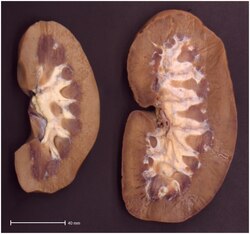
Compensatory growth is a type of regenerative growth that can take place in a number of human organs after the organs are either damaged, removed, or cease to function.1 Additionally, increased functional demand can also stimulate this growth in tissues and organs.2 The growth can be a result of increased cell size (compensatory hypertrophy) or an increase in cell division (compensatory hyperplasia) or both.3 For instance, if one kidney is surgically removed, the cells of the other kidney divide at an increased rate.1 Eventually, the remaining kidney can grow until its mass approaches the combined mass of two kidneys.1 Along with the kidneys, compensatory growth has also been characterized in a number of other tissues and organs including:
- The adrenal glands45
- The heart56
- Muscles5
- The liver57
- The lungs8
- The pancreas (beta cells and acinar cells)7
- The mammary glands5
- The spleen (where bone marrow and lymphatic tissue undergo compensatory hypertrophy and assumes the spleen function during spleen injury)5
- The testicles5
- The thyroid gland59
- The turbinates of the nose
A large number of growth factors and hormones are involved with compensatory growth, but the exact mechanism is not fully understood and probably varies between different organs.1 Nevertheless, angiogenic growth factors which control the growth of blood vessels are particularly important because blood flow significantly determines the maximum growth of an organ.1
Compensatory growth may also refer to the accelerated growth following a period of slowed growth, particularly as a result of nutrient deprivation.
References
References
- Widmaier, E. P.; Raff, H. & Strang, K. T. (2006). Vander's Human Physiology: The Mechanisms Of Body Function (10th ed.). Boston, Mass: McGraw-Hill Companies. pp. 383. ISBN 978-0-07-282741-5.
- Goss, R. (1965). "Kinetics of Compensatory Growth". The Quarterly Review of Biology. 40 (2): 123–146. doi:10.1086/404538. PMID 14338253. S2CID 19069765.
- "compensatory growth (biology) -- Britannica Online Encyclopedia". Retrieved 10 June 2011.
- Swale Vincent (1912). Internal secretion and the ductless glands. Arnold. p. 150. Retrieved 10 June 2011.
- Francis Delafield; Theophil Mitchell Prudden (1907). A text-book of pathology with an introductory section on post-mortem examinations and the methods of preserving and examining diseased tissues. William Wood and Company. pp. 61–62. Retrieved 10 June 2011.
- M. I. Gabriel Khan (5 December 2005). Encyclopedia of heart diseases. Academic Press. pp. 493–494. ISBN 978-0-12-406061-6. Retrieved 10 June 2011.
- Anthony Atala (2008). Principles of regenerative medicine. Academic Press. pp. 101–102. ISBN 978-0-12-369410-2. Retrieved 10 June 2011.
- Rannels, D. (1989). "Role of physical forces in compensatory growth of the lung". The American Journal of Physiology. 257 (4 Pt 1): L179–L189. doi:10.1152/ajplung.1989.257.4.L179. PMID 2679138.
- Harold Clarence Ernst (1919). The Journal of medical research. p. 199. Retrieved 10 June 2011.