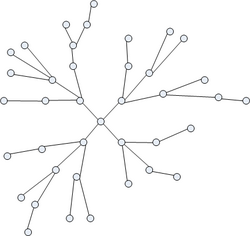
In the context of telecommunications, a terminal is a device which ends a telecommunications link and is the point at which a signal enters or leaves a network. Examples of terminal equipment include telephones, fax machines, computer terminals, printers and workstations.1
An end instrument is a piece of equipment connected to the wires at the end of a telecommunications link. In telephony, this is usually a telephone connected to a local loop.2 End instruments that relate to data terminal equipment include printers, computers, barcode readers, automated teller machines (ATMs) and the console ports of routers.345
See also
See also
References
References
- "Definition of Terminal - Gartner Information Technology Glossary". Gartner. Retrieved 16 March 2025.
- "Telephony terminal".
- Gnanasivam, P. (2005). Telecommunication switching and networks. New Delhi: New Age International. ISBN 81-224-1583-0. OCLC 762016601.
- P. Gnanasivam (2005). Telecommunication Switching and Networks. New Age International. p. 26. ISBN 978-81-224-1583-4.
- "Communications Terminal Definition". Law Insider. Retrieved 16 March 2025.