| European hamster | |
|---|---|

| |
| In Meidling cemetery, Vienna | |
Scientific classification 
| |
| Kingdom: | Animalia |
| Phylum: | Chordata |
| Class: | Mammalia |
| Infraclass: | Placentalia |
| Order: | Rodentia |
| Family: | Cricetidae |
| Subfamily: | Cricetinae |
| Genus: | Cricetus Leske, 1779 |
| Species: | C. cricetus
|
| Binomial name | |
| Cricetus cricetus | |

| |
| European hamster range (green) | |
| Synonyms2 | |
|
List
| |
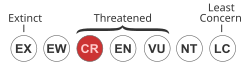
The European hamster (Cricetus cricetus), also known as the Eurasian hamster,3 black-bellied hamster4 or common hamster,561 is the only living species of hamster in the genus Cricetus.2 It is native to grassland and similar habitats in a large part of Eurasia, extending from Belgium to Xinjiang in China. Historically, it was considered a farmland pest and had been trapped for its fur. Its population has declined drastically in recent years and is now considered critically endangered.17 The main threats to the species are thought to be intensive agriculture, habitat destruction, and persecution by farmers.1
Description


The European hamster is the largest living hamster, reaching up to 20 to 30 centimetres (7.9 to 11.8 in) in length, with a tail 4–6 cm (1.6–2.4 in) long, with a body mass typically around 200 to 650 grams (7.1 to 22.9 oz), though exceptionally body masses of over 1 kg (2.2 lb) have been recorded. The colour of the body fur varies from being black on the belly, brown on the back, as well as white and cream on the nose, paws, cheeks, neck, and behind the forelimbs, with some rare colour variation being known. In the wild, female European hamsters generally live for 34 months (2 years 10 months) and up to 5 years, while males on average live for 31 months (2 years 7 months), and up to 4 years.8
Distribution and habitat
It is typically found in lowland areas with loam or loess-like soil and permeable bedrock below 500 metres (1,600 ft) altitude, naturally in relatively dry steppe-like habitats though it also inhabits similar human-modified habitat such as crop fields. It favours a continental climate. in areas It is found from Belgium and Alsace in eastern France in the west, to Russia and Xinjiang in northwest China in the east, and Bulgaria in the south, between 44°-59° N and the 5°-95° E.8 A significant population is found in Vienna Central Cemetery in Austria.9
Behaviour

The common hamster is often described as a nocturnal or crepuscular species, but it is also known to sometimes be active during the daytime.10 It lives in a complex burrow system, with a main chamber generally being connected to the surface by both a diagonal and vertical tunnel, with offshoot tunnels being used to store food or to defecate, with a single European hamster utilizing multiple burrows over the course of an active season. The vast majority of its diet is herbivorous, comprising of various vegetable matter including seeds, legumes, root vegetables and grasses, with a small part (10-13%) of its diet being from animal sources like earthworms, snails and insects. European hamsters sometimes engage in cannibalism, during stressed periods and/or times of high population density.8 It transports its food in its elastic cheek pouches to the food storage chambers. The storage chambers may be quite large and on average contain 2–3 kg (4.4–6.6 lb) of food, but exceptionally can be up to 65 kg (143 lb).1112 It hibernates between October and March. During this time, it wakes every five to seven days to feed from the storage chambers. They are usually solitary animals.11
When threatened, the European hamster rears up onto its hind legs, exposing its black underside, raises its hands and makes loud noises in an attempt to intimidate its opponent.13
Breeding
European hamsters are polygamous, with the males having no involvement in parental care and attempting to mate with as many females as they can. The species follows a r-selection life strategy, with early onset of sexual maturity and many offspring. Females reach sexual maturity at an age of 80 days, while males reach sexual maturity within 60 days, but generally do not breed until the year after their birth. Reproductively active males show descended testicles. The breeding period typically spans from April or May until August. Following mating, the vagina of females becomes sealed until the birth of the litter. Females generally produce two or occasionally three litters per breeding season, with each litter containing between 3 and 12 offspring. The gestation period is around 17-20 days for the first litter and sometimes up to 37 days for subsequent litters. Newborns are around 5 grams (0.18 oz), hairless and blind, with closed ears. They begin to consume non-milk food at 6 days of age. Hair grows within 5 days of birth, with eyes and ears opening 12 days after birth. Juveniles begin to leave the nest at around 25 days of age, with the parental bond disintegrating within three to five weeks of birth, with the mother moving on to a new burrow.8
Predators
European hamsters are predated upon by various predators, including carnivorous mammals such as weasel (Mustela nivalis), stoat (Mustela erminea), polecat (Mustela putorius), pine marten (Martes foina), badger (Meles meles) and red fox (Vulpes vulpes), as well as predatory birds, including buzzard (Buteo buteo), red kite (Milvus milvus), black kite (Milvus migrans) and eagle owl (Bubo bubo). In areas where it is abundant, it can form up to 50% of the diet of some birds of prey.8
Conservation
The Court of Justice of the European Union, the European Union's highest court, ruled in 2011 that France had failed to protect the European hamster.14 The government would be subject to fines of up to $24.6 million if France did not adjust its agricultural and urbanisation policies sufficiently to protect it.15 By 2014, France had started a captive-breeding programme, which aimed to release 500 European hamsters each year into fields that farmers were paid not to harvest.16
In 2020, the European hamster was classified as critically endangered across its global range on the IUCN Red List. The reasons for its drastic decline are not fully understood. It has been linked especially to habitat loss due to intensive agricultural practices and the building of roads that fragment populations, and to climate change, the historical fur trapping and to pollution; even light pollution appears to significantly reduce local populations, unless counterbalanced by other factors. Agriculture, development, and persecution are thought to be the biggest threats to the species.1
A significant benefit to existing conservation programs is that the European hamster breeds readily in captivity; captive breeding programs for the species exist in Belgium, France, Germany, Poland, Ukraine and elsewhere.17
References
References
- Banaszek, A.; Bogomolov, P.; Feoktistova, N.; La Haye, M.; Monecke, S.; Reiners, T. E.; Rusin, M.; Surov, A.; Weinhold, U. & Ziomek, J. (2020). "Cricetus cricetus". IUCN Red List of Threatened Species. 2020 e.T5529A111875852. doi:10.2305/IUCN.UK.2020-2.RLTS.T5529A111875852.en. Retrieved 12 November 2021.
- Musser, G. G.; Carleton, M. D. (2005). "Superfamily Muroidea". In Wilson, D. E.; Reeder, D. M. (eds.). Mammal Species of the World: A Taxonomic and Geographic Reference (3rd ed.). Johns Hopkins University Press. p. 1043. ISBN 978-0-8018-8221-0. OCLC 62265494.
- "Eurasian hamster". The Free Dictionary. Retrieved 26 April 2013.
- "Cricetus Cricetus – Common or Black-Bellied Hamster". AgroAtlas. Retrieved 26 April 2013.
- "Common Hamster: Cricetus Cricetus" (PDF). Habitats Directive. European Commission. Retrieved 26 April 2013.
- "hamster". Oxford Dictionaries. Oxford University Press. Archived from the original on 6 May 2014. Retrieved 26 April 2013.
- Dell'Amore, Christine (18 July 2020). "World's rarest wild hamster is now critically endangered". National Geographic.
- Weinhold U., 2008. Draft European Action Plan for the Conservation of the Common hamster (Cricetus cricetus, L. 1758), 2nd Version, 12 September 2008. Council of Europe Document T-PVS/Inf(2008)9.
- Seruga, Kaja (8 July 2025). "The Vienna cemetery where endangered species and biodiversity thrive". BBC Earth. Retrieved 10 June 2026.
- Flamand, Anna; Rebout, Nancy; Bordes, Camille; Guinnefollau, Lauréline; Bergès, Matthieu; Ajak, Fanny; Siutz, Carina; Millesi, Eva; Weber, Christiane; Petit, Odile (21 November 2019). Somers, Christopher M. (ed.). "Hamsters in the city: A study on the behaviour of a population of common hamsters (Cricetus cricetus) in urban environment". PLOS ONE. 14 (11): e0225347. Bibcode:2019PLoSO..1425347F. doi:10.1371/journal.pone.0225347. ISSN 1932-6203. PMC 6872164. PMID 31751416.
{{cite journal}}: CS1 maint: article number as page number (link) - MacDonald, David; Priscilla Barret (1993). Mammals of Britain & Europe. Vol. 1. London: HarperCollins. pp. 236–237. ISBN 0-00-219779-0.
- Weinhold, U. (8 July 2008), Draft European Action Plan For the conservation of the Common hamster (Cricetus cricetus, L. 1758), Convention on the Conservation of European Wildlife and Natural Habitats, Standing Committee, 28th meeting Strasbourg, 24–27 November 2008
- Chernova, O. F.; Khatsaeva, R. M.; Kupriyanov, V. P.; Feoktistova, N. Yu.; Surov, A. V. (December 2022). "Structural Features of the Skin, Hair, and Specific Skin Glands of the Common Hamster (Cricetus cricetus, Cricetidae, Rodentia)". Biology Bulletin. 49 (9): 1352–1365. Bibcode:2022BioBu..49.1352C. doi:10.1134/S1062359022090096. ISSN 1062-3590.
- "C-383/09 - Commission v France". InfoCuria. 9 June 2011.
- Erlanger, S. (2011). "France Is Scolded Over Care of Great Hamster of Alsace". The New York Times. Retrieved 10 June 2011.
- Rauber, P. (2014). "Wild Hamsters of Alsace". Sierra Club. Retrieved 2 July 2020.
- "World's rarest wild hamster is now critically endangered". Animals. 16 July 2020. Archived from the original on 26 February 2021. Retrieved 4 December 2022.
External links
External links
- Media related to Cricetus cricetus at Wikimedia Commons
- Data related to Cricetus cricetus at Wikispecies