| Hill mango | |
|---|---|
| |
Scientific classification 
| |
| Kingdom: | Plantae |
| Clade: | Embryophytes |
| Clade: | Tracheophytes |
| Clade: | Spermatophytes |
| Clade: | Angiosperms |
| Clade: | Eudicots |
| Clade: | Rosids |
| Order: | Sapindales |
| Family: | Burseraceae |
| Genus: | Commiphora |
| Species: | C. caudata
|
| Binomial name | |
| Commiphora caudata | |
| Synonyms1 | |
| |
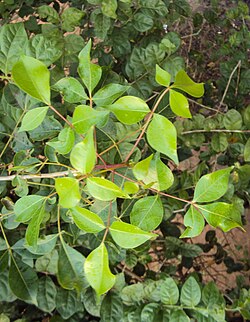
Commiphora caudata, the hill mango or green commiphora, is the most abundant Asian species of the genus Commiphora of flowering plants in the family Burseraceae. It is native to Southern India and Sri Lanka,1 usually growing in the full sun on hilly granite rock outcrops in dry zone areas. It is a small to medium-sized deciduous tree which may reach a height of 10-20m, but usually less.2 The tree has a smooth, succulent green bark, which partly flakes off with age, giving rise to a characteristic patchwork of green and brown patches. Its sap has a strong resinous scent. The tree has medicinal properties.3 The fruit is a globose fleshy drupe with 2 to 6 valves and 1 seed that is black and has 4 wings. Remnants of branches can form a kind of thorns on the trunk. The flowers have a greenish to cream-yellow pedestal with pink to red petals.4
References
References
- "Commiphora caudata (Wight & Arn.) Engl". Plants of the World Online. Royal Botanic Gardens, Kew. Retrieved 28 April 2026.
- Ashton et al Field Guide to the Common Trees and Shrubs of Sri Lanka p. 123, `India Diversity Portal: Commiphora caudata' at http://indiabiodiversity.org/species/show/266696 & 'Bihrmann's Caudiciforms: Commiphora caudata' at http://www.bihrmann.com/caudiciforms/subs/com-cau-sub.asp, http://indiabiodiversity.org/species/show/266696
- `Useful Tropical Plants: Commiphora caudata' http://tropical.theferns.info/viewtropical.php?id=Commiphora+caudata
- Ashton et al Field Guide to the Common Trees and Shrubs of Sri Lanka 1997: 123, 'Bihrmann's Caudiciforms: Commiphora caudata' at http://www.bihrmann.com/caudiciforms/subs/com-cau-sub.asp, `India Diversity Portal: Commiphora caudata' at http://indiabiodiversity.org/species/show/266696