

A comet tail is a projection of material from a comet that often becomes visible when illuminated by the Sun, while the comet passes through the inner Solar System. As a comet approaches the Sun, solar radiation causes the volatile materials within the comet to vaporize and stream out of the comet nucleus, carrying dust away with them.
Blown by the solar wind, these materials typically form two separate tails that extend outwards from the comet's orbit: the dust tail, composed of comet dust, and the gas or ion tail, composed of ionized gases. They become visible through different mechanisms: the dust tail reflects sunlight directly, while the gas tail glows because of the ionization.
Larger dust particles are less affected by solar wind and tend to persist along the comet's trajectory, forming a dust trail which, when seen from Earth in certain conditions, appears as an anti-tail (or antitail) extending in the opposite directions to the main tail.
Tail formation

In the outer Solar System, comets remain frozen and are extremely difficult or impossible to detect from Earth due to their small size. Statistical detections of inactive comet nuclei in the Kuiper belt have been reported from the Hubble Space Telescope observations,12 but these detections have been questioned,34 and have not yet been independently confirmed. As a comet approaches the inner Solar System, solar radiation causes the volatile materials within the comet to vaporize and stream out of the nucleus, carrying dust away with them. The streams of dust and gas thus released form a huge, extremely tenuous atmosphere around the comet called the coma, and the force exerted on the coma by the Sun's radiation pressure and solar wind cause an enormous tail to form, which points away from the Sun.
The streams of dust and gas each form their own distinct tails, pointing in slightly different directions. The tail of dust is left behind in the comet's orbit in such a manner that it often forms a curved tail called the antitail, only when it seems that it is directed towards the Sun. At the same time, the ion tail, made of gases, always points along the streamlines of the solar wind as it is strongly affected by the magnetic field of the plasma of the solar wind. The ion tail follows the magnetic field lines rather than an orbital trajectory. Parallax viewing from the Earth may sometimes mean the tails appear to point in opposite directions.5
Size
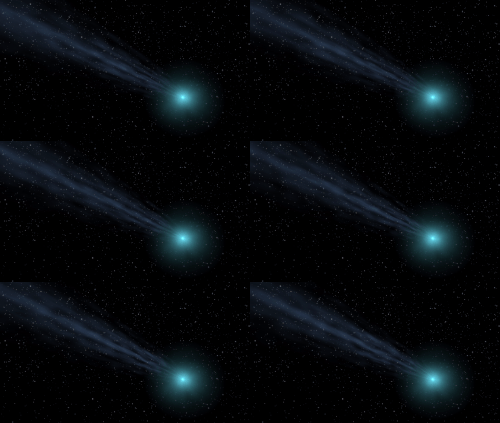
While the solid nucleus of comets is generally less than 30 km across, the coma may be larger than the Sun, and ion tails have been observed to extend 3.8 astronomical units (570 Gm; 350×10^6 mi).6
Structure of the ion tail

The structure of the ion tail is the result of complex interactions between the Sun and the comet. Ultraviolet radiation ionize molecules in the coma, forming plasma which in turn induces a magnetosphere around the comet. The comet and its induced magnetic field form an obstacle to solar wind particles. The comet is supersonic relative to the solar wind, so a bow shock is formed upstream of the comet (i.e. facing the Sun), in the flow direction of the solar wind. In this bow shock, large concentrations of cometary ions (called "pick-up ions") congregate and act to "load" the solar magnetic field with plasma. The field lines "drape" around the comet forming the ion tail.7: 898
Tail loss
If the ion tail loading is sufficient, then the magnetic field lines are squeezed together to the point where, at some distance along the ion tail, magnetic reconnection occurs. This leads to a "tail disconnection event".7 This has been observed on a number of occasions, notable among which was on April 20, 2007, when the ion tail of comet Encke was completely severed as the comet passed through a coronal mass ejection.8 This event was observed by the STEREO spacecraft.9 A disconnection event was also seen with C/2009 R1 (McNaught) on May 26, 2010.10
Analogues
Venus possesses a similar tail due to the induced magnetosphere formed by interaction of the solar wind with the venusian atmosphere. On January 29, 2013, ESA scientists reported that the ionosphere of the planet Venus streams outwards in a manner similar to "the ion tail seen streaming from a comet under similar conditions."1112 While Mercury lacks an atmosphere, the MESSENGER mission observed magnesium and sodium flowing off the planet, along the magnetic field lines trailing behind the planet, making them the primary components of Mercury's magnetotail.13
Dust Tail Structure


Dust particles emitted from a comet nucleus are acted upon by the attractive force of gravity, , and the repulsive force of solar radiation, . Both of the forces vary as the inverse square of the distance from the Sun. The net effect is that an emitted dust particle experiences and effective reduction in the force of gravity parameterized by and on leaving the neighborhood of the comet nucleus follows its own individual Keplerian orbit. Larger, heavier dust particles are less affected by solar radiation pressure and are characterized by smaller values of .
In 1968, Finson and Probstein14 developed a effective model for the observable properties of a comet tail. Their method relies on combining a function for the rate of dust production from the nucleus with functions for the size distribution of particles and their ejection velocity distribution.15 They applied their methods to comet C/1956 R1 (Arend-Roland).16 Their first paper laid out a framework for computing the trajectories of the comet and ejected dust particles. Sekanina employed this approach to successfully predict the appearance of anti-tails in comets C/1973 E1 (Kohoutek)17 and C/1975 V2 (Bradfield).1815
The Finson-Probstein (F-P) diagram on the right is for Comet Arend-Roland on April 28, 1957 about 2 days after the Earth crossed the comet's orbital plane. The view is looking down on the orbital plane. The solid lines are synchrones which represent streams of particles emitted at the same time with smaller, lighter particles (those with larger ) travelling further from the nucleus. The synchrones are labeled with the time in days since their emission. The dotted lines represent syndynes which connect dust particles with the same value of emitted at different times in the past. The synchrones are labeled with . The blue and orange arrows indicate the directions of the Earth and Sun respectively. The comet's orbital path is plotted in gray.
The other F-P diagram shows the view as seen from Earth. Both F-P diagrams were previously plotted by Sekanina19. Notice, from this perspective, that part of the dust tail appears in the sunward direction from the nucleus which produces an anti-tail. There is a considerable piling up of older synchrones producing the observed sharp edge on to the anti-tail. Younger synchrones are also crowded together while those of intermediate ages are spread out over a broad area of sky making the tail fainter in this region and giving the impression that the it is split into a main branch and a sunward branch.
Neck-Line Structure


Dust particles ejected isotropically from the comets nucleus follow their own Keplerian orbit, each specified by their own set of orbital elements. The orbits are, in general, inclined to the comet's orbital plane and the particles will initially move away from it. However, upon reaching a point in their orbit on the other side of Sun from where they were ejected, they will have returned and cross the orbital plane. This happens when the dust particle's true anomaly, , has increased by 180 ( radians) from its initial value on ejection. The crossing is described as reaching its second node. This behavior is represented stylistically in the diagram. In it the Sun is the orange ball and the comet's nucleus is shown in green. The orbital plane is shaded blue and the comet's orbital is shown in gray. The ejected shell of dust particles remains spherical for only a short period of time and soon becomes ellipsoidal. While continuing to expand in directions parallel to the orbital plane it reaches a maximum extent perpendicular to the plane before contracting to become a planar ellipse as the dust particles pass through the orbital plane at their second nodes. After that the ellipsoid again expands. The animation shows a Monte-Carlo simulation for a shell of 2,000 dust particles with =0.03 ejected by C/1956 R1 (Arend-Roland) at a speed of 360 m/s on 17 March, 1957 at 21:36 UT as seen by an observer following the comet outside of its orbit and looking in the direction of the Sun. The time since ejection, , and true anomaly, , are displayed.20
Shells of dust particles with different values of form their own distinct planar ellipses slightly displaced from one another and are known collectively as the neck-line structure (NLS). A couple of notable features of these ellipses. Its outer edge is formed by particles ejected parallel to the orbital plane. A particle with the same value of emitted from the nucleus at zero relative velocity would lie in the geometric center of the ellipse. The center of the ellipse therefore sits at the intersection of the associated synchrone and syndyne. Typically therefore much of the NLS is embedded in the normal dust tail. The NLS can only form after perihelion passage and its flatness means that it is best seen as the Earth crosses the comet's orbital plane.

The F-P diagram for comet C/2023 A3 (Tsuchinshan-ATLAS) is shown for 14 October, 2024 at 18:30 UT when the Earth crossed its orbital plane. Also shown are red, orange, yellow, green and blue planar ellipses for dust particles with = 0.01, 0.02, 0.03, 0.04 and 0.05 respectively ejected 64.5 days earlier. Most of the NLS lies outside of the comet's orbit (on the anti-sunward side), but some of the heaviest dust particles lie in a shorter spike on the sunward side. The sunward spike is short (a few arc mins to half a degree) while the tailward feature can be much longer (several degrees)21. Pansecchi et al22 coined the term sunward spike (SWS) for that part of the NLS falling on the sunward side of the orbit and ray-shaped structure (RSS) for the remainder. Because it is generally seen projected on the normal dust tail early attempts required careful microdensitometer measurements of photographic plates.2223
Anti-tail

The anti-tail is a needle-like feature that sometimes appears to extend from the coma towards the Sun, and therefore in the opposite direction to the gas and dust tails. The anti-tail typically consists of older dust particles ejected from the nucleus in the preceding weeks which remain close to the comet's orbital plane, forming a thin sheet of material. This material is normally too faint to be observed, but as Earth passes through the plane, the sheet is seen side-on and briefly becomes visible. Under favorable viewing conditions, the relative position of Earth, Sun, and the comet is such that part of the sheet is optically projected in front of the coma, appearing as the characteristic sunward spike.21 24
Most comets do not develop sufficiently for an anti-tail to become visible, but notable comets that did display anti-tails include Arend–Roland in 1957,25 Kohoutek in 1973,26 Hale–Bopp in 1997, C/1999 H1 (Lee) in 1999,27 Lulin in 2009, PANSTARRS and C/2022 E3 (ZTF) in 2023,28 12P/Pons–Brooks and C/2023 A3 Tsuchinshan–ATLAS in 2024,2930 and 3I/ATLAS in 2025.31 32
References
References
- Cochran, A. L.; Levison, H. F.; Stern, S. A.; Duncan, J. (1995). "The Discovery of Halley-sized Kuiper Belt Objects Using the Hubble Space Telescope". The Astrophysical Journal. 455: 342. arXiv:astro-ph/9509100. Bibcode:1995ApJ...455..342C. doi:10.1086/176581. S2CID 118159645.
- Cochran, A. L.; Levison, H. F.; Tamblyn, P.; Stern, S. A.; Duncan, J. (1998). "The Calibration of the Hubble Space Telescope Kuiper Belt Object Search: Setting the Record Straight". Astrophysical Journal Letters. 503 (1): L89. arXiv:astro-ph/9806210. Bibcode:1998ApJ...503L..89C. doi:10.1086/311515. S2CID 18215327.
- Brown, Michael E.; Kulkarni, S. R.; Liggett, T. J. (1997). "An Analysis of the Statistics of the Hubble Space Telescope Kuiper Belt Object Search". Astrophysical Journal Letters. 490 (1): L119. Bibcode:1997ApJ...490L.119B. doi:10.1086/311009.
- Jewitt, David C.; Luu, Jane; Chen, J. (1996). "The Mauna Kea-Cerro-Tololo (MKCT) Kuiper Belt and Centaur Survey". The Astronomical Journal. 112 (3): 1225. Bibcode:1996AJ....112.1225J. doi:10.1086/118093.
- McKenna, M. (May 20, 2008). "Chasing an Anti-Tail". Astronomy Sketch of the Day. Retrieved February 25, 2009.
- Yeomans, Donald K. (2005). "Comet". World Book Online Reference Center. World Book. Archived from the original on April 29, 2005. Retrieved December 27, 2008.
- Carroll, B. W.; Ostlie, D. A. (1996). An Introduction to Modern Astrophysics. Addison-Wesley. ISBN 978-0-201-54730-6.
- "The Sun Rips Off a Comet's Tail". Science@NASA. October 1, 2007. Archived from the original on November 4, 2009. Retrieved October 20, 2009.
- Eyles, C. J.; Harrison, R. A.; Davis, C. J.; Waltham, N. R.; Shaughnessy, B. M.; Mapson-Menard, H. C. A.; Bewsher, D.; Crothers, S. R.; Davies, J. A.; Rochus, P. (2009). "The Heliospheric Imagers Onboard the STEREO Mission". Solar Physics. 254 (2): 387–445. Bibcode:2009SoPh..254..387E. doi:10.1007/s11207-008-9299-0. hdl:2268/15675. S2CID 54977854.
- "Comet C/2009 R1 (McNaught) - Animation & Images". Remanzacco Observatory. May 30, 2010. Retrieved June 7, 2011.
- Staff (January 29, 2013). "When A Planet Behaves Like A Comet". ESA. Retrieved January 31, 2013.
- Kramer, Miriam (January 30, 2013). "Venus Can Have 'Comet-Like' Atmosphere". Space.com. Retrieved January 31, 2013.
- McClintock 2009, p. 610–611
- Finson, Michael L.; Probstein, Ronald F. (1 October 1968). "A Theory of Dust Comets. I. Model and Equations". The Astrophysical Journal. 154 (1): 327–352. doi:10.1086/149761.
- Fulle, M. (January 1987). "A new approach to the Finson-Probstein method of interpreting cometary dust tails". Astronomy and Astrophysics. 171 (1–2): 327–335. Bibcode:1987A&A...171..327F. ISSN 0004-6361.
- Finson, Michael L.; Probstein, Ronald F. (1 October 1968). "A Theory of Dust Comets. II. Results for Comet Arend-Roland". The Astrophysical Journal. 154 (1): 353–380. doi:10.1086/149761.
- Sekanina, Zdeněk (June 1974). "The Prediction of Anomalous Tails of Comets". Sky & Telescope. 47: 374–376.
- Sekanina, Zdeněk; Pansecchi, Luigi (1977). "The Anti-Tail of Comet Bradfield (1975p)". Astrophysical Letters. 18: 61–63.
- Sekanina, Zdeněk (June 1974). "The Prediction of Anomalous Tails of Comets". Sky & Telescope. 47: 374–376.
- Kimura, Hiroshi; Liu, Cai-pin (December 1977). "On the Structure of Cometary Dust Tails". Chinese Astronomy. 1: 235–264. doi:10.1016/0146-6364(77)90004-4.
- Boehnhardt, Hermann (2003). "The Anti-Tail of Comet C/1995 O1 (Hale–Bopp) in 1997/1998" (PDF). Earth, Moon, and Planets. 93 (1): 19–35. Bibcode:2003EM&P...93...19B. doi:10.1023/B:MOON.0000034496.28985.ef. Retrieved 17 October 2024.
- Pansecchi, L.; Fulle, M.; Sedmak, G. (1 April 1987). "The nature of two anomalous structures observed in the dust tail of Comet Bennett 1970 II: a possible Neck-Line Structure". Astronomy and Astrophysics. 176: 353–380.
- Pansecchi, L.; Fulle, M. (November 1990). "A Neck-Line Structure in the dust tail of the Great January Comet 1910I". Astronomy and Astrophysics. 239: 358–366.
- Rao, Joe (6 February 2009). "Newfound Comet Lulin to Grace Night Skies". SPACE.com. Archived from the original on 26 February 2009. Retrieved 2009-02-25.
- David Darling (2016). "Encyclopedia of science:antitail".
- Naugles, John E. (7 March 1974). "Statement of John E. Naugle, Associate Administrator for Space Science, NASA: Comet Kohoutek Program". Committee on Science and Astronautics U.S. House of Representatives. Hearings Before the Subcommittee on Space Science and Applications. 25 (3). Washington DC: 401. Retrieved 2021-11-10.
[drawing on page 403] the Skylab crewmen observed a brilliant spike or anti tail projecting toward the Sun from the head of Kohoutek [...] Dr Zdenek Sekanina concluded that the spike was not wholly due to a perspective or geometrical effect as has been assumed in previous comet studies.
- Kammerer, Andreas. "Analysis of past comet apparitions – C/1999 H1 (Lee)". Retrieved 2023-11-24.
- Harry Baker (2023-01-27). "Optical illusion gives rare green comet an 'anti-tail' that seemingly defies physics". Space.com. Retrieved 2023-01-28.
- Adrien (2024-06-15). ""The Devil's Comet reveals... an anti-tail"". techno-science.net. Retrieved 2024-10-15.
- Bob King (2024-10-15). ""Comet Tsuchinshan-ATLAS climbs, brigthens and delights!"". SkyAndTelescope.org. Retrieved 2024-10-15.
The comet displayed a strikingly narrow antitail the night of October 14th
- Opitom, Cyrielle; Snodgrass, Colin; Jehin, Emmanuel; Bannister, Michele T.; Bufanda, Erica; Deam, Sophie E.; et al. (7 July 2025). "Snapshot of a new interstellar comet: 3I/ATLAS has a red and featureless spectrum". Monthly Notices of the Royal Astronomical Society. 544 (1): L31–L36. arXiv:2507.05226. Bibcode:2025MNRAS.544L..31O. doi:10.1093/mnrasl/slaf095.
this approximately sunward feature is reminiscent of the distant activity of other comets
- Keto, Eric; Loeb, Abraham (9 September 2025). "The Physics of Cometary Anti-tails as Observed in 3I/ATLAS". Monthly Notices of the Royal Astronomical Society. 545 (1) staf2054. arXiv:2509.07771v1. Bibcode:2026MNRAS.545S2054K. doi:10.1093/mnras/staf2054.
This type of anti-tail, not a result of perspective, may not have been previously observed. We explain the anti-tail as an anisotropic extension of the snow line, or survival radius of a sublimating ice grain, in the direction of the Sun.
External links
External links
- Finson-Probstein diagrams for comets viewed from Earth can be produced online using J.-B. Vincent's Comet-toolbox
- Comets page at NASA's Solar System Exploration
- International Comet Quarterly at Harvard.edu
- 1957 photo of Comet Arend–Roland showing a prominent anti-tail