| Horseshoe whip snake | |
|---|---|
| |
Scientific classification 
| |
| Kingdom: | Animalia |
| Phylum: | Chordata |
| Class: | Reptilia |
| Order: | Squamata |
| Suborder: | Serpentes |
| Family: | Colubridae |
| Genus: | Hemorrhois |
| Species: | H. hippocrepis
|
| Binomial name | |
| Hemorrhois hippocrepis (Linnaeus, 1758)
| |

| |
| Synonyms23 | |
The horseshoe whip snake (Hemorrhois hippocrepis) is a species of snake in the family Colubridae. The species is native to southwestern Europe and northwestern Africa.
Description

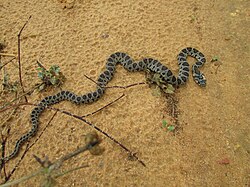
Adults of H. hippocrepis may attain a total length, including tail, of 1.5 to 1.8 m (5 to 6 feet), with no sexual dimorphism in body size.45 Its body is slender the head being wider than the neck. The eye is large, with a round pupil and a row of small scales below it. The smooth dorsal scales are arranged in 25-29 rows, and the ventrals number 220–258. Dorsally, it has a series of large spots which are either blackish or dark brown edged with black. There is a series of alternating smaller dark spots on each side. The lighter ground color between the spots may be yellowish, olive, or reddish. The dark spots are closely spaced, giving the appearance of a dark snake with a light pattern resembling a chain or a series of letters X. There is a light horseshoe-shaped mark on the neck and back of head.5
Geographic range
H. hippocrepis is found in Algeria, Morocco and Tunisia in North Africa, in southern and central Portugal, southern, eastern and central Spain, Gibraltar, southern Sardinia and Pantelleria Island in Europe.1 Since the early 2000s it has been reported in the Balearic Islands of Mallorca, Ibiza and Formentera. It is hypothesized to have been introduced by way of imported olive trees from mainland Spain. The species is thriving there and can grow larger than on the mainland.6789
Habitat
The natural habitats of H. hippocrepis are Mediterranean-type shrubby vegetation, rocky areas, rocky shores, sandy shores, arable land, pastureland, plantations, rural gardens, and urban areas.1
Reproduction
H. hippocrepis is oviparous. Its reproductive cycle is seasonal, with oviposition occurring in early summer and hatching in late summer. Most sexually mature females reproduce once per year. The cycle is relatively fast, with a complete cycle including vitellogenesis, ovulation, shelling and oviposition lasting approximately two months. A 1999 study found the mean clutch size to be 6.8 eggs and a positive correlation between fertility and female body size. 4
Subspecies
Two subspecies are recognized as being valid, including the nominotypical subspecies.3
- Hemorrhois hippocrepis hippocrepis (Linnaeus, 1758)
- Hemorrhois hippocrepis nigrescens (Cattaneo, 1985) Pantelleria
Nota bene: A trinomial authority in parentheses indicates that the subspecies was originally described in a genus other than Hemorrhois.
Conservation status
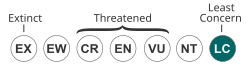
The horseshoe whip snake is assessed as being of "Least Concern" by the International Union for Conservation of Nature in its Red List of Threatened Species. Its population trend is thought to be steady, and it is able to adapt to modified habitats. Threats it faces include being run over by traffic, poisoned by agricultural chemicals and being captured for use by local snake charmers.1
References
References
- Jose Antonio Mateo Miras, Marc Cheylan, M. Saïd Nouira, Ulrich Joger, Paulo Sá-Sousa, Valentin Pérez-Mellado, Iñigo Martínez-Solano, Roberto Sindaco, Antonio Romano (2009). "Hemorrhois hippocrepis". IUCN Red List of Threatened Species. 2009 e.T61509A12495496. doi:10.2305/IUCN.UK.2009.RLTS.T61509A12495496.en. Retrieved 17 November 2021.
{{cite journal}}: CS1 maint: multiple names: authors list (link) - Boulenger GA (1893). Catalogue of the Snakes in the British Museum (Natural History). Volume I. Containing the Families ... Colubridæ Aglyphæ, part. London: Trustees of the British Museum (Natural History). (Taylor and Francis, printers). xiii + 448 pp. + Plates I-XXVIII. (Zamenis hippocrepis, pp. 409-410).
- Species Hemorrhois hippocrepis at The Reptile Database
- Pleguezuelos, Juan M.; Feriche, Mónica (1999). "Reproductive Ecology of the Horseshoe Whip Snake (Coluber hippocrepis) in the Iberian Peninsula". Journal of Herpetology. 33 (2): 202–207. doi:10.2307/1565715. Retrieved 27 April 2026.
- Arnold EN, Burton JA (1978). A Field Guide to the Reptiles and Amphibians of Britain and Europe. London: Collins. 272 pp., 40 color plates. ISBN 0-00-219318-3. (Coluber hippocrepis, pp. 191, 193-194 + Plate 34, Figure 4).
- Mar Leza et al, January 2015. "First finding in Mallorca of a horseshoe whip snake Hemorrhois hippocrepis in the stomach contents of a grey heron Ardea cinerea"
- Ulla Rahn-Huber, 23 July 2020. "The Snakes on Mallorca"
- Elba Montes et al. Current Zoology, Volume 66, Issue 4, August 2020, Pages 363–371. "Reproduction ecology of the recently invasive snake Hemorrhois hippocrepis on the island of Ibiza"
- Ellie Shechet, August 24, 2020. "A Plague on Ibiza"
Further reading
Further reading
- Cattaneo A (1985). "Il colubro ferro di cavallo dell'Isola di Pantelleria: Coluber hippocrepis nigrescens subsp. nova (Reptilia Squamata Colubridae)". Atti della Società italiana di Scienze naturali del Museo civico di Storia naturale di Milano 126 (3-4): 165–184. (Coluber hippocrepis nigrescens, new subspecies). (in Italian, with an abstract in English).
- Linnaeus C (1758). Systema naturæ per regna tria naturæ, secundum classes, ordines, genera, species, cum characteribus, differentiis, synonymis, locis. Tomus I. Editio Decima, Reformata. Stockholm: L. Salvius. 824 pp. (Coluber hippocrepis, new species, p. 226). (in Latin).
- Utiger U, Helfenberger N, Schätti B, Schmidt C, Ruf M, Ziswiler V (2002). "Molecular Systematics and Phylogeny of Old World Ratsnakes, Elaphe Auct., and Related Genera (Reptilia, Squamata, Colubridae)". Russian Journal of Herpetology 9 (2): 105–124. (Hemorrhois hippocrepis). (in English).