| Collared petrel | |
|---|---|
| |
Scientific classification 
| |
| Kingdom: | Animalia |
| Phylum: | Chordata |
| Class: | Aves |
| Order: | Procellariiformes |
| Family: | Procellariidae |
| Genus: | Pterodroma |
| Species: | P. brevipes
|
| Binomial name | |
| Pterodroma brevipes (Peale, 1849)
| |
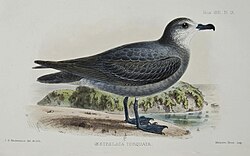
The collared petrel (Pterodroma brevipes) is a species of seabird in the family Procellariidae. It is sometimes regarded as a subspecies of Gould's petrel (P. leucoptera).
Its breeding range is uncertain and it is currently known to breed only in Fiji where it occurs on Gau and possibly other islands. It formerly bred in the Cook Islands and may still breed in Vanuatu and the Solomon Islands. It is an unconfirmed breeder in Samoa, American Samoa and French Polynesia.
It nests on steep, forested slopes in a burrow or among tree roots. It feeds in open seas and some disperse into the central Pacific outside the breeding season.
The population from Vanuatu was considered to be a new subspecies Pterodroma brevipes magnificens in 2010.2
The species is thought to vagrate poleward in response to warmer-than-average sea surface temperatures, suggesting that it may be expanding its foraging range in response to global warming.3
References
References
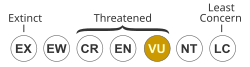
- BirdLife International (2018). "Pterodroma brevipes". IUCN Red List of Threatened Species. 2018 e.T22697987A132617265. doi:10.2305/IUCN.UK.2018-2.RLTS.T22697987A132617265.en. Retrieved 12 November 2021.
- Pterodroma brevipes magnificens (Bretagnolle & Shirihai, 2010): Banks Islands, Vanuatu. Bull BOC 130(4).
- Gorta, Simon B. Z.; Allen, Peter; Kingsford, Richard T.; Berryman, Alex J.; Davies, Jeff; Roderick, Mick; Clarke, Rohan H. (January 30, 2026). "Environmental drivers of gadfly petrel vagrancy in the Southwest Pacific". Ibis. 168 (2): 616–632. doi:10.1111/ibi.70027. ISSN 0019-1019.