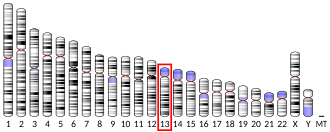



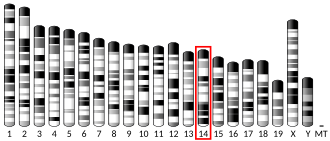

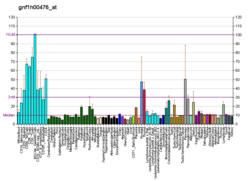
Conserved oligomeric Golgi complex subunit 3 is a protein that in humans is encoded by the COG3 gene.56
The protein encoded by this gene has similarity to a yeast protein. It seems to be part of a peripheral membrane protein complex localized on cis/medial Golgi cisternae where it may participate in tethering intra-Golgi transport vesicles.6
Interactions
COG3 has been shown to interact with COG27 and COG1.7
References
References
- GRCh38: Ensembl release 89: ENSG00000136152 – Ensembl, May 2017
- GRCm38: Ensembl release 89: ENSMUSG00000034893 – Ensembl, May 2017
- "Human PubMed Reference:". National Center for Biotechnology Information, U.S. National Library of Medicine.
- "Mouse PubMed Reference:". National Center for Biotechnology Information, U.S. National Library of Medicine.
- Ungar D, Oka T, Brittle EE, Vasile E, Lupashin VV, Chatterton JE, Heuser JE, Krieger M, Waters MG (April 2002). "Characterization of a mammalian Golgi-localized protein complex, COG, that is required for normal Golgi morphology and function". The Journal of Cell Biology. 157 (3): 405–15. doi:10.1083/jcb.200202016. PMC 2173297. PMID 11980916.
- "Entrez Gene: COG3 component of oligomeric golgi complex 3".
- Loh E, Hong W (June 2002). "Sec34 is implicated in traffic from the endoplasmic reticulum to the Golgi and exists in a complex with GTC-90 and ldlBp". The Journal of Biological Chemistry. 277 (24): 21955–61. doi:10.1074/jbc.M202326200. PMID 11929878.
External links
External links
- Human COG3 genome location and COG3 gene details page in the UCSC Genome Browser.
Further reading
Further reading
- Maruyama K, Sugano S (January 1994). "Oligo-capping: a simple method to replace the cap structure of eukaryotic mRNAs with oligoribonucleotides". Gene. 138 (1–2): 171–4. doi:10.1016/0378-1119(94)90802-8. PMID 8125298.
- Andersson B, Wentland MA, Ricafrente JY, Liu W, Gibbs RA (April 1996). "A "double adaptor" method for improved shotgun library construction". Analytical Biochemistry. 236 (1): 107–13. doi:10.1006/abio.1996.0138. PMID 8619474.
- Yu W, Andersson B, Worley KC, Muzny DM, Ding Y, Liu W, Ricafrente JY, Wentland MA, Lennon G, Gibbs RA (April 1997). "Large-scale concatenation cDNA sequencing". Genome Research. 7 (4): 353–8. doi:10.1101/gr.7.4.353. PMC 139146. PMID 9110174.
- Suzuki Y, Yoshitomo-Nakagawa K, Maruyama K, Suyama A, Sugano S (October 1997). "Construction and characterization of a full length-enriched and a 5'-end-enriched cDNA library". Gene. 200 (1–2): 149–56. doi:10.1016/S0378-1119(97)00411-3. PMID 9373149.
- Kim DW, Sacher M, Scarpa A, Quinn AM, Ferro-Novick S (October 1999). "High-copy suppressor analysis reveals a physical interaction between Sec34p and Sec35p, a protein implicated in vesicle docking". Molecular Biology of the Cell. 10 (10): 3317–29. doi:10.1091/mbc.10.10.3317. PMC 25597. PMID 10512869.
- VanRheenen SM, Cao X, Sapperstein SK, Chiang EC, Lupashin VV, Barlowe C, Waters MG (November 1999). "Sec34p, a protein required for vesicle tethering to the yeast Golgi apparatus, is in a complex with Sec35p". The Journal of Cell Biology. 147 (4): 729–42. doi:10.1083/jcb.147.4.729. PMC 2156162. PMID 10562277.
- Suvorova ES, Kurten RC, Lupashin VV (June 2001). "Identification of a human orthologue of Sec34p as a component of the cis-Golgi vesicle tethering machinery". The Journal of Biological Chemistry. 276 (25): 22810–8. doi:10.1074/jbc.M011624200. PMID 11292827.
- Loh E, Hong W (June 2002). "Sec34 is implicated in traffic from the endoplasmic reticulum to the Golgi and exists in a complex with GTC-90 and ldlBp". The Journal of Biological Chemistry. 277 (24): 21955–61. doi:10.1074/jbc.M202326200. PMID 11929878.
- Gevaert K, Goethals M, Martens L, Van Damme J, Staes A, Thomas GR, Vandekerckhove J (May 2003). "Exploring proteomes and analyzing protein processing by mass spectrometric identification of sorted N-terminal peptides". Nature Biotechnology. 21 (5): 566–9. doi:10.1038/nbt810. PMID 12665801. S2CID 23783563.
- Loh E, Hong W (June 2004). "The binary interacting network of the conserved oligomeric Golgi tethering complex". The Journal of Biological Chemistry. 279 (23): 24640–8. doi:10.1074/jbc.M400662200. PMID 15047703.