| Cockington | |
|---|---|
 | |
Cockington Location within Devon | |
| Population | 10,636 (ward 2011)1 |
| OS grid reference | SX8963 |
| Unitary authority | |
| Ceremonial county | |
| Region | |
| Country | England |
| Sovereign state | United Kingdom |
| Post town | Torquay |
| Postcode district | TQ2 |
| Dialling code | 01803 |
| Police | Devon and Cornwall |
| Fire | Devon and Somerset |
| Ambulance | South Western |
| UK Parliament | |
Cockington is a village near Torquay, in the Torbay district, in the ceremonial county of Devon, England. Cockington with Chelston had a population of 8,366 in 2021.2 It has old cottages within its boundaries, and is about two miles from the centre of Torquay.
History


Name and early evidence
Several theories have been advanced to explain the place-name Cockington. Arthur Ellis recorded in 1930 that one authority writing in 1750 explained it as "a place of great cock fighting", while another local historian believed it derived from "the ham or settlement of the Cooks".3 The Devon historian Richard Worth proposed "the enclosure of the red meadow", derived from the Celtic word coch, meaning red, combined with the Old English words ing, meaning meadow, and ton, meaning enclosure or settlement.4 Gover et al. described it in 1931 as Old English for "Cocca's farm", with a similar interpretation being "the tun of the people of Cocca".4 Watkin proposed "settlement of or adjacent to the springs", while a further interpretation combines Old English cocc, meaning woodcock or wild bird, with Old English ing tun, meaning a place associated with.4
Historical spellings include Cochintone and Chochintona in the Domesday Book of 1086; Cokinton in 1199; Kokyntone in a charter of St Dogmaels Abbey in 1203; Cokemanton and Cokyngton in the Devon Feet of Fines in 1222–23; Kokinton and Kokington in the 13th century; Cokyntone in the 14th century; Cokynton in 1450; and Cossington, Cockyngton, Cokkyngton and Cockkington in the 17th century.4
Archaeological finds indicate activity in the Cockington area from prehistoric times, but do not establish a continuous settlement from the Iron Age. In 1867, three Neolithic stone axe-heads were uncovered in the garden of Chelston Towers, now held at Torquay Museum. Two are igneous stone from Balstone Down in south-east Cornwall, and the third is greenstone. In 1987, a scatter of flint scrapers with possible Mesolithic, Neolithic or Bronze Age attribution was found at Cockington Woods Farm.4 A fragmented Bronze Age basal-looped leaf-shaped bronze spearhead was found at neighbouring Kingsland in the 1960s, and is now in Torquay Museum. A possible cairn has also been noted at Stantor Barton.4
Two possible Iron Age British hillcamps have been identified in the parish. The first is at Castle Park, also known as Church Plantation, on the southern side of Cockington Church, though whether the earthworks are Iron Age or the product of later landscaping remains debated. The second possible site is near Seaway Lane, which was known as Castle Lane between 1773 and the 19th century, a name likely alluding to a hillcamp. The inhabitants would have been the Dumnonii, the local Celtic tribe. The field name "Walborough" is derived from Old English weard-setl, meaning guard-house, combined with burh, meaning defended place.4
Three Roman coins have been found near Cockington village: a Gordian III antoninianus from AD 238–244, a Hostilian antoninianus from AD 251, and a Constantine I reduced follis from AD 307–337. All are now in Torquay Museum. A midden of oyster and cockle shells, indicating a Romano-British habitation site, was uncovered in the early 1960s during excavation near Armada Park, Chelston.4
A 9th-century copper-alloy zoomorphic strap-end, found at Watercombe, is the principal surviving evidence of Anglo-Saxon occupation in the parish. The Domesday Book records that the manor was held by Alric the Saxon "on the day King Edward was alive and dead", meaning until the Norman Conquest of 1066.4
Domesday and medieval manor
The Domesday Book of 1086 records Cockington under the name Chochintona, held by William de Falaise, a Norman who had purchased it from William Hostiarius before the survey. The entry records the manor as rendering geld for three hides, workable by thirteen ploughs. Resources included villeins, six bordars, fourteen serfs, one pack horse, eight cattle, fifty acres of pasture and fifty acres of woodland. The manor was valued at fifty shillings.4
Around 1087–1113, the manor passed to Robert Fitz Martin. In 1130, Fitz Martin bestowed it upon his younger son Roger, retaining the chapel and two farthings of land separately. Roger renounced the name Fitz Martin in favour of de Cockington, founding a family that held the manor for about 220 years.4 After the death of Roger de Cockington VI in 1316, his three sons divided the manor between them. The de Cockington line ended in 1351 when the manor passed to Sir Walter de Wodeland, knighted by the Black Prince in 1350.4
Cary family
In 1371, Sir Walter's widow sold the manor to Sir William Cary, the first of a family that would hold Cockington, with breaks, for 236 years.4 Sir John Cary, a King's Bench judge under Richard II, gave legal advice supporting the King's claim to absolute royal power. He was tried for high treason at the Merciless Parliament on 6 March 1388, convicted, and banished to Ireland for life, confined within 3 km of Waterford on an annual allowance of £20. His estates were forfeited for thirty years, from 1388 to 1418, passing first to John, Earl of Huntingdon in 1388, then to Sir Robert Chalonus in 1400, before being restored to the Carys by Henry V in 1418.4
Sir William Cary II, a Lancastrian supporter of Margaret of Anjou, was captured at the Battle of Tewkesbury on 4 May 1471 and beheaded. His estates were confiscated by Edward IV and granted to Sir Thomas Bourchier, before being restored by Henry VII following the Battle of Bosworth in 1485, after fourteen years of forfeiture.4
Sir Henry Cary, knighted by Charles I in 1644 for raising a Royalist regiment, surrendered Kingswear Castle to Parliamentary forces in 1646 and was fined £1,985. Unable to meet his debts, he sold Cockington in December 1654 to Roger Mallock for £10,300, ending 236 years of Cary ownership.4
Two late 16th or early 17th-century gold finger-rings were found in Ladypark, behind Cockington Court: a bezel ring set with rubies, with a diamond now missing, and a posy ring inscribed No treasure to a true frend. These are believed to have belonged to Wilmota Cary, wife of Sir George Cary, who died in 1581, or one of her three daughters. Both rings are now in Torquay Museum.4
Mallock family
Roger Mallock, an Exeter merchant and Royalist, purchased Cockington from Sir Henry Cary for £10,300 in December 1654, founding a family that held the estate until the 20th century.54
A succession of Mallock owners followed. Roger was succeeded by his son Rawlyn Mallock, a Devon MP who supported the Whig movement and was among the local gentry who welcomed William of Orange at Brixham on 5 November 1688. Rawlyn Mallock II died unmarried in 1700, and the estate passed to Rawlyn Mallock III, then to Rawlyn Mallock IV. A different branch of the family later inherited Cockington through the Reverend Samuel Mallock, Rector of Trusham, and his son Roger Mallock.4
The local government of the Parish of Cockington became the responsibility of Newton Abbot Rural District Council in 1875. Cockington Local Board, later renamed Cockington District Council, administered the parish. Under the Torquay Borough Extension Act of 9 November 1900, the urban portion of the parish, including Chelston and most of Cockington, merged with Torquay and formed Chelston Ward. Cockington Village transferred to Torquay in 1928, marked by a ceremony of welcome at Cockington Court on 1 October 1928. The new Torbay Borough Council, formed on 1 April 1968, absorbed the Parish of Cockington along with the rest of Torquay.4
In May 1932, Richard Herbert Mallock sold most of the estate to Cockington Trust Ltd for £50,000. The company leased Cockington Court and about 10 hectares of land to Torquay Borough Council for 999 years. The council acquired the freehold in June 1932.4
Cockington Trust Ltd commissioned Edwin Lutyens to redesign Cockington as a model village, with plans for shops, dwellings, craft workshops and an inn. A brochure to this effect was produced in 1935. Of the twenty thatched and limewashed buildings envisaged, only the Drum Inn opened on 23 May 1936. The rest of the scheme was not completed, as funds ran out and the Second World War intervened.4
Later estate management
During the Second World War, the Prudential Assurance Company evacuated its London staff to Torquay. In 1946, when the council lacked funds to maintain the village properties, Cockington Trust auctioned the village as a job lot. The Prudential purchased the lot while the council retained Cockington Court and approximately 300 acres.6 The Prudential acted as stewards rather than developers, maintaining the thatched cottages and appointing a resident village warden to oversee day-to-day management. In 1991, the estate was designated a country park through a joint arrangement between the Prudential and Torbay Council. The Prudential gradually sold off its interests during the 1990s.6
Management of the estate passed to the Torbay Coast & Countryside Trust in 2000. In October 2025, the Trust announced that it was ceasing to trade and going into liquidation.7 Torbay Council stated that the Trust formally entered creditors' voluntary liquidation in December 2025, and that the council had taken back management of the land and buildings it owned and had previously leased to the Trust.8
Buildings
There are several buildings of note in Cockington.
Cricket Pavilion and grounds

The park which is now home to the cricket grounds was originally a medieval deer park. Cricket started to be played on it in 1947. The current cricket pavilion was built after the original burnt down in the 1990s.
Drum Inn
The Grade II listed thatched Drum Inn9 is the local public house and restaurant in Cockington. Designed by Sir Edwin Lutyens, it opened in 1936 and cost £7,000 to build. Covering 522 square metres, it uses 16th century styled bricks, made in Belgium to Lutyens specifications. The two largest chimney stacks are evocative of the shape of another Lutyens creation, The Cenotaph in London.10 The Drum Inn occupies the site of a former sawmill and was the flagship project of Cockington Trust Ltd, who were proposing to build a new village.10 It was the only building they were able to complete before the village was sold in 1946.11 Originally intended to be called "The Forge Inn", the name was changed as the Cockington Trust thought it might be "Predudicial to the celebrated forge in the village".10
The pub sign depicting an Elizabethan soldier beating a drum, is attributed to be from the studio of Dame Laura Knight.12 The original was painted on a solid sheet of copper and today it hangs on a wall inside the pub, with a facsimile in its place outside.13 Sir Alan Charles Laurence Whistler, the noted poet and glass engraver presented Sir Edwin Lutyens with a poem titled "The Drum", engraved on a glass pane that was originally placed in a lounge window.10 It is now framed and is on display inside the pub.
Cockington Forge
Cockington Forge is a Grade II listed former smithy at the village crossroads. Historic England describes the standing building as probably late eighteenth or early nineteenth century in date, built of local stone rubble with some cob, thatched, with the roof carried forward to shelter an open working bay on three posts, and a small lean-to outshut at the rear.14
Local writers have treated the site as ancient, although firm documentary evidence for a medieval structure is lacking. In 1930 Arthur Ellis wrote that “of the old Forge… which dates probably from the 14th century, nothing is known”, and noted that in 1615 Anthony Hopping was a “striker” or apprentice to the Cockington smith, later marrying his master’s daughter, Grace Davey.15 Joan F. Lang recorded in 1971 that the forge was reputed to date to the fourteenth century, but quoted a Devon Notes and Queries item of 1910 that spoke of a thatched farriers’ forge “dating from 1552”, adding that the accuracy of the statement could not be verified.16
Parish and estate references list payments to blacksmiths in the eighteenth century, and named smiths are traceable from the nineteenth century. William Davy is recorded between about 1851 and 1896, followed by Thomas Stevens until 1913; Mr Hopgood worked between 1910 and 1915. In the early 1930s the smith was Ernest Bickford, and during the Second World War there was work for two smiths, Bill Bradford and Harry Sweeney. From 1947 the resident blacksmith was Bill Brooking, who gave demonstrations for visitors alongside the retail trade. The manufacture and sale of miniature horseshoes was introduced by David Behar, Chairman of Cockington Trust Ltd., in the early 1930's. 17
In 1949 Julius (Jack) Segelman acquired the lease of the forge and adjoining cottages, and the business traded as Cockington Forge & Gift Shops Ltd. A related company, Cockington Forge & Village Industries Ltd, was placed into members’ voluntary liquidation in 1952, as recorded in The London Gazette.18 In 1969 the limited company was purchased by the Emdon family, who managed the forge alongside 3 other retail gift shops in the village centre, into the mid-1990s when the forge was sold to a farrier. (The Emdon family continued trading from Court Cottage (aka The Old School House) until August, 2001). During the Emdon period the Forge, with the blacksmithing tools moth-balled, operated primarily as a gift and brass shop, with occasional smithing demonstrations rather than a full-time resident smith. By the time the farrier sold the forge in 2001 all the blacksmithing equipment had been comprehensively removed. The current owners run it as a gift shop. 19
The forge has attracted regular press attention and has been widely photographed. In 1929 and 1930 a rumour that an American planned to buy the forge and re-erect it overseas prompted a public rebuttal from A. R. Powys of the Society for the Protection of Ancient Buildings, who stated that the forge had never been offered for sale.20
The Almshouses
The Almshouses consist of seven terraced cottages built during the reign of King James I of England by the Cary family to house the poor and those who could not work within the village. When the Mallock family took over the Cockington estate, the almshouses fell into disrepair. They were rebuilt between 1790 and 1810.
Cockington Court
Cockington Court21 was the mansion house of the Mallock family, and remains the focal point of the estate. It was originally built in the 16th century, but few architectural features remain from that time. It has been altered and extended several times, most notably in 1673 by Rawlyn Mallock and about 1820 by the Reverend Roger Mallock, who had the top floor removed and the interior remodelled.21

Cockington Court was built over the remains of a medieval court. A far cry from the days of the Cary family when it was an actual court, it is now filled with various arts and crafts workshops.2223
In her youth, Agatha Christie regularly visited Cockington. Her novel Why Didn't They Ask Evans? is dedicated to Christopher Mallock. The Mallock family were friends of Christie's from the years before her first marriage. The Mallocks staged amateur theatricals at Cockington Court, in which Christie, managing to overcome her usual crippling shyness, took part.2425
Other notable buildings
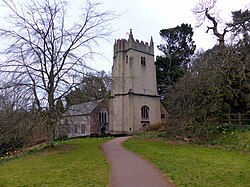
- Cockington Church which has been estimated to have been standing since 1069 26 built by William de Falaise.26
- A water mill that is in the middle of the village;
Notable residents
- Robert Cary a chronologer was born in Cockington in about 1615.27
- Robert Sweet (1782-1835) an author and horticulturalist, was also born in the village.28
- Patrick, a four-year-old therapy pony, was informally elected mayor in July 2022 following a publicity campaign by a local charity. He worked with recovery groups in hospitals and mental health wards and community projects some of which involved him visiting the Drum Inn, as mentioned above. About two weeks after his appointment as honorary mayor, local health officials from the governing authority, the Torbay Council in responding to a complaint issued a restraining order preventing the pony entering the inn.29
See also
See also
- History of Torquay
- Chelston
- Cockington Green Gardens – park in Australia named after Cockington, Devon
References
References
- "Torbay ward 2011". Retrieved 5 April 2015.
- "Cockington with Chelston (Ward, United Kingdom) - Population Statistics, Charts, Map and Location". citypopulation.de. Retrieved 16 January 2025.
- Ellis, Arthur (1930). An History of Torquay.
- Read, Brian (2015). Cockington Bygones: A History of the Manors of Cockington and Chelston and the Parish of Cockington. Portcullis Publishing. ISBN 9780953245086.
- Stephens, W. B. (1960). "Roger Mallock, Merchant and Royalist". Transactions of the Devonshire Association. 92: 279–292.
- Cockington Conservation Area Character Appraisal (Report). Torbay Council. 19 December 2005.
- "Liquidation notice". Torbay Coast & Countryside Trust. 24 October 2025. Retrieved 18 May 2026.
- "Torbay Coast and Countryside Trust voluntary liquidation". Torbay Council. 10 December 2025. Retrieved 18 May 2026.
- Historic England (10 April 1987). "Details from listed building database (1306171)". National Heritage List for England. Retrieved 7 August 2019.
- Read, Brian (2015). Cockington Bygones - A history of the Manors of Cockington and Chelston and the Parish of Cockington. Portcullis Publishing. p. 124. ISBN 9780953245086.
- Read, Brian (2015). Cockington Bygones - A history of the Manors of Cockington and Chelston and the Parish of Cockington. Portcullis Publishing. p. 17. ISBN 9780953245086.
- Historic England (3 May 1994). "Details from listed building database (1206758)". National Heritage List for England. Retrieved 7 August 2019.
- "Torbay Council Planning Application P/2019/0034". Torbay Council. 10 May 2019. Retrieved 7 August 2019.
- Historic England (20 November 1952). "The Forge, Cockington Lane (1206862)". National Heritage List for England. Retrieved 31 August 2025.
- Ellis, Arthur (1930). An Historical Survey of Torquay. The Devonshire Press. p. 81.
- Lang, Joan F. (1971). Old Cockington. Devon Books. p. 35.
- Read, Brian (2015). Cockington Bygones: A History of the Manors of Cockington and Chelston and the Parish of Cockington. Portcullis Publishing. pp. 204–205.
- "Cockington Forge & Village Industries Limited". The London Gazette. No. 39505. 1 April 1952. p. 1847.
- Read, Brian (2015). Cockington Bygones: A History of the Manors of Cockington and Chelston and the Parish of Cockington. Portcullis Publishing. pp. 205–206.
- Read, Brian (2015). Cockington Bygones: A History of the Manors of Cockington and Chelston and the Parish of Cockington. Portcullis Publishing. p. 206.
- "Caring for Cockington" (PDF). Torbay Council. Archived from the original (PDF) on 19 July 2014. Retrieved 15 July 2014.
- "Cockington Court Craft Centre". Archived from the original on 13 June 2010. Retrieved 16 May 2010.
- "Cockington Court Centre for Arts, Crafts and Culture". Archived from the original on 13 June 2010. Retrieved 16 May 2010.
- "Cockington Court history". Archived from the original on 13 June 2010. Retrieved 16 May 2010.
- "The Manor House". Archived from the original on 13 June 2010. Retrieved 16 May 2010.
- "Cockington Parish Churches". toplocalplaces.com.
- Hutton, Charles (1815). A philosophical and mathematical dictionary containing... memoirs of the lives and writings of the most eminent authors, Volume 1. Charles Hutton. p. 278.
- Blewitt, Octavian (1832). The panorama of Torquay: a descriptive and historical sketch of the district comprised between the Dart and Teign. Simkin. pp. 270, 274.
- O'Connor, Amber (2 August 2022). "Beer-loving Shetland pony mayor 'banned from pub' by council - 'it's disgusting'". Daily Mirror.