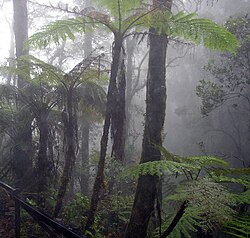
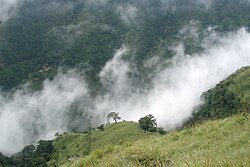
A cloud forest, also called a water forest, primas forest, or tropical montane cloud forest, is a generally tropical or subtropical, evergreen, montane, moist forest characterized by a persistent, frequent or seasonal low-level cloud cover, usually at the canopy level, formally described in the International Cloud Atlas (2017) as silvagenitus.12 Cloud forests often exhibit an abundance of mosses covering the ground and vegetation, in which case they are also referred to as mossy forests. Mossy forests usually develop on the saddles of mountains, where moisture introduced by settling clouds is more effectively retained.
Cloud forests form when winds carry moisture-laden air against mountain slopes, causing the air to rise and cool through orographic lift until it condenses into persistent low clouds. This mechanism sustains the characteristically high humidity that defines the biome and sets it apart from other montane forest types.3
These forests are among the most biodiversity-rich biomes in the world, harboring a disproportionately large number of endemic plant and animal species that depend on the stable, moist microclimate they provide.4 They also play a critical role in regional hydrology: fog drip, condensation that forms on foliage and drips to the ground, can supplement annual precipitation substantially, making cloud forests vital freshwater sources for downstream communities and ecosystems.567
Despite their ecological importance, cloud forests are under threat from deforestation, agricultural encroachment, and climate change. Approximately 2.4% of global cloud forest cover was lost between 2001 and 2018, with losses in some regions exceeding 8%.4 Because cloud formation is tightly linked to local temperature and atmospheric conditions, rising global temperatures are projected to push optimal cloud forest climates to higher elevations, effectively shrinking available habitat over the coming decades.89
Climate
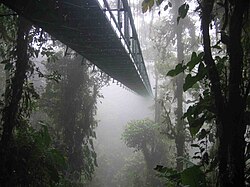
Cloud forest distribution is governed by the mixing of latitude, proximity to the ocean, topography, and elevation. Most tropical cloud forests occur between latitudes 25°N and 25°S and at elevations ranging from approximately 500 m to 4,000 m above sea level.10 11 Within this broad range, suitable conditions are typically restricted to a relatively narrow altitudinal band where atmospheric temperature and humidity permit persistent cloud formation at vegetation level.
The defining climatic mechanism is orographic lift: prevailing winds carry moisture-laden air from the ocean toward mountain ranges, and as the air is forced upward it cools at the dry adiabatic lapse rate until it reaches the dew point, at which point water vapor condenses into cloud. The elevation at which this condensation occurs, the cloud base, is where cloud forests characteristically develop.12 Once cloud envelops the canopy, direct sunlight is reduced, lowering evapotranspiration and creating the persistently humid conditions in which cloud forest vegetation thrives.1011
Within cloud forests, a significant proportion of the moisture available to plants arrives not as rainfall but as fog drip: water droplets from the cloud condense on the needles and leaves of trees, coalesce into larger drops, and fall to the ground below.[12] In seasonally dry climates, this fog drip can effectively double the amount of moisture reaching the forest floor compared with rainfall alone, and in wetter climates it augments wet-season precipitation by roughly 10%.567
Annual rainfall in cloud forest zones ranges from approximately 500 to 10,000 mm per year, and mean annual temperatures typically fall between 8 and 20 °C (46.4–68 °F).1011 The relatively cool temperatures suppress rates of decomposition and evapotranspiration, contributing to the waterlogged, peat-rich soils that are characteristic of the biome.
Regional and local terminology for cloud forests varies considerably. Some countries prefer terms such as Afromontane forest, upper montane rain forest, montane laurel forest, or locally specific names such as the Bolivian yungas and the laurisilva of the Atlantic Islands.136 In cooler parts of the tropics where similar meteorological conditions prevail, subtropical and temperate forests are sometimes also classified as cloud forests, though this usage is not universally accepted. 14
Characteristics
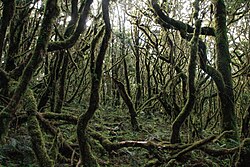
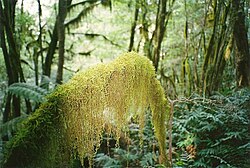
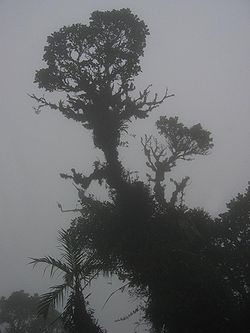
Compared with lower-altitude tropical moist forests, cloud forests are characterised by reduced tree stature combined with increased stem density and, generally, lower woody plant diversity.1011 Trees tend to be shorter and more heavily stemmed than their lowland counterparts, with gnarled trunks, dense compact crowns, and leaves that become progressively smaller, thicker, and harder with increasing altitude.15
The persistently high moisture promotes exceptional development of epiphytes, plants that grow on other plants without making them parasites, particularly bryophytes (mosses and liverworts), lichens, ferns (including filmy ferns), bromeliads, and orchids.1617 Epiphyte biomass can be very high; in some cloud forests, the weight of mosses and other epiphytes on a single tree exceeds the weight of the tree's own foliage.18 The number of endemic plant species can also be very high.16
Cloud forests are frequently peatlands. The combination of high soil moisture, reduced solar radiation, and low rates of decomposition and mineralisation creates strongly acidic soils, with humus and peat often forming the upper soil layer.171920
Stadtmüller (1987) distinguishes two general types of tropical montane cloud forests:
Areas with high annual precipitation due to frequent cloud cover combined with heavy and sometimes persistent orographic rainfall. These forests have perceptible canopy strata, a high number of epiphytes, and a thick peat layer with high water-storage capacity.
Drier areas with mainly seasonal rainfall, where cloud stripping, the interception and deposition of cloud moisture by vegetation, accounts for a large proportion of the total moisture available to plants.21
Distribution of tropical montane cloud forests
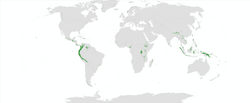
Cloud forests are globally rare: they account for only approximately 1% of the world's woodland area.16 A total of around 736 cloud forest sites have been identified in 59 countries by the World Conservation Monitoring Centre, of which 327 were legally protected areas as of 2002.23 Important areas occur in Central and South America (principally Costa Rica, Venezuela, Honduras, El Salvador, Guatemala, Mexico, Ecuador, and Colombia), East and Central Africa, India, Sri Lanka, Thailand, Vietnam, Indonesia, Malaysia, the Philippines, Hawaii, Papua New Guinea, and the Caribbean.123
A 1997 World Conservation Monitoring Centre database recorded 605 tropical montane cloud forest sites in 41 countries. Of these, 280 sites (46%) were in Latin America, with the largest concentrations in Venezuela (64 sites), Mexico (64), Ecuador (35), and Colombia (28). Southeast Asia and Australasia accounted for 228 sites across 14 countries, with major concentrations in Indonesia (66), Malaysia (54), Sri Lanka (33), the Philippines (32), and Papua New Guinea (28). Africa had 97 sites scattered across 21 countries. Of all 605 sites, 264 were in protected areas.24
Conservation status
Cloud forests occupied 0.4% of the global land surface in 2001 and harbored ~3,700 species of birds, mammals, reptiles, amphibians, and tree ferns (~15% of the global diversity of those groups), with half of those species entirely restricted to cloud forests.22 Worldwide, ~2.4% of cloud forests (in some regions, more than 8%) were lost between 2001 and 2018, especially in readily accessible places. While protected areas have slowed this decline, a large proportion of loss in TCF cover is still occurring despite formal protection.22
Temperate cloud forests
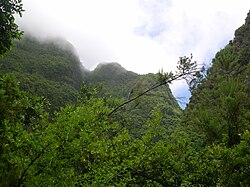
Although not universally accepted as true cloud forests, several forests in temperate regions share strong structural and climatic similarities with their tropical counterparts. The classification is further complicated by the occasional use of "temperate" to describe cool-climate cloud forests within tropical countries.
Distribution by country
- Argentina – Salta, Jujuy, Catamarca and Tucumán (Southern Andean Yungas)25
- Australia – Lamington National Park, Springbrook National Park, Mount Bartle Frere and Mount Bellenden Ker (Queensland) and Mount Gower (Lord Howe Island)2627282930
- Brazil – Serra do Mar coastal forests31
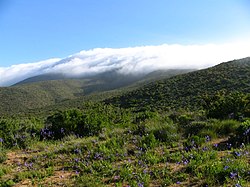
- Chile – Bosque de Fray Jorge National Park32
- China – Yunnan Plateau, mountains of southern and eastern China33
- Costa Rica – Monteverde Cloud Forest Reserve. Approximately 10,500 hectares, containing around 2,500 plant species (including the greatest concentration of orchid species of any single site on Earth), 100 species of mammals, 400 species of birds, 120 species of reptiles, and thousands of insect species.34
- Ethiopia – Harenna Forest, Bale Mountains National Park and Kafa Biosphere Reserve35
- Fiji Islands – Tropical montane cloud forests of Taveuni and Gau Island36
- Iran – Eastern Alborz mountains, Golestan Province37
- Japan – Parts of Yakushima Island38
- Portugal – Azores and Madeira (referring primarily to the wetter, higher-altitude laurisilva)39
- Sri Lanka – Upper slopes of the Knuckles Mountain Range, Matale40
- Taiwan – Yuanyang Lake Nature Reserve, Chatianshan Nature Reserve, and Fuxing District, Taoyuan41
Conservation status
Cloud forests occupied approximately 0.4% of the global land surface in 2001 and harbored around 3,700 species of birds, mammals, reptiles, amphibians, and tree ferns — approximately 15% of global diversity in those groups — with roughly half of those species entirely restricted to cloud forests.4
Worldwide, approximately 2.4% of cloud forest cover was lost between 2001 and 2018. In some regions, losses exceeded 8%, and losses were most severe in readily accessible lowland cloud forest zones. Although protected areas have slowed the rate of decline, a significant proportion of loss continues to occur within formally protected areas.4
In 1970, the original extent of cloud forests on Earth was estimated at around 50 million hectares.42 Population growth, poverty, and uncontrolled land use have contributed to substantial losses since then. The 1990 Global Forest Survey found that 1.1% of tropical mountain and highland forests were being lost annually — a higher rate than in any other tropical forest type.43 In Colombia, one of the countries with the greatest cloud forest area, only 10–20% of the original cover is estimated to remain.[7] Significant areas have been converted to plantations, agriculture, and pasture; important crops in montane forest zones include tea and coffee, and selective logging of unique tree species alters forest structure even where outright clearance has not occurred.17
In 2004, approximately one-third of all cloud forests on the planet were under some form of legal protection.44 Conservation efforts in some regions have achieved measurable successes: for example, the Monteverde Cloud Forest Reserve in Costa Rica has maintained and expanded its protected area since its establishment, and similar private and community-led reserves across the Andes have helped stabilize cover in targeted localities.45
Importance
Watershed function
Cloud forests play a disproportionately important role in the regional hydrological cycle relative to their small global extent. The cloud-stripping mechanism — whereby tree canopies intercept wind-driven cloud moisture — can effectively double rainfall inputs during dry seasons and add approximately 10% to wet-season totals.567 Experiments by Costin and Wimbush (1961) demonstrated that the canopies of non-cloud forests intercept and evaporate 20% more precipitation than cloud forests do, meaning that cloud forests deliver a larger net water input to the land surface.46 This function makes cloud forests critical catchment areas for rivers and groundwater systems serving large human populations, particularly in seasonally dry regions such as coastal Peru and northern Chile where cloud forests are virtually the sole source of freshwater.
Vegetation
Tropical montane cloud forests are not as species-rich as tropical lowland forests in terms of overall woody plant diversity, but they provide habitat for many species found nowhere else on Earth.4711For example, Cerro de la Neblina, a permanently cloud-covered massif in southern Venezuela, supports numerous shrubs, orchids, and insectivorous plants entirely restricted to that single mountain.[26]47 The extraordinary richness of epiphytic flora is a particular hallmark: cloud forests harbor a large proportion of the world's orchid, bromeliad, and filmy fern diversity, and bryophyte biomass per unit area frequently exceeds that of any other forest type.48
Fauna
Faunal endemism in cloud forests is exceptionally high. In Peru alone, more than one-third of the country's 270 endemic birds, mammals, and frogs are found in cloud forests.47 Globally, cloud forests are particularly important for birds: highly specialized species such as the resplendent quetzal (Pharomachrus mocinno) of Central America, numerous hummingbird species, and many tanagers and antpittas are closely tied to cloud forest habitats and are among the region's flagship conservation species. 49
Among mammals, the spectacled bear (Tremarctos ornatus), the only bear native to South America, is one of the best-known cloud forest species and serves as an important seed disperser across Andean cloud forests.17 Amphibian diversity is also notable: the cool, moist microclimate supports many frog and salamander species that are highly sensitive to desiccation and temperature change, making them among the most vulnerable groups to projected climate warming.
Impact of climate change
Because cloud forests are defined by a delicate dependency on specific atmospheric conditions at specific elevations, they are among the ecosystems most sensitive to global climate change. As temperatures rise, the elevation at which cloud condensation occurs shifts upward, pushing the cloud base — and therefore the zone suitable for cloud forest — to higher altitudes and reducing the total land area available.89
Projections for Mexico suggest that the geographic extent of environmentally suitable habitat for cloud forests will decline sharply over the next 70 years under most climate scenarios.50 A number of climate models indicate that low-altitude cloudiness will be reduced, meaning that some existing cloud forests will experience a drying trend even before temperature-driven habitat loss becomes acute.89
As cloud moisture immersion decreases and temperatures rise, the hydrological cycle within these forests will change, and the system will progressively dry out.9 This will cause wilting and dieback of epiphytes, which depend on near-constant high humidity for water and nutrient uptake.[29] Frogs, lizards, and other ectotherms are expected to suffer increasing physiological stress from drought and temperature extremes.9 Modelling of Mexican cloud forests suggests that these changes could drive the extinction of up to 37 vertebrate species endemic to that region.50
Human-induced climate change is also projected to increase the frequency of rapid hurricane intensification, which will periodically cause severe structural damage to tropical montane cloud forests in vulnerable coastal cordilleras.51 Taken together, the consequences of climate change for cloud forests include biodiversity loss, disrupted biogeochemistry, altitude shifts in species ranges, wholesale community reshuffling, and, in some areas, complete disappearance of the ecosystem.8
Footnotes
Footnotes
- Hostettler, Silvia (2002). "Tropical Montane Cloud Forests: A Challenge for Conservation". Bois et Forets des Tropiques. 274 (4): 19–31. doi:10.19182/bft2002.274.a20121.
- Sutherland, Scott (23 March 2017). "Cloud Atlas joins the digital age while adding a dozen new cloud types". The Weather Network. Pelmorex Media. Retrieved 13 August 2025.
- amazonaid (23 September 2015). "Cloud Forests". Amazon Aid. Retrieved 30 April 2026.
- Karger, Dirk Nikolaus; Kessler, Michael; Lehnert, Marcus; Jetz, Walter (2021). "Limited protection and ongoing loss of tropical cloud forest biodiversity and ecosystems worldwide". Nature Ecology & Evolution. 5 (6): 854–862. Bibcode:2021NatEE...5..854K. doi:10.1038/s41559-021-01450-y. PMID 33927369. S2CID 256726846.
- Vogelmann 1973 and Bruijnzeel 1990, p. quote by Hamilton, Juvik & Scatena 1995
- García-Santos, G; Marzol, M. V; Aschan, G (2004). "Water dynamics in a laurel montane cloud forest in the Garajonay National Park (Canary Islands, Spain)". Hydrology and Earth System Sciences. 8 (6): 1065–75. Bibcode:2004HESS....8.1065G. doi:10.5194/hess-8-1065-2004.
- Köhler, Lars; Tobón, Conrado; Frumau, K. F. Arnoud; Bruijnzeel, L. A. (Sampurno) (1 December 2007). "Biomass and water storage dynamics of epiphytes in old-growth and secondary montane cloud forest stands in Costa Rica". Plant Ecology. 193 (2): 171–184. Bibcode:2007PlEco.193..171K. doi:10.1007/s11258-006-9256-7. ISSN 1573-5052. S2CID 1032485.
- Foster, Pru (2001). "The potential negative impacts of global climate change on tropical montane cloud forests." Earth-Science Reviews. 55 (1-2): 73-106.
- Bubb, Philip; May, Ian; Miles, Lera; Sayer, Jeff (2004). Cloud Forest Agenda. UNEP World Conservation Monitoring Centre.
- García-Santos, G; Marzol, M. V; Aschan, G (2004). "Water dynamics in a laurel montane cloud forest in the Garajonay National Park (Canary Islands, Spain)". Hydrology and Earth System Sciences. 8 (6): 1065–75. Bibcode:2004HESS....8.1065G. doi:10.5194/hess-8-1065-2004.
- García-Santos, G. (2007). An ecohydrological and soils study in a montane cloud forest in the National Park of Garajonay, La Gomera (Canary Islands, Spain) (PhD Thesis). By-Print. hdl:1871/12697.
- Rastogi, Bharat (2016-01-15). "Spatial and Temporal Patterns of Cloud Cover and Fog Inundation in Coastal California: Ecological Implications" (PDF). journals.ametsoc.org. Retrieved 2026-04-29
- García-Santos, G; Bruijnzeel, L.A; Dolman, A.J (2009). "Modelling canopy conductance under wet and dry conditions in a subtropical cloud forest". Agricultural and Forest Meteorology. 149 (10): 1565–72. Bibcode:2009AgFM..149.1565G. doi:10.1016/j.agrformet.2009.03.008.
- "Cloud forest | Definition, Description, Ecology, Plants, Distribution, & Facts | Britannica". Encyclopedia Britannica. Archived from the original on 2025-09-20. Retrieved 2026-02-16.
- Bruijnzeel, L. A; Proctor, J (1995). "Hydrology and Biogeochemistry of Tropical Montane Cloud Forests: What Do We Really Know?". In Hamilton, Lawrence S.; Juvik, James O.; Scatena, F. N. (eds.). Tropical Montane Cloud Forests. Ecological Studies. Vol. 110. pp. 38–78. doi:10.1007/978-1-4612-2500-3_3. ISBN 978-1-4612-7564-0.
- Häger, Achim (2006). Einfluss von Klima und Topographie auf Struktur, Zusammensetzung und Dynamik eines tropischen Wolkenwaldes in Monteverde, Costa Rica [Influence of climate and topography on the structure, composition and dynamics of a tropical cloud forest in Monteverde, Costa Rica] (Dissertation) (in German). doi:10.53846/goediss-2265. hdl:11858/00-1735-0000-0006-B0EE-1. S2CID 247019823.
- Hamilton, Lawrence S; Juvik, James O; Scatena, F. N (1995). "The Puerto Rico Tropical Cloud Forest Symposium: Introduction and Workshop Synthesis". In Hamilton, Lawrence S.; Juvik, James O.; Scatena, F. N. (eds.). Tropical Montane Cloud Forests. Ecological Studies. Vol. 110. pp. 1–18. doi:10.1007/978-1-4612-2500-3_1. ISBN 978-1-4612-7564-0.
- Diaz, Ivan A; Sieving, Kathryn E; Pena-Faxon, ME; Larrain, Juan (2010-03). "Epiphyte diversity and biomass loads of canopy emergent trees in Chilean temperate rain forests: A neglected functional component". ResearchGate.
- van Steenis, Cornelis Gijsbert Gerrit Jan (1972). The Mountain Flora of Java. Brill. OCLC 741884105.
- Grubb, PJ; Tanner, EVJ (July 1976). "The montane forests and soils of Jamaica: a reassessment". Journal of the Arnold Arboretum. 57 (3): 313–68. doi:10.5962/p.185865. JSTOR 43794514. S2CID 134572910.
- Stadtmüller, Thomas (1987). Cloud Forests in the Humid Tropics: A Bibliographic Review. Bib. Orton IICA / CATIE. ISBN ISBN 978-92-808-0670-0.
- Karger, Dirk Nikolaus; Kessler, Michael; Lehnert, Marcus; Jetz, Walter (2021). "Limited protection and ongoing loss of tropical cloud forest biodiversity and ecosystems worldwide". Nature Ecology & Evolution. 5 (6): 854–862. Bibcode:2021NatEE...5..854K. doi:10.1038/s41559-021-01450-y. PMID 33927369. S2CID 256726846.
- "Resources Data – UNEP-WCMC". unep-wcmc.org. Archived from the original on 11 April 2011. Retrieved 12 December 2006.
- Mark Aldrich, Clare Billington, Mary Edwards and Ruth Laidlaw (1997) "Tropical Montane Cloud Forests: An Urgent Priority for Conservation" WCMC Biodiversity Bulletin No. 2, World Conservation Monitoring Centre.
- Albanesi, Sebastián Alejandro; Santos, Daniel Andrés Dos (20 April 2026). "Linking Thermal Availability to Mammal Activity Patterns through Long-Term Camera Trap Monitoring in the Southern Andean Yungas". doi.org. doi:10.21203/rs.3.rs-9369097/v1. Retrieved 30 April 2026.
- "Lamington National Park". Parks and forests | Department of the Environment, Tourism, Science and Innovation. Retrieved 30 April 2026.
- "Springbrook National Park". Parks and forests | Department of the Environment, Tourism, Science and Innovation. Retrieved 30 April 2026.
- "Bartle Frere trail, Wooroonooran National Park". Parks and forests | Department of the Environment, Tourism, Science and Innovation. Retrieved 30 April 2026.
- "Mount Bellenden Ker", Wikipedia, 6 April 2026, retrieved 29 April 2026
- "'It's like living in a David Attenborough documentary': Island cloud forest thrives". ABC News. 7 March 2021. Retrieved 30 April 2026.
- Pompeu, Patrícia Vieira; Fontes, Marco Aurélio Leite; Mulligan, Mark; Bueno, Inácio Thomaz; de Siqueira, Marinez Ferreira; Acerbi Júnior, Fausto Weimar; Kamino, Luciana Hiromi Yoshino; Waterloo, Maarten J.; Bruijnzeel, L. A. (1 June 2018). "Assessing Atlantic cloud forest extent and protection status in southeastern Brazil". Journal for Nature Conservation. 43: 146–155. Bibcode:2018JNatC..43..146P. doi:10.1016/j.jnc.2018.04.003. ISSN 1617-1381.
- "The Strange Forests that Drink—and Eat—Fog". www.caryinstitute.org. 22 July 2009. Retrieved 30 April 2026.
- "Yunnan Plateau Subtropical Evergreen Forests". One Earth. 29 July 2022. Retrieved 30 April 2026.
- "Monteverdes Cloud Forest". MONTEVERDEINFO.COM. Retrieved 30 April 2026.
- "Ethiopia's Forest in the Clouds - NASA Science". 24 February 2021. Retrieved 30 April 2026.
- Keppel, Gunnar; Thomas, Nunia T (2009). "Composition and structure of the cloud forest on Mt. Delaco, Gau, Fiji" (PDF). CSIRO.
- "Cloud forest – Iran Travel Information". 16 February 2021. Retrieved 30 April 2026.
- Centre, UNESCO World Heritage. "Yakushima". UNESCO World Heritage Centre. Retrieved 30 April 2026.
- González-Montelongo, Cristina; Pérez-Vargas, Israel (25 September 2024). "On the Conservation of the Canarian Laurel Forest: What Do Lichens Have to Say?". Journal of Fungi (Basel, Switzerland). 10 (10): 668. doi:10.3390/jof10100668. ISSN 2309-608X. PMC 11508214. PMID 39452620.
- Lanka, Best of. "Tours in Sri Lanka – Local & Tailor-Made Tours in Sri Lanka & Maldives". Best of Lanka. Retrieved 30 April 2026.
- "Yuanyang Lake Nature Reserve". Forestry and Conservancy Agency. 2026-03-13.
- "WHAT IS A CLOUD FOREST?". Ecuador Forest Of Clouds. Retrieved 2026-04-29.
- "Forest resources assessment 1990 - Tropical countries". www.fao.org. Retrieved 30 April 2026.
- Kappelle 2004 quote by Häger 2006, p.
- Salazar, Maria Angeles (2017-09-06). "A global view from a mountain town: how conservation became ingrained in Monteverde". Conservation news. Retrieved 2026-04-29
- Costin, A. B., and D. J. Wimbush, 1961. “Studies in Catchment Hydrology in the Australian Alps. IV. Interception by Trees of Rain, Cloud and Fog.” (Division of Plant Industry Technical Paper No. 16). Commonwealth Scientific and Industrial Research Organization, Melbourne, Australia.
- Bruijnzeel, L.A.; Hamilton, L.S. (2000). Decision Time For Cloud Forests: Water-Related Issues And Problems Of The Humid Tropics And Other Warm Humid Regions. Paris, France: UNESCO's IHP Humid Tropics Programme Series No.13.
- Lai, G. Y.; Liu, H. C.; Kuo, A. J.; Huang, C. Y. (2020). "Epiphytic bryophyte biomass estimation on tree trunks and upscaling in tropical montane cloud forests". PeerJ. 8 e9351. doi:10.7717/peerj.9351. PMC 7295022. PMID 32566412.
- "Birds and Cloud Forests". Community Cloud Forest Conservation. Retrieved 30 April 2026.
- Ponce-Reyes, Rocio; Nicholson, Emily; Baxter, Peter W. J; Fuller, Richard A; Possingham, Hugh (2013). "Extinction risk in cloud forest fragments under climate change and habitat loss". Diversity and Distributions. 19 (5–6): 518–29. Bibcode:2013DivDi..19..518P. doi:10.1111/ddi.12064.
- Li, Yi; Tang, Youmin; Wang, Shuai; Toumi, Ralf; Song, Xiangzhou; Wang, Qiang (2023-08-24). "Recent increases in tropical cyclone rapid intensification events in global offshore regions". Nature Communications. 14 (1): 5167. doi:10.1038/s41467-023-40605-2. ISSN 2041-1723. PMC 10449825. PMID 37620321.
References
References
- amazonaid (2015-09-23). "Cloud forests". Amazon Aid.
- "Bartle Frere trail, Wooroonooran National Park". Parks and forests | Department of the Environment, Tourism, Science and Innovation. Retrieved 2026-04-29.
- "Birds and Cloud Forests". Community Cloud Forest Conservation. Retrieved 2026-04-29.
- Britannica Editors. (1998, July 20). Cloud forest | Definition, Description, Ecology, Plants, Distribution, & Facts. Encyclopedia Britannica. http://web.archive.org/web/20250920081136/https://www.britannica.com/science/cloud-forest-ecology
- Bruijnzeel, L. A. (1990). Hydrology of Moist Tropical Forests and Effects of Conversion: A State of Knowledge Review. OCLC 222853422.
- Bruijnzeel, L.A.; Hamilton, L.S. (2000). Decision Time For Cloud Forests: Water-Related Issues And Problems Of The Humid Tropics And Other Warm Humid Regions. Paris, France: UNESCO's IHP Humid Tropics Programme Series No.13.
- Bruijnzeel, L. A; Proctor, J (1995). "Hydrology and Biogeochemistry of Tropical Montane Cloud Forests: What Do We Really Know?". In Hamilton, Lawrence S.; Juvik, James O.; Scatena, F. N. (eds.). Tropical Montane Cloud Forests. Ecological Studies. Vol. 110. pp. 38–78. doi:10.1007/978-1-4612-2500-3_3. ISBN 978-1-4612-7564-0.
- Bubb, Philip; May, Ian; Miles, Lera; Sayer, Jeff (2004). Cloud Forest Agenda. UNEP World Conservation Monitoring Centre. ISBN 92-807-2399-5. Archived from the original on 26 December 2017. Retrieved 26 December 2017.
- Centre, UNESCO World Heritage. "Yakushima". UNESCO World Heritage Centre. Retrieved 2026-04-29.
- Clarke, Charles (1997). Nepenthes of Borneo. Natural History Publications. ISBN 978-983-812-015-9.
- "Cloud forest – Iran Travel Information". 2021-02-16. Retrieved 2026-04-29.
- Costin, A. B., and D. J. Wimbush, 1961. “Studies in Catchment Hydrology in the Australian Alps. IV. Interception by Trees of Rain, Cloud and Fog.” (Division of Plant Industry Technical Paper No. 16). Commonwealth Scientific and Industrial Research Organization, Melbourne, Australia.
- Diaz, Ivan A; Sieving, Kathryn E; Pena-Faxon, ME; Larrain, Juan (2010-03). "Epiphyte diversity and biomass loads of canopy emergent trees in Chilean temperate rain forests: A neglected functional component". ResearchGate.
- "Ethiopia's Forest in the Clouds - NASA Science". 2021-02-24. Retrieved 2026-04-29.'
- "Forest resources assessment 1990 - Tropical countries". www.fao.org. Retrieved 2026-04-29.
- Foster, Pru (2001). "The potential negative impacts of global climate change on tropical montane cloud forests". Earth-Science Reviews. 55 (1–2): 73–106. Bibcode:2001ESRv...55...73F. doi:10.1016/S0012-8252(01)00056-3.
- García-Santos, G; Marzol, M. V; Aschan, G (2004). "Water dynamics in a laurel montane cloud forest in the Garajonay National Park (Canary Islands, Spain)". Hydrology and Earth System Sciences. 8 (6): 1065–75. Bibcode:2004HESS....8.1065G. doi:10.5194/hess-8-1065-2004.
- García-Santos, G. (2007). An ecohydrological and soils study in a montane cloud forest in the National Park of Garajonay, La Gomera (Canary Islands, Spain) (PhD Thesis). By-Print. hdl:1871/12697.
- García-Santos, G; Bruijnzeel, L.A; Dolman, A.J (2009). "Modelling canopy conductance under wet and dry conditions in a subtropical cloud forest". Agricultural and Forest Meteorology. 149 (10): 1565–72. Bibcode:2009AgFM..149.1565G. doi:10.1016/j.agrformet.2009.03.008.
- González-Montelongo, Cristina; Pérez-Vargas, Israel (2024-09-25). "On the Conservation of the Canarian Laurel Forest: What Do Lichens Have to Say?". Journal of Fungi (Basel, Switzerland). 10 (10): 668. doi:10.3390/jof10100668. ISSN 2309-608X. PMC 11508214. PMID 39452620.
- Grubb, PJ; Tanner, EVJ (July 1976). "The montane forests and soils of Jamaica: a reassessment". Journal of the Arnold Arboretum. 57 (3): 313–68. doi:10.5962/p.185865. JSTOR 43794514. S2CID 134572910.
- Häger, Achim (2006). Einfluss von Klima und Topographie auf Struktur, Zusammensetzung und Dynamik eines tropischen Wolkenwaldes in Monteverde, Costa Rica [Influence of climate and topography on the structure, composition and dynamics of a tropical cloud forest in Monteverde, Costa Rica] (Dissertation) (in German). doi:10.53846/goediss-2265. hdl:11858/00-1735-0000-0006-B0EE-1. S2CID 247019823.
- Hamilton, Lawrence S; Juvik, James O; Scatena, F. N (1995). "The Puerto Rico Tropical Cloud Forest Symposium: Introduction and Workshop Synthesis". In Hamilton, Lawrence S.; Juvik, James O.; Scatena, F. N. (eds.). Tropical Montane Cloud Forests. Ecological Studies. Vol. 110. pp. 1–18. doi:10.1007/978-1-4612-2500-3_1. ISBN 978-1-4612-7564-0.
- "'It's like living in a David Attenborough documentary': Island cloud forest thrives". ABC News. 2021-03-07. Retrieved 2026-04-29.
- Kappelle, M (2004). "Tropical Montane Forests". In Burley, Jeffery (ed.). Encyclopedia of Forest Sciences. pp. 1782–92. doi:10.1016/B0-12-145160-7/00175-7. ISBN 978-0-12-145160-8.
- Keppel, Gunnar; Thomas, Nunia T (2009). "Composition and structure of the cloud forest on Mt. Delaco, Gau, Fiji" (PDF). CSIRO.
- Knutson, T (2024). "Global Warming and Hurricanes: An overview of current research results". National Oceanographic and Atmospheric Administration.'
- Lai, Guan-Yu; Liu, Hung-Chi; Kuo, Ariel J.; Huang, Cho-Ying (2020). "Epiphytic bryophyte biomass estimation on tree trunks and upscaling in tropical montane cloud forests". PeerJ. 8: e9351. doi:10.7717/peerj.9351. ISSN 2167-8359. PMC 7295022. PMID 32566412.
- "Lamington National Park". Parks and forests | Department of the Environment, Tourism, Science and Innovation. Retrieved 2026-04-29.
- Lanka, Best of. "Knuckles Forest Reserve, Sri Lanka". Best of Lanka. Retrieved 2026-04-29.
- "Monteverdes Cloud Forest". MONTEVERDEINFO.COM. Retrieved 2026-04-29.
- Pompeu, Patrícia Vieira; Fontes, Marco Aurélio Leite; Mulligan, Mark; Bueno, Inácio Thomaz; de Siqueira, Marinez Ferreira; Acerbi Júnior, Fausto Weimar; Kamino, Luciana Hiromi Yoshino; Waterloo, Maarten J.; Bruijnzeel, L. A. (2018-06-01). "Assessing Atlantic cloud forest extent and protection status in southeastern Brazil". Journal for Nature Conservation. 43: 146–155. doi:10.1016/j.jnc.2018.04.003. ISSN 1617-1381.
- Ponce-Reyes, Rocío; Reynoso-Rosales, Víctor-Hugo; Watson, James E. M; Vanderwal, Jeremy; Fuller, Richard A; Pressey, Robert L; Possingham, Hugh P (2012). "Vulnerability of cloud forest reserves in Mexico to climate change" (PDF). Nature Climate Change. 2 (6): 448–52. Bibcode:2012NatCC...2..448P. doi:10.1038/nclimate1453.
- Ponce-Reyes, Rocio; Nicholson, Emily; Baxter, Peter W. J; Fuller, Richard A; Possingham, Hugh (2013). "Extinction risk in cloud forest fragments under climate change and habitat loss". Diversity and Distributions. 19 (5–6): 518–29. Bibcode:2013DivDi..19..518P. doi:10.1111/ddi.12064.
- Rastogi, B., A. Park Williams, Fischer, D. T., Iacobellis, S. F., McEachern, K., Carvalho, L. V., Jones, C., Baguskas, S. A., & Still, C. J. (2016). Spatial and Temporal Patterns of Cloud Cover and Fog Inundation in Coastal California: Ecological Implications. Earth Interactions, 20(15), 1–19. https://doi.org/10.1175/ei-d-15-0033.1
- Salazar, Maria Angeles (2017-09-06). "A global view from a mountain town: how conservation became ingrained in Monteverde". Conservation news. Retrieved 2026-04-29.
- "Springbrook National Park". Parks and forests | Department of the Environment, Tourism, Science and Innovation. Retrieved 2026-04-29.
- "The Strange Forests that Drink—and Eat—Fog". www.caryinstitute.org. 2009-07-22. Retrieved 2026-04-29.
- van Steenis, Cornelis Gijsbert Gerrit Jan (1972). The Mountain Flora of Java. Brill. OCLC 741884105.
- Vogelmann, H. W (1973). "Fog Precipitation in the Cloud Forests of Eastern Mexico". BioScience. 23 (2): 96–100. Bibcode:1973BiSci..23...96V. doi:10.2307/1296569. JSTOR 1296569.
- "WHAT IS A CLOUD FOREST?". Ecuador Forest Of Clouds. Retrieved 2026-04-29.
- Yuanyang Lake Nature Reserve". Forestry and Conservancy Agency. 2026-03-13.
External links
External links
- Tropical Montane Cloud Forest Initiative Archived 5 April 2008 at the Wayback Machine
- Monteverde Cloud Forest Ecology
- Roach, John (August 13, 2001). "Cloud Forests Fading in the Mist, Their Treasures Little Known". National Geographic News
- Cloud Forests United
- Tropical hydrology and cloud forests project
- Hydrology of tropical cloud forests project
- Cloud Forest Video – Rara Avis CR
- Tropical Montane Cloud Forests – Science for Conservation and Management (L.A. Bruijnzeel, F.N. Scatena and L.S. Hamilton, 2011)
- Andes Biodiversity and Ecosystem Research Group
- Costin, A.B.; Wimbush, D.J. (1961). Studies in catchment hydrology in the Australian Alps. IV, Interception by trees of rain, cloud, and fog. OCLC 822214607.
- Stadtmüller, Thomas (1987). Cloud Forests in the Humid Tropics: A Bibliographic Review. Bib. Orton IICA / CATIE. ISBN 978-92-808-0670-0.