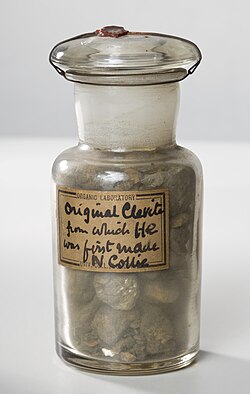
Cleveite is an impure radioactive variety of uraninite containing uranium, found in Norway. It has the composition UO2 with about 10% of the uranium substituted by rare-earth elements.2 It was named after Swedish chemist Per Teodor Cleve. It was first described by Adolf Erik Nordenskiöld in 1878 from the Garta Feldspar quarry in Arendal, Norway.3 It was described by Ramsey to be "imbedded in felspathic rock, and forms black nodules and veins in the light reddish feldspar".4
Cleveite was the first known terrestrial source of helium, which is created over time by alpha decay of the uranium and accumulates trapped (occluded) within the mineral. The first sample of terrestrial helium was obtained by William Ramsay in 1895 when he treated a sample of the mineral with dilute sulfuric acid.5 Cleve and Abraham Langlet succeeded in isolating helium from cleveite at about the same time.
Yttrogummite is a variant of cleveite, also found in Norway.
References
References
- Kirk, Wendy L. "Cleveite [not Clevite] and helium". Museums & Collections Blog. University College London. Retrieved 18 August 2017.
- http://www.mindat.org/min-29957.html Mindat.
- Nordenskiöld, A. E. (1878). "Mineralogiska bidrag 5. Cleveit, ett nytt yttro-uran mineral från Garta felsspatsbrott nära Arendal" [Mineralogical contributions 5. Cleveite, a new yttro-uranium mineral from the Garta felspar quarry near Arendal]. Geologiska Föreningen i Stockholm Förhandlingar (in Swedish). 4 (1): 28–32. Retrieved 2026-06-04.
- "Cleveite [not Clevite] and helium | UCL UCL Culture Blog". blogs.ucl.ac.uk. Retrieved 2026-06-04.
- https://archive.org/details/becquerelraysthe00raylrich Rayleigh, Robert and John Strutt, 1904, The Becquerel rays and the properties of radium, London, E. Arnold.