| CLCN2 |
|---|
|
| Identifiers |
|---|
| Aliases | CLCN2, CIC-2, CLC2, ECA2, ECA3, EGI11, EGI3, EGMA, EJM6, EJM8, LKPAT, clC-2, chloride voltage-gated channel 2, HALD2 |
|---|
| External IDs | OMIM: 600570; MGI: 105061; HomoloGene: 3213; GeneCards: CLCN2; OMA:CLCN2 - orthologs |
|---|
|
| Gene location (Mouse) |
|---|
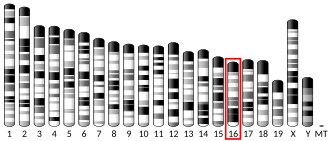 | | Chr. | Chromosome 16 (mouse)2 |
|---|
| | Band | 16 A3- B1|16 12.5 cM | Start | 20,521,714 bp2 |
|---|
| End | 20,536,496 bp2 |
|---|
|
|
|
|
| Wikidata |
|
Chloride channel protein 2 is a protein that in humans is encoded by the CLCN2 gene.56 Mutations of this gene have been found to cause leukoencephalopathy7 and Idiopathic generalised epilepsy (OMIM: 600699),8 although the latter claim has been disputed.9
A gain of function mutation in the CLCN2 gene was found to cause primary aldosteronism,10 a form of arterial hypertension due to excessive production of aldosterone by the neuroendocrine cells of the zona glomerulosa of the adrenal gland. The mutation was found to cause a chloride leak in these cells and increased the expression of aldosterone synthase.11
CLCN2 contains a transmembrane region that is involved in chloride ion transport as well two intracellular copies of the CBS domain.
See also
See also
References
References
- GRCh38: Ensembl release 89: ENSG00000114859 – Ensembl, May 2017
- GRCm38: Ensembl release 89: ENSMUSG00000022843 – Ensembl, May 2017
- "Human PubMed Reference:". National Center for Biotechnology Information, U.S. National Library of Medicine.
- "Mouse PubMed Reference:". National Center for Biotechnology Information, U.S. National Library of Medicine.
- Cid LP, Montrose-Rafizadeh C, Smith DI, Guggino WB, Cutting GR (March 1995). "Cloning of a putative human voltage-gated chloride channel (CIC-2) cDNA widely expressed in human tissues". Human Molecular Genetics. 4 (3): 407–413. doi:10.1093/hmg/4.3.407. PMID 7795595.
- "Entrez Gene: CLCN2 chloride channel 2".
- Depienne C, Bugiani M, Dupuits C, Galanaud D, Touitou V, Postma N, et al. (July 2013). "Brain white matter oedema due to ClC-2 chloride channel deficiency: an observational analytical study". The Lancet. Neurology. 12 (7): 659–668. doi:10.1016/S1474-4422(13)70053-X. hdl:11858/00-001M-0000-0018-F3BD-9. PMID 23707145. S2CID 16634353.
- Combi R, Grioni D, Contri M, Redaelli S, Redaelli F, Bassi MT, et al. (April 2009). "Clinical and genetic familial study of a large cohort of Italian children with idiopathic epilepsy". Brain Research Bulletin. 79 (2): 89–96. doi:10.1016/j.brainresbull.2009.01.008. PMID 19200853. S2CID 3036929.
- Niemeyer MI, Cid LP, Sepúlveda FV, Blanz J, Auberson M, Jentsch TJ (January 2010). "No evidence for a role of CLCN2 variants in idiopathic generalized epilepsy". Nature Genetics. 42 (1): 3. doi:10.1038/ng0110-3. PMID 20037607.
- Fernandes-Rosa FL, Daniil G, Orozco IJ, Goppner C, Zein R, Jain V, et al. (March 2018). "A gain-of-function mutation in the CLCN2 chloride channel gene causes primary aldosteronism". Nature Genetics. 50 (3): 355–361. doi:10.1038/s41588-018-0053-8. ISSN 1546-1718. PMID 29403012.
- Stowasser M, Wolley M, Wu A, Gordon RD, Schewe J, Stolting G, et al. (April 2019). "Pathogenesis of Familial Hyperaldosteronism Type II: New Concepts Involving Anion Channels". Current Hypertension Reports. 21 (4): 31. doi:10.1007/s11906-019-0934-y. ISSN 1522-6417. PMID 30949771.
Further reading
Further reading
- Lamb FS, Clayton GH, Liu BX, Smith RL, Barna TJ, Schutte BC (March 1999). "Expression of CLCN voltage-gated chloride channel genes in human blood vessels". Journal of Molecular and Cellular Cardiology. 31 (3): 657–666. doi:10.1006/jmcc.1998.0901. PMID 10198195.
- Sander T, Schulz H, Saar K, Gennaro E, Riggio MC, Bianchi A, et al. (June 2000). "Genome search for susceptibility loci of common idiopathic generalised epilepsies". Human Molecular Genetics. 9 (10): 1465–1472. doi:10.1093/hmg/9.10.1465. PMID 10888596.
- Lamb FS, Graeff RW, Clayton GH, Smith RL, Schutte BC, McCray PB (April 2001). "Ontogeny of CLCN3 chloride channel gene expression in human pulmonary epithelium". American Journal of Respiratory Cell and Molecular Biology. 24 (4): 376–381. doi:10.1165/ajrcmb.24.4.4114. PMID 11306429.
- Lipecka J, Bali M, Thomas A, Fanen P, Edelman A, Fritsch J (April 2002). "Distribution of ClC-2 chloride channel in rat and human epithelial tissues". American Journal of Physiology. Cell Physiology. 282 (4): C805–C816. doi:10.1152/ajpcell.00291.2001. PMID 11880269.
- Nehrke K, Arreola J, Nguyen HV, Pilato J, Richardson L, Okunade G, et al. (June 2002). "Loss of hyperpolarization-activated Cl(-) current in salivary acinar cells from Clcn2 knockout mice". The Journal of Biological Chemistry. 277 (26): 23604–23611. doi:10.1074/jbc.M202900200. PMID 11976342.
- Dhani SU, Mohammad-Panah R, Ahmed N, Ackerley C, Ramjeesingh M, Bear CE (May 2003). "Evidence for a functional interaction between the ClC-2 chloride channel and the retrograde motor dynein complex". The Journal of Biological Chemistry. 278 (18): 16262–16270. doi:10.1074/jbc.M209828200. PMID 12601004.
- Olsen ML, Schade S, Lyons SA, Amaral MD, Sontheimer H (July 2003). "Expression of voltage-gated chloride channels in human glioma cells". The Journal of Neuroscience. 23 (13): 5572–5582. doi:10.1523/JNEUROSCI.23-13-05572.2003. PMC 6741216. PMID 12843258.
- Cuppoletti J, Tewari KP, Sherry AM, Ferrante CJ, Malinowska DH (May 2004). "Sites of protein kinase A activation of the human ClC-2 Cl(-) channel". The Journal of Biological Chemistry. 279 (21): 21849–21856. doi:10.1074/jbc.M312567200. PMID 15010473.
- Niemeyer MI, Yusef YR, Cornejo I, Flores CA, Sepúlveda FV, Cid LP (September 2004). "Functional evaluation of human ClC-2 chloride channel mutations associated with idiopathic generalized epilepsies". Physiological Genomics. 19 (1): 74–83. doi:10.1152/physiolgenomics.00070.2004. hdl:10533/175595. PMID 15252188.
- Huber SM, Duranton C, Henke G, Van De Sand C, Heussler V, Shumilina E, et al. (October 2004). "Plasmodium induces swelling-activated ClC-2 anion channels in the host erythrocyte". The Journal of Biological Chemistry. 279 (40): 41444–41452. doi:10.1074/jbc.M407618200. PMID 15272009.
- Hori K, Takahashi Y, Horikawa N, Furukawa T, Tsukada K, Takeguchi N, et al. (September 2004). "Is the ClC-2 chloride channel involved in the Cl- secretory mechanism of gastric parietal cells?". FEBS Letters. 575 (1–3): 105–108. Bibcode:2004FEBSL.575..105H. doi:10.1016/j.febslet.2004.08.044. PMID 15388342. S2CID 13755479.
- Chu S, Blaisdell CJ, Bamford P, Ferro TJ (November 2004). "Interferon-gamma regulates ClC-2 chloride channel in lung epithelial cells". Biochemical and Biophysical Research Communications. 324 (1): 31–39. doi:10.1016/j.bbrc.2004.09.026. PMID 15464978.
- D'Agostino D, Bertelli M, Gallo S, Cecchin S, Albiero E, Garofalo PG, et al. (October 2004). "Mutations and polymorphisms of the CLCN2 gene in idiopathic epilepsy". Neurology. 63 (8): 1500–1502. doi:10.1212/01.wnl.0000142093.94998.1a. PMID 15505175. S2CID 46730230.
- Blaisdell CJ, Howard TD, Stern A, Bamford P, Bleecker ER, Stine OC (October 2004). "CLC-2 single nucleotide polymorphisms (SNPs) as potential modifiers of cystic fibrosis disease severity". BMC Medical Genetics. 5: 26. doi:10.1186/1471-2350-5-26. PMC 526769. PMID 15507145.
- Heils A (2004). "CLCN2 and idiopathic generalized epilepsy". Advances in Neurology. 95: 265–271. PMID 15508929.
- Hinzpeter A, Lipecka J, Brouillard F, Baudoin-Legros M, Dadlez M, Edelman A, et al. (January 2006). "Association between Hsp90 and the ClC-2 chloride channel upregulates channel function". American Journal of Physiology. Cell Physiology. 290 (1): C45–C56. CiteSeerX 10.1.1.533.5601. doi:10.1152/ajpcell.00209.2005. PMID 16049054. S2CID 8655480.
External links
External links
This article incorporates text from the United States National Library of Medicine, which is in the public domain.