| Citrangequat | |
|---|---|
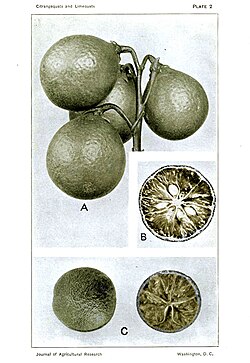
| |
| Citrangequat Thomasville (A and B ) - Citrangequat Telfair (C) | |
Scientific classification 
| |
| Kingdom: | Plantae |
| Clade: | Embryophytes |
| Clade: | Tracheophytes |
| Clade: | Spermatophytes |
| Clade: | Angiosperms |
| Clade: | Eudicots |
| Clade: | Rosids |
| Order: | Sapindales |
| Family: | Rutaceae |
| Genus: | Citrus |
| Species: | C. × georgiana
|
| Binomial name | |
| Citrus × georgiana | |
The citrangequat (Citrus × georgiana) is a citrus hybrid of a citrange and a kumquat, developed by Walter Swingle at Eustis, Florida, in 1909.1 Citrangequats are bitter in taste, but are considered edible by some at the peak of their maturity. Three named cultivars exist:
- 'Sinton' – Nagami kumquat (Fortunella margarita) x Rusk citrange; named for the city of Sinton, Texas
- 'Telfair' – Nagami kumquat x Willits citrange; named for Telfair County, Georgia
- 'Thomasville' – most common citrangequat; named for the city of Thomasville, Georgia.2 'Thomasville' is considered the most cold-hardy edible citrus variety. It can tolerate temperatures down to −15 °C (5 °F).3
References
References
- "Citrus Pages: Kumquats & Kumquat Hybrids". Archived from the original on 28 July 2014. Retrieved 1 May 2010.
- "Home Fruit Production". Aggie-horticulture.tamu.edu. 26 July 2005. Retrieved 1 May 2010.
- Cold Hardy Citrus and Hybrids. Limette (Newsletter Citrus Friends Europe) 8: 1–2.