| Chyloderma | |
|---|---|
| Other names | lymphscrotum or elephantiasis scroti |
 | |
| Elephantiasis caused by infection with a filarial worm circa 1892 | |
| Specialty | Genitourinary |
| Symptoms | Progressive swelling of the scrotum and surrounding tissues |
| Complications | Buried Penis, Hygiene issues, Permanent tissue damage |
| Causes | Genetic, Nematode Infection, Radiotherapy, Trauma |
| Treatment | Surgical excision and reconstruction |
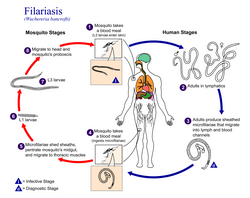
Chyloderma is swelling of the scrotum resulting from chronic lymphatic obstruction.1 Obstruction may be caused by infection, such as with a nematode like Wuchereria bancrofti, or long-term Chlamydia trachomatis; genetic conditions like hereditary lymphedema; or as a result of tissue damage either via trauma, lymphnode removal, or radiotherapy.2 This condition is also known as lymphscrotum or elephantiasis scroti.
See also
See also
References
References
- Liu, Yi; Zeng, Rui (2020), Wan, Xue-Hong; Zeng, Rui (eds.), "Physical Examination of Anus, Rectum and Genitals", Handbook of Clinical Diagnostics, Singapore: Springer, pp. 227–239, doi:10.1007/978-981-13-7677-1_47, ISBN 978-981-13-7677-1, retrieved 2023-01-03
{{citation}}: CS1 maint: work parameter with ISBN (link) - Maachi, Youssef; Fouimtizi, Jaafar; Salim lalaoui, Amine; slaoui, amine; karmouni, Tariq; El Khader, Khalid; Koutani, Abdellatif; Iben Attya Andaloussi, Ahmed (September 2024). "Massive scrotal elephantiasis: A case report". Urology Case Reports. 56 102804. doi:10.1016/j.eucr.2024.102804. PMC 11314419. PMID 39130693.