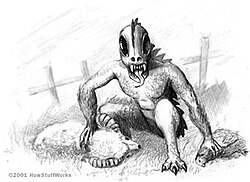
 An artist's rendition of the chupacabra | |
| Creature information | |
|---|---|
| Other name(s) | Chupacabras, El Chupacabra |
| Similar entities | |
| Origin | |
| First attested | 1995 (1995) |
| Country | |
| Region |
|
The chupacabra or chupacabras (Spanish pronunciation: [tʃupaˈkaβɾas], literally 'goat-sucker', from Spanish: chupa, 'sucks', and cabras, 'goats') is a legendary creature, or cryptid, in the folklore of parts of the Americas. The name comes from the animal's purported vampirism – the chupacabra is said to attack and drink the blood of livestock, including goats.
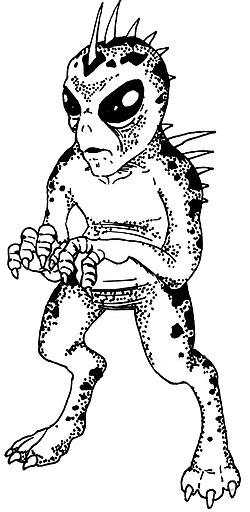
Physical descriptions of the creature vary. In Puerto Rico and in Hispanic America it is generally described as a heavy creature, reptilian and alien-like, roughly the size of a small bear, and with a row of spines reaching from the neck to the base of the tail, while in the Southwestern United States it is depicted as more dog-like.
Initial sightings and accompanying descriptions first occurred in Puerto Rico in 1995. The creature has since been reported as far north as Maine, as far south as Chile, and even outside the Americas in countries like Russia and the Philippines. All of the reports are anecdotal and have been disregarded as uncorroborated or lacking evidence. Sightings in northern Mexico and the Southern United States have been verified as canids afflicted by mange.12
Name
Chupacabras can be literally translated as 'goat-sucker', from chupar ('to suck') and cabras ('goats'). It is known as both chupacabras and chupacabra throughout the Americas, with the former being the original name,3 and the latter a regularization. The name is attributed to Puerto Rican comedian Silverio Pérez, who coined the label in 1995 while commenting on the attacks as a San Juan radio deejay.45
History
In 1975, a series of livestock killings in the small town of Moca, Puerto Rico were attributed to el vampiro de Moca ('the vampire of Moca').6 Initially, it was suspected that the killings were committed by a Satanic cult; later more killings were reported around the island, and many farms reported loss of animal life. Each of the animals was reported to have had its body bled dry through a series of small circular incisions.
The first reported attack eventually attributed to the actual chupacabras occurred in March 1995. Eight sheep were discovered dead in Puerto Rico, each with three puncture wounds in the chest area and reportedly completely drained of blood.7 A few months later, in August, an eyewitness named Madelyne Tolentino reported seeing the creature in the Puerto Rican town of Canóvanas, where as many as 150 farm animals and pets were reportedly killed.7
Puerto Rican comedian and entrepreneur Silverio Pérez is credited with coining the term chupacabras soon after the first incidents were reported in the press. Shortly after the first reported incidents in Puerto Rico, other animal deaths were reported in other countries, such as Argentina, Bolivia, Brazil, Chile, Colombia, Dominican Republic, El Salvador, Honduras, Mexico, Nicaragua, Panama, Peru, and the United States.7
Reports of alleged sightings of the creature proliferated in the mid-1990s in various locations. In Nayarit, dozens of mutilated animals began to appear, as well as in other parts of Mexico, the southwestern United States and in China. The first reports from Puerto Rico numbered more than 200 in 1995.8
In April 2000, in the mining city of Calama (in northern Chile), around one hundred farm animals were reported drained of blood or mutilated in a very unusual manner, a situation that continued until nearly the end of 2002. Soon, a series of complaints reported by the sensationalist press emerged from other parts of the country, although nothing extraordinary was ever confirmed.9 A farmer killed a güiña, attracting international attention,10 and others mistook the fetus of a monito del monte for the creature. An urban myth arose that a supposed NASA mission had arrived in the country to study the phenomenon.11 After much speculation, studies concluded that the attacks were caused solely by dogs: “Both the footprints and hair indicated they were domestic dogs.”12
In the first half of 2002, mutilated cattle were found in several areas of Argentina (in the region between the provinces of Río Negro and Santa Fe). Although removal of the animals' reproductive organs was observed, the media associated the events with the chupacabra phenomenon or with satanic sect rituals. Shortly thereafter, the Servicio Nacional de Sanidad y Calidad Agroalimentaria (SENASA) concluded that the mutilations had been carried out by foxes or hocicudo rats.13
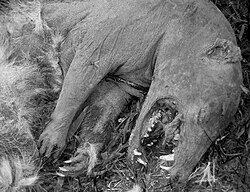
In July 2004, a rancher killed a creature resembling a hairless dog, which he discovered attacking his livestock near San Antonio, Texas.14 The animal, initially named the Elmendorf Beast, was later identified as a coyote with sarcoptic mange after its DNA was examined by the University of California, Davis. In October of that same year, two more carcasses were found in the same area. Biologists in Texas examined samples from both carcasses and determined that they were also coyotes suffering from very severe cases of mange.15
In Coleman County, Texas, a farmer named Reggie Lagow captured an animal using a trap he had set after some of his poultry were found dead. The animal's appearance was described as a mixture of hairless dog, rat and kangaroo. Lagow made the animal available to Texas parks and wildlife officials for identification, although he later stated in an interview with John Adolfi that he had disposed of the creature two days after finding it.16
In mid-August 2006, a woman named Michelle O'Donnell, from Maine, photographed a strange animal by a roadside. O'Donnell recalled having seen the same animal near her home a week earlier, and her husband described it as a mixture between a rodent and a canid. The animal had apparently been struck by a car and was not identifiable. It was originally reported that the carcass had been destroyed by vultures before experts could examine it, but later wildlife officials were able to obtain a DNA sample, determining that it was a hybrid of wolf and dog.17
In August 2007, a woman named Phylis Canion was informed of the discovery of the remains of a strange-looking animal in Cuero, Texas, outside the property of a neighbor.18 Canion had spent the previous weeks attempting to photograph or film a supposed strange creature she believed responsible for the deaths of around 30 of her chickens over several years. Canion also claimed to have seen three creatures similar to the remains discovered. After photographing the remains, Canion contacted a taxidermist to preserve the creature, which she later began displaying in her home. After the story gained national attention, experts from Texas State University–San Marcos offered to conduct DNA testing. The analysis identified the creature as a coyote.19 Unsatisfied, Canion contacted experts at the University of California, Davis for a second analysis, which determined that the creature was specifically a hybrid: a cross between a coyote and a Mexican wolf.18 According to scientists and wildlife specialists, this hybrid is not unknown and has been studied before. The unusual appearance of the animal is believed to have been caused by mange, which may explain its grayish-blue skin.18
The town of Cuero would again be the setting for another sighting a year later, in August 2008, when Brandon Riedel, a deputy sheriff of DeWitt County, filmed an unidentified animal in alleyways using his patrol car dashboard camera.20 The animal was the size of a coyote but hairless, with a long snout, short front legs, and long hind legs. Sheriff Jode Zavesky suspected it was the same type of coyote identified in 2007.21
In September 2009, CNN broadcast a video showing a close-up of an unidentified dead animal. Local speculation suggested it might be a chupacabra. A taxidermist in Blanco County, Texas stated that the animal was likely a genetically mutated coyote.22
In July 2010, animal control officers reportedly shot and killed a supposed chupacabra in Hood County, Texas.23 Scientists from Texas A&M University later identified it as a coyote–dog hybrid with signs of mange and internal parasites.24
On 18 December 2010, in Nelson County, Kentucky, a man named Mark Cothren shot and killed an unrecognizable animal.25 Numerous photographs were taken, and the story was widely reported. The animal was described as having long ears, whiskers, a long tail, and being the size of a domestic cat. It was reportedly submitted for analysis.26
On 4 July 2011, Jack Crabtree of Lake Jackson, Texas reported seeing a supposed chupacabra in his backyard. He later accepted expert explanations that it was likely a coyote with mange.27
In September 2013, a family in Rosario, Santa Fe Province, Argentina, presented the body of a small unidentified animal found in Vera. It was later identified as a naturally mummified cat.28
In September 2013, reports in St. Louis, Missouri, were attributed to a dog with mange.29
On 23 February 2014, a Texas couple claimed to have shot and killed a chupacabra; wildlife experts attributed the animal to known mammals affected by mange.30
On 3 April 2014, another Texas couple claimed to have captured a chupacabra in Ratcliff, Texas. Benjamin Radford suggested it was likely a raccoon affected by sarcoptic mange.31
In 2019 a video recorded by Mundo Ovni showed the results of a supposed attack on chickens in the Seburuquillo sector of Lares, Puerto Rico.32
Reputed origin
A five-year investigation by Benjamin Radford, documented in his 2011 book Tracking the Chupacabra, concluded that the description given by the original eyewitness in Puerto Rico, Madelyne Tolentino, was based on the creature Sil in the 1995 science-fiction horror film Species.1 The alien creature Sil is nearly identical to Tolentino's chupacabra eyewitness account and she had seen the movie before her report: "It was a creature that looked like the chupacabra, with spines on its back and all... The resemblance to the chupacabra was really impressive", Tolentino reported.33 Radford revealed that Tolentino "believed that the creatures and events she saw in Species were happening in reality in Puerto Rico at the time", and therefore concludes that "the most important chupacabra description cannot be trusted".1 This, Radford believes, seriously undermines the credibility of the chupacabra as a real animal.34
The reports of blood-sucking by the chupacabra were never confirmed by a necropsy,1 the only way to conclude that the animal was drained of blood. Dr. David Morales, a Puerto Rican veterinarian with the Department of Agriculture, analyzed 300 reported victims of the chupacabra and found that they had not been bled dry.1
Radford divided the chupacabra reports into two categories: the reports from Puerto Rico and Latin America, where animals were attacked and it is supposed their blood was extracted; and the reports in the United States of mammals, mostly dogs and coyotes with mange, that people call "chupacabra" due to their unusual appearance.35
In 2010, University of Michigan biologist Barry O'Connor concluded that all the chupacabra reports in the United States were simply coyotes infected with the parasite Sarcoptes scabiei, whose symptoms would explain most of the features of the chupacabra: they would be left with little fur, thickened skin, and a rank odor. O'Connor theorized that the attacks on goats occurred "because these animals are greatly weakened, [so] they're going to have a hard time hunting. So they may be forced into attacking livestock because it's easier than running down a rabbit or a deer."361 Both dogs and coyotes can kill and not consume the prey, either because they are inexperienced, or due to injury or difficulty in killing the prey.137 The prey can survive the attack and die afterwards from internal bleeding or circulatory shock.137 The presence of two holes in the neck, corresponding with the canine teeth, are to be expected since this is the only way that most land carnivores have to catch their prey.1 There are reports of stray Mexican hairless dogs being mistaken for chupacabras.38
Appearance

The most common description of the chupacabra is that of a reptile-like creature, said to have leathery or scaly greenish-gray skin and sharp spines or quills running down its back.39 It is said to be approximately 3 to 4 feet (0.9 to 1.2 m) high, and stands and hops in a fashion similar to that of a kangaroo.40 This description was the chief one given to the few Puerto Rican reports in 1995 that claimed to have sighted the creature, with similar reports in parts of Chile and Argentina following.1
Another common description of the chupacabra is of a strange breed of wild dog. This form is mostly hairless and has a pronounced spinal ridge, unusually pronounced eye sockets, fangs, and claws. This description started to appear in the early 2000s from reports trailing north from the Yucatán Peninsula, northern Mexico, and then into the United States; becoming the predominant description since.1 Unlike conventional predators, the chupacabra is said to drain all of the animal's blood (and sometimes organs) usually through three holes in the shape of a downwards-pointing triangle, but sometimes through only one or two holes.41
Plausibility of existence
The chupacabra panic first started in late 1995, Puerto Rico: farmers were mass reporting the mysterious killings of various livestock. In these reports, the farmers recalled two puncture wounds on the animal carcasses.1 Chupacabra killings were soon associated with a seemingly untouched animal carcass other than puncture wounds which were said to be used to suck the blood out of the victim. Reports of such killings began to spread around and eventually out of the country, reaching areas such as Mexico, Brazil, Chile, and the Southern area of the United States.
Most notably, these areas experience frequent, and extreme dry seasons; in the cases of the Puerto Rican reports of 1995 and the Mexican reports of 1996, both countries were currently experiencing or dealing with the aftermath of severe droughts. Investigations carried out in both countries at this time noted a certain dramatic violence in these killings.42 These environmental conditions could provide a simple explanation for the livestock killings: wild predators losing their usual prey to the drought, therefore being forced to hunt the livestock of farmers for sustenance. Thus, the same theory can be applied to many of the other "chupacabra" attacks: that the dry weather had created a more competitive environment for native predators, leading them to prey on livestock to survive. Such an idea can also explain the increased violence in the killings; hungry and desperate predators are driven to hunt livestock to avoid starvation, causing an increase in both the number of livestock killings, and the viciousness of each one.
Evidence of such is provided in page 179 of Benjamin Radford's book, Tracking the Chupacabra: The Vampire Beast in Fact, Fiction, and Folklore. Radford's chart highlights ten significant reports of chupacabra attacks, seven of which had a carcass recovered and examined; these autopsies concluded the causes of death as various animal attacks, as displayed though the animal DNA found on the carcasses.1 Radford provides further evidence in pages 161-162 of his book, displaying animals who are proven to have fallen victim to regular coyote attacks; thus, explaining that it is not unusual for an animal carcass to be left uneaten while only displaying puncture wounds and/or minimal signs of attack.1
The plausibility of the chupacabra's existence is also discredited by the varying descriptions of the creature. Depending on the reported sighting, the creature is described with thick skin or fur, wings or no wings, a long tail or no tail, is bat-like, dog-like, or even alien-like.1 Evidently, the chupacabra has a wide variety of descriptions; to the point where it is hard to believe that all the sightings are of the same creature. A very likely explanation for this phenomenon is that individuals who had heard of the newly popular chupacabra had the creature's name fresh in their mind before they happened to see a strange looking animal. They then resort to make sense of their encounter by labelling it as the recently "discovered" monster, instead of a more realistic explanation. For example, some scientists hypothesize that what many believe to be a chupacabra is a wild or domestic dog affected by mange, a disease causing a thick buildup of skin and hair loss.43
Related legends
The "Ozark Howler", a large bear-like animal, is the subject of a similar legend.44
The Peuchens of Chile also share similarities in their supposed habits, but instead of being dog-like they are described as winged snakes. This legend may have originated from the vampire bat, an animal endemic to the region.45
In the Philippines, another legendary creature called the sigbin shares many of the features in descriptions of the chupacabra. The discovery of a cat-fox in Southeast Asia suggests that sightings of this creature could be attributed to this animal, which remained undiscovered for a long time.46
In 2018 there were reports of suspected chupacabras in Manipur, India. Many domestic animals and poultry were killed in a manner similar to other chupacabra attacks, and several people reported that they had seen creatures. Forensic experts opined that street dogs were responsible for mass killing of domestic animals and poultry after studying the remnants of a corpse.47
In popular culture
- A chupacabra is referred to in the 2009 novel Drive Your Plow Over the Bones of the Dead.
- The debut album by Imani Coppola is titled Chupacabra.
- In Indigenous (2014), the chupacabra is the main antagonist.
- The myth of the chupacabra is mocked in a 2012 episode of the cartoon series South Park, titled "Jewpacabra", in which antisemitic main character Eric Cartman claims to have seen a Jewish Chupacabra that kills children on Easter.48
- The chupacabra was included as one of several vinyl figurines in Cryptozoic Entertainment's Cryptkins blind box toy line in 2018.4950 A redesigned series of figurines, including an updated chupacabra, was released in August 2020.51
- The search for a chupacabra was featured in the 1997 The X-Files episode "El Mundo Gira".52
- "Chupacabra" was the title of the midseason finale of season 4 of the supernatural drama television series Grimm, in December 2014.
- Teen Titans Academy, a DC Comics book, has a bat-like metahuman called Chupacabra, whose alter ego is Diego Pérez, named in honour of George Pérez (the artist that initially illustrated the Teen Titans).53
- A 1999 episode of Futurama features a monster called "El Chupanibre".
- In the Jackie Chan Adventures episode "The Curse of El Chupacabra", Jackie Chan's friend El Toro gets scratched and infected by a Chupacabra, causing him to transform into another Chupacabra every night, much like a werewolf.
- In season 3 of Workaholics called "To Kill a Chupacabraj", Blake finds what he believes to be the deceased corpse of the Rancho Chupacabra in the pool, though it turns out to be the neighbor's dog.
- In the Netflix original series The Imperfects, the character of Juan Ruiz transforms into a chupacabra whenever anyone he cares about is in danger.
- The 2016 film La leyenda del Chupacabras features the titular Chupacabra initially as an antagonist before revealing the creature is merely trying to rescue its family.
- The Brazilian Chupa-Cu legend created in 2017 takes its cues from the chupacabra.
- Guadelupe Garcia McCall's book Summer of the Mariposas features a character named Chencho, a chupacabra who disguises himself as a soggy, young boy who befriends the Garza Sisters and attacks them at nightfall.
- A "Chupakabura" plays the role of a tourism mascot for the fictional town of Manoyama in P.A. Works' 2017 anime Sakura Quest. The spelling and pronunciation relates to a retired mascot called "Kabura Kid", whose name was a pun alluding to the Japanese word for turnips.54
- The 2023 film Chupa is about a chupacabra that is saved from scientists who want to capture it to prove it is real and exploit it for medicine.
- The 2010-2011 Super Sentai series Tensou Sentai Goseiger's main antagonist Brajira of the Messiah assumes the guise Buredoran of the Chupacabra when working with the Yuumajuu, the villain faction of the second arc that is based on cryptids.
- The Ukrainian news program TSN used to broadcast fake news about the Chupacabra when no interesting news were there to broadcast.
- In a short titled "Mission: Chupacabras" from Helluva Boss, a Mexican goat-farmer mistakes Blitzo for a chupacabra and tries to sell him.
- One of the monster clan leaders in I Am Frankelda is a goat riding chupacabra named Chupasangre.
- Chupacabra vs. The Alamo, a 2013 made-for-TV movie.
- Guns of El Chupacabra, a 1997 martial arts based monster film.
- "Chupacabras," a song by the Welsh band Super Furry Animals from their 1997 album Radiator.
- "Chupacabra" is the title of the fifth episode of season 2 of The Walking Dead, in 2011. In it, Daryl Dixon (Norman Reedus) claims to have seen a chupacabra at some point in his life.
- At least one mystery novel uses aspects of the myth as a central theme of the plot.55 Other types of books include those that offer a scientific explanation of the phenomenon.5657
- Ed Lavandera,58 a correspondent for CNN, described it as the "Bigfoot of Latin American culture", and stated that "the chupacabra also symbolizes fear of something that does not exist".59
- Following the incident in Cuero, Texas, the popularity of the chupacabra myth received worldwide attention.60 Phylis Canion, responsible for capturing the alleged specimen, claimed to have sent T-shirts highlighting the event to places such as Italy, Guam and Iraq. The publicity received by the city of Cuero after this event has led some to suggest changing the town's mascot.60 In July 2008, the program Monster Quest, on the History Channel, presented the remains found in Texas, which were later determined to belong to a hybrid between a dog and a coyote.61
- In episode 45 of season 2 of the animated series Dexter's Laboratory, broadcast on 29 October 1997, the boy genius accidentally creates "La Chupacabra", a creature that devours everything in its path and manages to reach South America. Dexter and DeeDee travel there to find and stop it.62
- In a special issue of Fantastic Four by Marvel Comics, released on 28 December 2008, a group of chupacabras are presented as antagonists.63
References
References
- Radford, Benjamin (2011). Tracking the Chupacabra: The Vampire Beast in Fact, Fiction and Folklore. UNM Press. ISBN 978-0-8263-5015-2.
- González Rodríguez, Miried (24 September 2002). "Disfrazado el chupacabras" [Disguised as chupacabras]. Primera Hora (in Spanish). Puerto Rico. Archived from the original on 25 April 2018. Retrieved 25 April 2018.
- "chupacabras". Diccionario Clave. Archived from the original on 4 March 2016. states that both singular and plural is chupacabras.
- Pérez, Silverio (2000). Más humortivación: para el camino del éxito [More Humortivation: The Path for Success]. Dreams Come True. p. 7. ISBN 978-0-9702011-0-2. Archived from the original on 16 November 2023. Retrieved 25 April 2018.
- Radford, Benjamin (1 June 2017). "Was the Nightjar an Early Chupacabra?". Center for Inquiry. Archived from the original on 14 September 2019.
- Wagner, Stephen (2000). "Encounters with Chupacabras". About.com. Archived from the original on 17 October 2007.
- Wagner, Stephen (1998). "On the trail of the Chupacabras". About.com. Archived from the original on 19 September 2005.
- Ker Than (28 October 2010). "Chupacabra Science: How Evolution Made a Mythical Monster". National Geographic. National Geographic Society. Archived from the original on 31 October 2010. Retrieved 6 April 2014.
- Farmer claims on television to have been attacked by a chupacabra
- "Campesinos chilenos anuncian captura del famoso "Chupacabras"" [Chilean farmers announce capture of the famous “Chupacabra”]. Archived from the original on 22 October 2012. Retrieved 16 July 2013.
- "Prensa nicaragüense hace eco de rumor que en Chile, Nasa capturó chupacabras" [Nicaraguan press echoes rumor that NASA captured a chupacabra in Chile]. Archived from the original on 11 January 2014.
- "Copia archivada" [Archived copy]. Archived from the original on 22 October 2012. Retrieved 30 January 2011.
- "Los zorros atacan" [Foxes attack]. Archived from the original on 11 March 2007. Retrieved 5 May 2006.
- Walker Robinson (3 August 2004). "Chupacabra? Strange Animal Found in Elmendorf". WOAI. Archived from the original on 9 November 2005. Retrieved 5 October 2007.
- "Texas' Blood-Sucking Monster". Archived from the original on 3 July 2007. Retrieved 12 June 2007.
- "Texas Farmer Claims He Caught Legendary 'Chupacabra'". KNBC Los Angeles. 25 August 2005. Archived from the original on 26 October 2005.
- "Maine Mystery Beast Possibly Killed By Car". 16 August 2006. Archived from the original on 24 June 2013. Retrieved 30 January 2015.
- "Mysterious Texas 'Blue Dog' Claimed to be Chupacabra". 29 August 2013. Archived from the original on 1 September 2013. Retrieved 30 January 2015.
- "Texas State researchers solve mystery of Cuero chupacabra". Texas State University News Service. 1 November 2007. Archived from the original on 10 May 2019. Retrieved 1 February 2015.
- Ingham, Donna (2010). Mysteries and Legends of Texas: True Stories of the Unsolved and the Unexplained. ISBN 0762766689.
- "'Is this Texas' goat-sucker'". CNN. 11 August 2008. Archived from the original on 16 August 2000.
- "Texas mystery: 'Defective coyote' or chupacabra?". Archived from the original on 5 September 2009.
- "msnbc.com Video Player". MSNBC. Archived from the original on 16 July 2010. Retrieved 6 September 2010.
- "Expert: 'Chupacabra' a coyote-dog hybrid". UPI.com. 14 July 2010. Archived from the original on 16 July 2010. Retrieved 6 September 2010.
- "Mysterious creature found in Nelson County". Wave3.com. 23 December 2010. Archived from the original on 25 December 2010. Retrieved 31 October 2011.
- "Man Shoots, Kills 'Chupacabra' in Ky". Fox News. 28 December 2010. Archived from the original on 30 December 2010. Retrieved 4 February 2014.
- "Gotta Watch: Mythical creatures – This Just In". CNN. Archived from the original on 13 July 2011. Retrieved 31 October 2011.
- "¿Chupacabras o felino?: la historia del bicho raro recorre el mundo" [Chupacabra or feline?: the story of the strange creature goes around the world]. Rosario3.com. 3 September 2013. Archived from the original on 13 November 2013. Retrieved 12 November 2013.
- "Woman claims to have spotted a "Chupacabra" in St. Louis". fox2now.com. Archived from the original on 20 September 2013.
- Heather Saul (27 February 2014). "Texan family claim to have 'killed a mythical chupacabra'". The Independent. Retrieved 6 April 2014.
- Benjamin Radford (4 April 2014). "Texas 'Chupacabra' Turns Out to Be Imposter". Live Science. TechMedia Network. Archived from the original on 6 April 2014. Retrieved 6 April 2014.
- Reportaje: Ataque a gallinas en el sector Seburuquillo de Lares [Report: Attack on hens in the Seburquillo sector of Lares] (News segment) (in Spanish). Mundo Ovnis. Archived from the original on 3 November 2021. Retrieved 20 June 2020 – via YouTube.
- Corrales, Scott (September 1997). Chupacabras and Other Mysteries. Greenleaf Publications. ISBN 1-883729-06-8.
- Radford, Benjamin (May 2011). "Slaying the Vampire: Solving the Chupacabra Mystery" (PDF). Skeptical Inquirer. Vol. 35, no. 3. pp. 45–48. Archived (PDF) from the original on 27 August 2020.
- Than, Ker (28 October 2010). "Chupacabra Science: How Evolution Made a Mythical Monster". National Geographic. Archived from the original on 19 May 2014. Retrieved 6 April 2014.
- Ross-Flannigan, Nancy (25 October 2010). "Scary chupacabras monster is as much victim as villain". The University Record. University of Michigan. Archived from the original on 27 August 2020.
- Wade, Dale A.; Bowns, James E. (May 2010). "Evaluation of Suspected Predator Kills". Texas AgriLife Research and Extension Center. Texas A&M University. Archived from the original on 1 January 2012.
- "Breaking News Videos, Story Video and Show Clips". CNN. 12 March 2014. Archived from the original on 31 August 2010. Retrieved 5 December 2014.
- Carroll, Robert Todd (29 October 2015). "Chupacabra". The Skeptic's Dictionary. Archived from the original on 27 August 2020.
- Wagner, Stephen (8 September 2017). "The Top 10 Most Mysterious Creatures of Modern Times". ThoughtCo. Dotdash. Archived from the original on 17 April 2019.
- De Jesús Mangual, Tomás (9 January 2006). "Imputan otro ataque al Chupacabras" [Another attack attributed to chupacabras]. El Vocero. San Juan, Puerto Rico. Archived from the original on 11 October 2007.
- Davis, Mike (1997). "Monsters and Messiahs". Grand Street (61): 34–38. doi:10.2307/25000088. JSTOR 25000088.
- Rivkin, Jennifer (2014). Searching for el Chupacabra. New York: New York: PowerKids Press. p. 24. ISBN 978-1-4777-7113-6.
{{cite book}}: CS1 maint: publisher location (link) - "Legends of the Ozarks". Travel Channel. pp. 6–8. Archived from the original on 26 July 2019. Retrieved 26 July 2019.
- Moraga, Patricio (26 July 2004). "Tras los pasos del chupacabras" [Following the steps of chupacabras]. El centro, Journal (in Spanish).
{{cite web}}: CS1 maint: deprecated archival service (link) - Meek, James (7 December 2005). "On the trail of the Borneo cat-fox". The Guardian. Archived from the original on 10 December 2005. Retrieved 23 July 2007.
- Karmakar, Rahul (8 December 2018). "On the mystery of livestock deaths in Manipur" (Online news article). The Hindu. Archived from the original on 26 September 2021. Retrieved 26 September 2021.
- Kleinman, Jacob (5 April 2012). "New South Park Episode 'Jewpacabra' Takes on Easter, Passover, Chupacabra [video]". International Business Times. Archived from the original on 25 December 2015. Retrieved 24 December 2015.
- "Cryptkins Vinyl Figures". Cryptozoic Entertainment. Archived from the original on 12 May 2019. Retrieved 3 August 2018.
- Squires, John (13 February 2018). "New Vinyl Toy Line 'Cryptkins' Will Feature Blind Box Monsters of Myth". Bloody Disgusting. Archived from the original on 13 February 2018. Retrieved 3 August 2018.
- "Cryptkins™ Unleashed". Cryptozoic Entertainment. 2020. Archived from the original on 27 August 2020. Retrieved 26 August 2020.
- Hutmacher, Ed (February 2009). "Mexico's Chupacabras Meets the X-Files". Banderas News. Archived from the original on 20 August 2019. Retrieved 20 August 2019.
- Olsen, Jon (9 August 2021). "Teen Titans Academy Reveals a Student's Major Batman Villain Connection". CBR. Archived from the original on 25 May 2022. Retrieved 25 May 2022.
- "The Spring 2017 Anime Preview Guide - Sakura Quest". Anime News Network. 27 June 2024. Retrieved 28 June 2024.
- Wagner, Lloyd. El Chupacabras: Trail of the Goatsucker. ISBN 0-595-33315-X
- Corrales, Scott. Chupacabras: And Other Mysteries. ISBN 1-883729-06-8
- Authors, Mandy, and Clifton C. Phillips. Chupacabra, You Don't Scare Me! ISBN 0-8059-4490-7
- "Ed Lavandera - National Correspondent". Biography. Cable News Network. A Warner Media Company. 2016. Archived from the original on 5 May 2015. Retrieved 6 January 2021.
- "Illegal Immigrants Frightened by Raid Rumors; George Bush: "The Decider"; "Happy Slapping"". CNN. 2 May 2006. Archived from the original on 14 November 2007. Retrieved 5 October 2007.
- "Chupacabra craze goes global". KVUE. 28 August 2007. Archived from the original on 4 December 2007. Retrieved 5 October 2007.
- "MonsterQuest: Chupacabra". 23 July 2008. Archived from the original on 11 September 2008. Retrieved 24 July 2008.
- "Dexters Lab: Got Your Goat". Archived from the original on 13 February 2014. Retrieved 23 February 2014.
- Beale, Lewis (26 December 2007). "Chupacabras Marvel back". NY Daily News. Retrieved 22 June 2013.
External links
External links
- Alleged chupacabra likely a "Xolo dog"; story a hoax
- Lundborg, Pam (25 September 2009). ""Chupacabra" remains bought by Oswego County man". Syracuse.com. Retrieved 20 January 2016.
- Chupacabra mystery solved from Seeker.com
- Ooty: Kangaroo cousin lived in western ghats?
- Dunning, Brian (22 January 2022). "Skeptoid #815: On the Trail of the Chupacabra". Skeptoid.