| Chubutisaurus Temporal range: Cenomanian
| |
|---|---|
| |
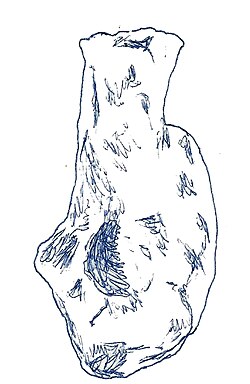
| Drawing of the scapula | |
Scientific classification 
| |
| Kingdom: | Animalia |
| Phylum: | Chordata |
| Class: | Reptilia |
| Clade: | Dinosauria |
| Clade: | Saurischia |
| Clade: | †Sauropodomorpha |
| Clade: | †Sauropoda |
| Clade: | †Macronaria |
| Clade: | †Somphospondyli |
| Genus: | †Chubutisaurus del Corro, 1975 |
| Type species | |
| †Chubutisaurus insignis del Corro, 1975
| |
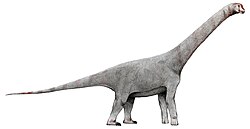
Chubutisaurus (meaning "Chubut lizard") is a genus of somphospondylan sauropod dinosaur from the Late Cretaceous (Cenomanian) Cerro Barcino Formation of Argentina.1 The type species, Chubutisaurus insignis, was described by del Corro in 1975.23 Chubutisaurus had a more robust radius than Venenosaurus.4 In 2010 Gregory S. Paul gave a length of 18 metres (59 ft) and a weight of 12 tonnes (13 short tons).5 Thomas Holtz estimated its length at 23 metres (75 ft) in 2012.6
Discovery and history
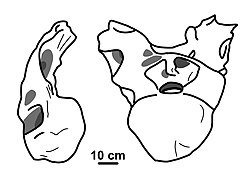
Fossils of Chubutisaurus were first discovered in 1961 by Mr. Martinez, a local farmer near El Escorial village in Chubut Province, Patagonia in central Argentina. In 1965, these fossils were collected by paleontologist Guillermo del Corro through the use of dynamite and then cataloged at the Museo Argentino de Ciencias Naturales under MACN 18222. The strata these fossils derive from corresponds to the Bayo Overo Member of the Cerro Barcino Formation, which dates to the Cenomanian age (100-98 mya) of the early Late Cretaceous period. In 1975, del Corro scientifically described the remains and assigned them to a new genus and species of sauropod, which he named Chubutisaurus insignis. The generic name Chubutisaurus derives from Chubut, the province the fossils were found in, and the Latin root "sauros" meaning "lizard", a common suffix for dinosaur names. The specific name insignis comes from the Latin "insignis" meaning "remarkable".217
The holotype (name-bearing) specimen of Chubutisaurus comes from a single incomplete and disarticulated individual which was unearthed over several expeditions. The remains initially collected in 1965 included fragments of dorsal (back) vertebrae, a sacral vertebra, eleven caudal (tail) centrum, a left femur, tibia, humerus, ulna, radius, four metacarpals, and several appendicular fragments.1 However, del Corro did not describe or correctly identify many of these elements in his description.21 In 1993, paleontologist Leonardo Salgado redescribed Chubutisaurus and reinterpreted it as an indeterminate sauropod.7 In 1991, an expedition to Chubut, with the help of Mr. Martinez's son, relocated the quarry where the holotype was found. In excavations in 1991 and 2007, many new remains were unearthed including: several dorsal vertebrae fragments, a caudal vertebra, ribs, and chevrons. In 2011, these fossils, along with previously undescribed elements, were described in detail by paleontologist Jose Carballido and colleagues who concluded that they all belonged to the holotype individual. Parts of the holotype such as the femur and tibia, were donated to the Museo Provincial de Ciencias Naturales y Oceanografía and deposited under CHMO-901 and CHMO-565. The fossils unearthed by the 1991 and 2007 trips were cataloged at the Museo Paleontológico ‘Egidio Feruglio’ under MPEF-PV 1129, meaning that the holotype of Chubutisaurus is deposited in three institutions.18
Paleoecology

Chubutisaurus lived in the Cerro Barcino Formation of Cretaceous Argentina. It lived alongside the notosuchian Barcinosuchus,9 the large titanosaur Patagotitan,10 the ceratosaurid Genyodectes,11 and the carcharodontosaurid Tyrannotitan.12
References
References
- Carballido, José L.; Pol, Diego; Cerda, Ignacio; Salgado, Leonardo (2011-02-10). "The osteology of Chubutisaurus insignis del Corro, 1975 (Dinosauria: Neosauropoda) from the 'middle' Cretaceous of central Patagonia, Argentina". Journal of Vertebrate Paleontology. 31 (1): 93–110. Bibcode:2011JVPal..31...93C. doi:10.1080/02724634.2011.539651. hdl:11336/94194. ISSN 0272-4634.
- G. del Corro. 1975. Un nuevo sauropodo del Cretácico Superior. Actas del Primer Congreso Argentino de Paleontologia y Bioestratigrafia 2:229-240
- Weishampel, et al. (2004).
- "Forelimb," Tidwell, Carpenter, and Meyer (2001). Page 148.
- Paul, Gregory S. (2010). The Princeton Field Guide to Dinosaurs. New Jersey: Princeton University Press. pp. 206. ISBN 9780691137209.
- Holtz, Thomas R. (2012). "Holtz's Genus List" (PDF).
- Salgado, Leonardo (1993). "COMMENTS ON CHUBUTISAURUS INSIGNIS DEL CORRO (SAURISCHIA, SAUROPODA)". Ameghiniana (in Spanish). 30 (3): 265–270. ISSN 1851-8044.
- Carballido, Jose L.; Bellardini, Flavio; Salgado, Leonardo (2022), "The Rise of Non-Titanosaur Macronarians in South America", in Otero, Alejandro; Carballido, José L.; Pol, Diego (eds.), South American Sauropodomorph Dinosaurs: Record, Diversity and Evolution, Cham: Springer International Publishing, pp. 237–268, doi:10.1007/978-3-030-95959-3_7, ISBN 978-3-030-95959-3, retrieved 2025-07-26
- Juan Martín Leardi and Diego Pol (2009). "The first crocodyliform from the Chubut Group (Chubut Province, Argentina) and its phylogenetic position within basal Mesoeucrocodylia". Cretaceous Research. 30 (6): 1376–1386. Bibcode:2009CrRes..30.1376L. doi:10.1016/j.cretres.2009.08.002. hdl:11336/90736.
- Carballido, José L.; Pol, Diego; Otero, Alejandro; Cerda, Ignacio A.; Salgado, Leonardo; Garrido, Alberto C.; Ramezani, Jahandar; Cúneo, Néstor R.; Krause, Javier M. (2017-08-16). "A new giant titanosaur sheds light on body mass evolution among sauropod dinosaurs". Proceedings of the Royal Society B: Biological Sciences. 284 (1860). doi:10.1098/rspb.2017.1219. ISSN 0962-8452. PMC 5563814. PMID 28794222.
- Rauhut, Oliver W. M. (2004-12-10). "Provenance and anatomy of Genyodectes serus, a large-toothed ceratosaur (Dinosauria: Theropoda) from Patagonia". Journal of Vertebrate Paleontology. 24 (4): 894–902. doi:10.1671/0272-4634(2004)024[0894:PAAOGS]2.0.CO;2. ISSN 0272-4634. S2CID 131178611.
- Canale, Juan Ignacio; Novas, Fernando Emilio; Pol, Diego (2015-01-02). "Osteology and phylogenetic relationships of Tyrannotitan chubutensis Novas, de Valais, Vickers-Rich and Rich, 2005 (Theropoda: Carcharodontosauridae) from the Lower Cretaceous of Patagonia, Argentina" (PDF). Historical Biology. 27 (1): 1–32. Bibcode:2015HBio...27....1C. doi:10.1080/08912963.2013.861830. hdl:11336/17607. ISSN 0891-2963. S2CID 84583928.
Bibliography
- Tidwell, V., Carpenter, K. & Meyer, S. 2001. New Titanosauriform (Sauropoda) from the Poison Strip Member of the Cedar Mountain Formation (Lower Cretaceous), Utah. In: Mesozoic Vertebrate Life. D. H. Tanke & K. Carpenter (eds.). Indiana University Press, Eds. D.H. Tanke & K. Carpenter. Indiana University Press. 139–165.
- Weishampel, David B; et al. (2004). "Dinosaur distribution (Early Cretaceous, South America)." In: Weishampel, David B.; Dodson, Peter; and Osmólska, Halszka (eds.): The Dinosauria, 2nd, Berkeley: University of California Press. pp. 563–570. ISBN 0-520-24209-2.
External links
External links
- Data related to Chubutisaurus at Wikispecies
- Chubutisaurus in the Paleobiology Database
- Chubutisaurus in the Dino Directory