| Chriacus | |
|---|---|
| |
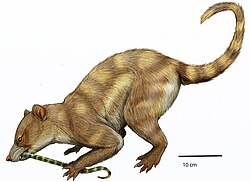
| Life reconstruction | |
Scientific classification 
| |
| Kingdom: | Animalia |
| Phylum: | Chordata |
| Class: | Mammalia |
| Infraclass: | Placentalia |
| Order: | †Arctocyonia |
| Family: | †Arctocyonidae |
| Genus: | †Chriacus Cope, 1883 |
| Type species | |
| †Lipodectes pelvidens Cope, 1881
| |
| Species | |
| |
| Synonyms | |
|
Genus synonymy
Species synonymy
| |
Chriacus is an extinct genus of placental mammals that lived in what is now North America during the Paleocene and early Eocene epochs (Puercan through Wasatchian faunal ages). In life, members of the genus may have looked and lived in ways similar to coatimundis,12 though they were not closely related to any living mammal. Like many early Cenozoic mammals, its relationships are uncertain, with possible affinities to ungulates or Ferae (carnivorans and their relatives). Chriacus and similar Paleocene-Eocene mammals are generally known as arctocyonids, though it is unclear whether different arctocyonids are actually related to each other.
Paleobiology
Chriacus were probably omnivores, eating fruit, eggs, insects and small mammals.3
Climbing adaptations
Chriacus has better-preserved fossils than most other Paleocene mammals.4156 The most complete skeleton belongs to an uncertain species (Chriacus sp.) from the Willwood Formation of Wyoming.1 In life, it would have measured around 1 metre (3.3 ft) long, including a long, robust tail, which may or may not have been prehensile. Other features include a light build, weighing approximately 5–7 kilograms (11–15 lb), and many adaptations typical of animals that live in trees. These include the ability to walk on the soles of their five-toed feet, as well as claws which are long, curved, and compressed. The powerfully-built limbs have flexible joints, especially the ankles, an adaptation that allows an animal to turn its hind feet behind it, like modern tree squirrels, in order to climb downward.12
Senses
Analysis of casts of the brain and inner ear from C. pelvidens and C. baldwini suggest these animals depended more on their sense of smell than sight, may have been able to hear about as well as a modern aardvark, and were slow-moving to moderately agile.7
The encephalization quotient (EQ) had a range of 0.12–0.41 (1.0 is set as an average brain size in modern mammals of a similar body size) and the neocortex was less developed than later mammals. By the standards of modern mammals, Chriacus would have been neither especially quick nor intelligent, but their brains were comparable to many mammals of their time.7
Derived features of the inner ear were shared with fossils that are assigned to Euungulata (artiodactyls+perissodactyls), suggesting the genus may be close to the origin of ungulates,7 though it is too different in form to be a direct ancestor.1
Classification
Species
At least nine species are currently recognized in the genus,7 though it is unknown whether all of these species share exclusive ancestry with each other. Variation within the genus (at its widest concept) is unusually high.7 Chriacus fossils from the Willwood Formation point towards a slow, climbing lifestyle similar to some scansorial carnivorans.126 Others, such as a C. baldwini skeleton from New Mexico, are oddly similar to the fleet-footed early artiodactyl Diacodexis.6
| Species | Author and Year | Notes |
|---|---|---|
| C. badgleyi | Gingerich, 1989 | A small species from the Wasatchian 0 age of Clarks Fork Basin, Wyoming. Name honors Dr. Catherine Badgley.8 |
| C. baldwini | (Cope, 1882) | A medium-sized species from the Torrejonian age of New Mexico,4910 Wyoming, Utah, and Montana.11 Molars similar to C. baldwini are also found in the Roche Percée local fauna of Saskatchewan (Ravenscrag Formation, Tiffanian 4 age).12 |
| C. calenancus | Van Valen, 1978 | Based on teeth from Montana. Puercan 2 to Torrejonian 1 in age, this species of Chriacus may be the oldest and most herbivorous in the genus.11 Name means "green jaws" in J.R.R. Tolkien's Sindarin language.13 May be a junior synonym of C. baldwini.10 |
| C. gallinae | Matthew & Granger, 1915 | From the Wasatchian-age Almagre fauna, in the San Jose Formation of New Mexico.1415 The original tooth fossils of this species were missing as of 1971, and may not actually qualify as Chriacus. Similar teeth are also known from the Powder River fauna of Wyoming.16 |
| C. katrinae | Van Valen, 1978 | Based on a jaw from Rock Bench Quarry in Bighorn Basin, Wyoming. Named after Van Valen's daughter.13 Rock Bench Quarry is late Torrejonian in age.17 |
| C. metocometi | Van Valen, 1978 | Based on an upper molar from Mason Pocket in southwestern Colorado. Named after the Wampanoag chief Metacomet.13 Mason Pocket is Tiffanian 4 in age.18 |
| C. oconostotae | Van Valen, 1978 | Based on fossils from Wyoming: Cedar Point Quarry in Bighorn Basin and the Chappo type locality in the Green River Basin.19 Also reported from the Paskapoo Formation of Alberta.20 All of these sites are Tiffanian 3 in age.1918 Named after the Cherokee chief Oconostota.13 |
| C. orthogonius | Russell, 1929 | From the Torrejonian age of Alberta, Montana, and New Mexico.21 |
| C. pelvidens | (Cope, 1881) | The type species of Chriacus, originally regarded as a species of Lipodectes. A large species from the Torrejonian age of New Mexico and Wyoming.14510 |
| C. punitor | (Simpson, 1935) | From the Torrejonian age of New Mexico, Montana,11 and Alberta. Formerly known as Metachriacus punitor.14 Sometimes regarded as a synonym of C. orthogonius,13 though other times regarded as a valid species of its own.11 |
Affinities
Like most early placental mammals, the classification of Chriacus in relation to other groups is disputed. Halliday et al. (2015)22 consider it a member of the family Oxyclaenidae, a sister group to palaeoryctids and creodonts, while Tabuce et al. (2011) classify it as an arctocyonid, most closely related to Loxolophus, then Arctocyon, and allied to the Mesonychia.23
This difference mirrors the history of the mammals classified as arctocyonids. They were first considered creodonts (imagined to be the ancestors of modern carnivorans), and then "condylarths" (imagined to be the ancestors of hoofed mammals).13624 Modern studies suggest the confusion is due to the fact that ungulates, carnivorans, and creodonts are related groups, and flesh-eating lineages and adaptations evolved within each of them. Chriacus lies somewhere within the range of their early relatives.
References
References
- Rose, K. D. (1987-04-17). "Climbing adaptations in the early eocene mammal Chriacus and the origin of artiodactyla". Science. 236 (4799): 314–316. Bibcode:1987Sci...236..314R. doi:10.1126/science.3426662. ISSN 0036-8075. JSTOR 1698647. PMID 3426662.
- Rose, Kenneth D. (1990), Bown, Thomas M.; Rose, Kenneth D. (eds.), "Postcranial skeletal remains and adaptations in early Eocene mammals from the Willwood Formation, Bighorn Basin, Wyoming", Dawn of the Age of Mammals in the northern part of the Rocky Mountain Interior, North America, Geological Society of America, pp. 107–134, doi:10.1130/spe243-p107, ISBN 978-0-8137-2243-6, retrieved 2026-04-05
{{citation}}: CS1 maint: work parameter with ISBN (link) - Palmer, D., ed. (1999). The Marshall Illustrated Encyclopedia of Dinosaurs and Prehistoric Animals. London: Marshall Editions. p. 234. ISBN 1-84028-152-9.
- Matthew, W.D. (1897). "A revision of the Puerco fauna". Bulletin of the American Museum of Natural History. 9: 259–323.
- Williamson, T.E.; Lucas, S.G. (1993). "Paleocene vertebrate paleontology of the San Juan Basin, New Mexico". New Mexico Museum of Natural History and Science Bulletin. 2: 105–135.
- Rose, K D (1996-02-20). "On the origin of the order Artiodactyla". Proceedings of the National Academy of Sciences. 93 (4): 1705–1709. doi:10.1073/pnas.93.4.1705. ISSN 0027-8424. JSTOR 1698647. PMC 40006. PMID 11607634.
- Bertrand, Ornella C.; Shelley, Sarah L.; Wible, John R.; Williamson, Thomas E.; Holbrook, Luke T.; Chester, Stephen G.B.; Butler, Ian B.; Brusatte, Stephen L. (2019). "Virtual endocranial and inner ear endocasts of the Paleocene 'condylarth' Chriacus: new insight into the neurosensory system and evolution of early placental mammals". Journal of Anatomy. 236 (1): 21–49. doi:10.1111/joa.13084. PMC 6904649. PMID 31667836. S2CID 204969130.
- Gingerich, Philip D. (1989). "New Earliest Wasatchian Mammalian Fauna from the Eocene of Northwestern Wyoming: Composition and Diversity in a Rarely Sampled High-Floodplain Assemblage". University of Michigan Papers on Paleontology. 28.
- Matthew, W.D. (1937). "Paleocene faunas of the San Juan Basin, New Mexico". Transactions of the American Philosophical Society. 30 (3532). American Philosophical Society: 1–510. Bibcode:1937Natur.140...46C. doi:10.2307/1005521. JSTOR 1005521.
- Kondrashov, Peter E.; Lucas, Spencer G. (2006). "Early Paleocene (Puercan and Torrejonian) archaic ungulates (Condylarthra, Procreodi and Acreodi) of the San Juan Basin, New Mexico". New Mexico Museum of Natural History and Science Bulletin. 34: 84–97.
- Clemens, William A.; Wilson, Gregory P. (2009). "Early Torrejonian mammalian local faunas from northeastern Montana, USA". Museum of Northern Arizona Bulletin. 65: 111–158.
- Rankin, Brian D. (2018-04-09). "New late Paleocene (late middle Tiffanian) mammals from the Roche Percée local fauna, south-eastern Saskatchewan, Canada". Journal of Systematic Palaeontology. 16 (5): 361–393. doi:10.1080/14772019.2017.1296498. ISSN 1477-2019.
- Van Valen, Leigh (1978). "The beginning of the age of mammals" (PDF). Evolutionary Theory. 4: 45–80.
- Matthew WD; Granger W (1915) A review of the lower Eocene Wasatch and Wind River faunas. Part I. —Order Ferae (Carnivora). Suborder Creodonta. Bull Am Mus Nat Hist 34, 1–103.
- Lucas, Spencer G.; Schoch, Robert M.; Manning, Earl; Tsentas, Costas (1981). "The Eocene biostratigraphy of New Mexico". Geological Society of America Bulletin. 92 (12): 951. doi:10.1130/0016-7606(1981)92<951:TEBONM>2.0.CO;2. ISSN 0016-7606.
- E. Delson (1971.) "Fossil mammals of the early Wasatchian Powder River local fauna, Eocene of northeast." Bulletin of the American Museum of Natural History 146(4)
- Gingerich, Philip D.; Rose, Kenneth D.; Krause, David W. (1980). "Early Cenozoic mammalian faunas of the Clark's Fork Basin-Polecat Bench area, northwestern Wyoming". University of Michigan Papers on Paleontology. 24: 51–68.
- Sweedler, Rory E.; Rust, Kathleen L.; Beard, K. Christopher (2025-12-31). "Late Paleocene (Tiffanian) Mammalia from the Titanoides Locality, Bison Basin, Wyoming: Revised Biostratigraphic Age and Paleobiogeographic Implications". Annals of Carnegie Museum. 91 (3). doi:10.2992/007.091.0303. ISSN 0097-4463.
- Gunnell, Gregg F. (1994-03-31). "Paleocene mammals and faunal analysis of the Chappo Type Locality (Tiffanian), Green River Basin, Wyoming". Journal of Vertebrate Paleontology. 14 (1): 81–104. doi:10.1080/02724634.1994.10011540. ISSN 0272-4634. JSTOR 4523547.
- Scott, Craig S.; Webb, Michael W.; Fox, Richard C. (2006). "Horolodectes sunae, an enigmatic mammal from the late Paleocene of Alberta, Canada". Journal of Paleontology. 80 (5): 1009–1025. doi:10.1666/0022-3360(2006)80[1009:HSAEMF]2.0.CO;2. ISSN 0022-3360.
- Szalay, Frederick S.; Lucas, Spencer G. (1996). "The postcranial morphology of Paleocene Chiacus and Mixodectes and the phylogenetic relationships of archontan mammals". New Mexico Museum of Natural History and Science Bulletin. 7: 1–47.
- Halliday, Thomas J.D.; Upchurch, Paul; Goswami, Anjali (2015). "Resolving the relationships of Paleocene placental mammals". Biological Reviews. 92 (1): 521–550. doi:10.1111/brv.12242. PMC 6849585. PMID 28075073.
- Tabuce, Rodolphe; Clavel, Julien; Telles Antunes, Miguel (2011-02-01). "A structural intermediate between triisodontids and mesonychians (Mammalia, Acreodi) from the earliest Eocene of Portugal". Die Naturwissenschaften. 98 (2): 145–55. Bibcode:2011NW.....98..145T. doi:10.1007/s00114-010-0747-y. PMID 21181109. S2CID 22526630.
- Shelley, Sarah L, Stephen L Brusatte, and Thomas E Williamson (2015). "Resolving the higher-level phylogenetic relationships of "Triisodontidae" ('Condylarthra') within Placentalia" (PDF). Society of Vertebrate Paleontology 75th Annual Meeting (Dallas, TX) - Meeting Program & Abstracts.
{{cite web}}: CS1 maint: multiple names: authors list (link)