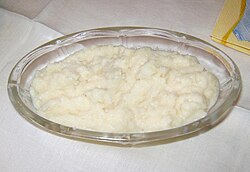
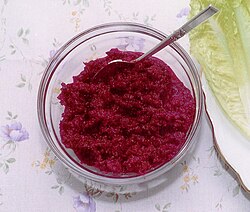
Chrain (Czech: křen; Slovak: chren; German: Meerrettich or Kren; Polish: chrzan; Romanian: hrean; Russian: хрен, romanized: khren; Ukrainian: хрiн, romanized: khrin; Yiddish: כריין, romanized: khreyn; Hebrew: חזרת, romanized: khazeret; meaning 'horseradish' in all these languages) is a spicy paste made of grated horseradish. It is a common condiment for meat and fish dishes in Eastern and Central European cuisines (Slovene, northern Croatian, Belarusian, Czech, Slovak, German (especially Bavarian), Polish, Romanian, Latvian, Lithuanian, Russian, Ukrainian and Ashkenazi Jewish cuisine).12 Chrain comes from Yiddish כריין, which is in turn a loanword from Slavic languages.2
There are two common forms of chrain in the Slavic and Ashkenazi Jewish cuisines. White chrain consists of grated horseradish and vinegar, and sometimes sugar and salt, while red chrain includes the addition of beetroot. These types of chrain are distinct from other horseradish-based condiments in that they are pareve (contain no dairy products), making it acceptable at both meat and dairy meals according to Jewish dietary law. In contrast, many Central European varieties include cream, while some Russian recipes call for chrain with smetana (sour cream).1 There are also varieties including apples, lingonberry, cranberry and oranges.
The use of chrain in Eastern and Central European cuisines Jewish communities is ancient, and is first attested in writing from the 12th century. Though it has had several historical uses, chrain is most commonly associated in modern times with gefilte fish, for which it is considered an essential condiment.2 In Eastern and Central European cuisines chrain is a typical condiment for various fish dishes, as well as for meat and fish zakuski, such as kholodets (aspic) and beef tongue.1
-
 Gefilte fish with red chrain
 -
 Meat with mustard (left) and white chrain (right)
 -
 Smoked pork belly with spices and horseradish Chernihiv region Ukraine
References
References
- Похлёбкин, Вильям Васильевич (1991). "Русский хрен". Приправы. Москва: Агропромиздат. p. 30. ISBN 5-9524-0718-8. Archived from the original on 2019-04-30. Retrieved 2016-03-05. [William Pokhlebkin (1991). "Russian chrain". Condiments (in Russian). Moscow: Agropromizdat. p. 30.]
- Marks, Gil (2010). "Horseradish". Encyclopedia of Jewish Food. Hoboken: John Wiley & Sons. pp. 265–266. ISBN 978-0-470-39130-3.