| Choptank Formation | |
|---|---|
| Stratigraphic range: | |
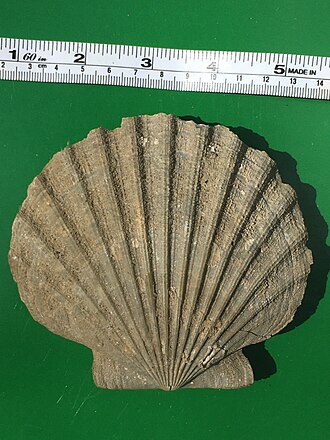 Chesapecten nefrens, Choptank Formation | |
| Type | Formation |
| Unit of | Chesapeake Group |
| Underlies | St. Marys Formation |
| Overlies | Calvert Formation |
| Location | |
| Region | Virginia, Maryland |
| Country | United States |
| Type section | |
| Named for | Choptank River |
The Choptank Formation is a geologic formation in Virginia and Maryland. It preserves fossils dating from the mid-late Miocene of the Neogene period, from the latest Langhian to the early Tortonian (13.9 to 11 million years ago).1
Fossils
The Choptank Formation is extremely fossiliferous. Some of the fossil species represented include the following:23
Sharks
- Otodus megalodon
- Carcharodon hastalis
- Isurus oxyrhincus
- Carcharomodus escheri
- Physogaleus contortus
- Galeocerdo aduncus
- Carcharhinus
- Hemipristis serra
- Squatina sp.
- Notorhyncus cepedianus
- Carcharias
- Isurus retroflexus
- Parotodus benedeni
- Alopias vulpinus
- Alopias grandis
- Cetorhinus
- Negaprion brevirostris
- Rhizoprionodon
- Sphryna laevissima
Rays and Other Cartilaginous Fish
Fish
- Acipenseridae indet.
- Opsanus sp.
- Serranidae indet
- Pogonias sp.
- Sciaenops sp.
- Tautoga sp.
- Acanthocybium cf. solandri
- Thunnus sp.
- Istiophorus cf. platypterus
- Mola cf. pileata
- Ariopsis aff. A. felis
- Trisopterus sculptus
- Micromesistius cognatus
- Prionotus
Cetaceans
- Aglaocetus sp.
- Cetotherium sp.
- Delphinodon sp.
- Eurhinodelphis sp.
- Macrokentriodon morani
- Mesocetus
- Parietobalaena
- Orycterocetus
- Pelocetus
Pinnipeds
- Callophoca obscura
- Leptophoca proxima
- Prophoca sp.
Crocodilians
- Thecachampsa antiquus
- Thecachampsa sericodon
Invertebrates
- Chesapecten nefrens
- Chesacardium
- Euspira heros
- Mariacolpus octonnaria
- Macrocallista marylandica
- Stewartia anodonta
- Marvacrassitella marylandica
- Ecphora
- Panopea
- Albertella aberti
Terrestrial Mammals
- Chesalophodon gulottai5
- Cynarctus wangi
- Gomphotherium calvertensis
- Hipparion cf. phosphorum
See also
See also
References
References
- Carnevale, Giorgio; Godfrey, Stephen James (2018). "Miocene bony fishes from the Calvert, Choptank, St. Marys and Eastover Formations, Chesapeake Group, Maryland and Virginia". Smithsonian Contributions to Paleobiology (100).
- Godfrey, Stephen J., ed. (2018-09-25). "The Geology and Vertebrate Paleontology of Calvert Cliffs, Maryland, USA". Smithsonian Contributions to Paleobiology (100): 2–274. doi:10.5479/si.1943-6688.100. ISSN 1943-6688.
- "Paleobiology Collections Search". collections.nmnh.si.edu. Retrieved 2020-08-14.
- "Collections". The Fossil Forum. Retrieved 2020-08-14.
- Eshelman, R. E.; Lambert, W. D.; Morgan, G. S.; Godfrey, S. J.; Bohaska, D. J. (2026). "Review of the Miocene Gomphotheriidae (Mammalia: Proboscidea) from the Chesapeake Group, Middle Atlantic Coastal Plain of North America". Smithsonian Contributions to Paleobiology. 109: 5–72. doi:10.5479/si.32085168.
- Various Contributors to the Paleobiology Database. "Fossilworks: Gateway to the Paleobiology Database". Retrieved 17 December 2021.