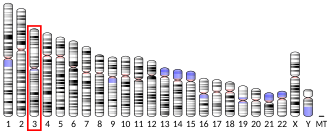
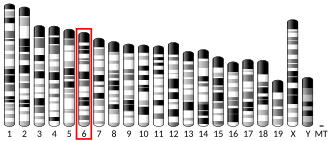
Neural cell adhesion molecule L1-like protein also known as close homolog of L1 (CHL1) is a protein that in humans is encoded by the CHL1 gene.6
CHL1 is a cell adhesion molecule closely related to the L1. In melanocytic cells CHL1 gene expression may be regulated by MITF,7 and can act as a helicase protein during the interphase stage of mitosis.
The protein, however, has dynamic localisation, meaning that it has not only multiple roles in the cell, but also various locations.
References
References
- GRCh38: Ensembl release 89: ENSG00000134121 – Ensembl, May 2017
- GRCm38: Ensembl release 89: ENSMUSG00000030077 – Ensembl, May 2017
- "Human PubMed Reference:". National Center for Biotechnology Information, U.S. National Library of Medicine.
- "Mouse PubMed Reference:". National Center for Biotechnology Information, U.S. National Library of Medicine.
- Pandey G, Kanwar P, Pandey A (2014). Global Comparative Analysis of CBL-CIPK Gene Families in Plants. Springer International Publishing. p. 52. ISBN 978-3-319-09078-8.
- Wei MH, Karavanova I, Ivanov SV, Popescu NC, Keck CL, Pack S, et al. (September 1998). "In silico-initiated cloning and molecular characterization of a novel human member of the L1 gene family of neural cell adhesion molecules". Human Genetics. 103 (3): 355–364. doi:10.1007/s004390050829. PMID 9799093. S2CID 3177127.
- Hoek KS, Schlegel NC, Eichhoff OM, Widmer DS, Praetorius C, Einarsson SO, et al. (December 2008). "Novel MITF targets identified using a two-step DNA microarray strategy". Pigment Cell & Melanoma Research. 21 (6): 665–676. doi:10.1111/j.1755-148X.2008.00505.x. PMID 19067971. S2CID 24698373.
Further reading
Further reading
- Chen QY, Chen Q, Feng GY, Lindpaintner K, Chen Y, Sun X, et al. (March 2005). "Case-control association study of the close homologue of L1 (CHL1) gene and schizophrenia in the Chinese population". Schizophrenia Research. 73 (2–3): 269–274. doi:10.1016/j.schres.2004.06.001. PMID 15653271. S2CID 40310550.
- Manderson EN, Birch AH, Shen Z, Mes-Masson AM, Provencher D, Tonin PN (May 2009). "Molecular genetic analysis of a cell adhesion molecule with homology to L1CAM, contactin 6, and contactin 4 candidate chromosome 3p26pter tumor suppressor genes in ovarian cancer". International Journal of Gynecological Cancer. 19 (4): 513–525. doi:10.1111/IGC.0b013e3181a3cd38. PMID 19509545. S2CID 27315616.
- Rose JE, Behm FM, Drgon T, Johnson C, Uhl GR (2010). "Personalized smoking cessation: interactions between nicotine dose, dependence and quit-success genotype score". Molecular Medicine. 16 (7–8): 247–253. doi:10.2119/molmed.2009.00159. PMC 2896464. PMID 20379614.
- Tam GW, van de Lagemaat LN, Redon R, Strathdee KE, Croning MD, Malloy MP, et al. (April 2010). "Confirmed rare copy number variants implicate novel genes in schizophrenia". Biochemical Society Transactions. 38 (2): 445–451. doi:10.1042/BST0380445. PMID 20298200. S2CID 31716113.
- Gast D, Riedle S, Riedle S, Schabath H, Schlich S, Schneider A, et al. (July 2005). "L1 augments cell migration and tumor growth but not beta3 integrin expression in ovarian carcinomas". International Journal of Cancer. 115 (4): 658–665. doi:10.1002/ijc.20869. PMID 15704102. S2CID 44309818.
- Lim SD, Stallcup W, Lefkove B, Govindarajan B, Au KS, Northrup H, et al. (2007). "Expression of the neural stem cell markers NG2 and L1 in human angiomyolipoma: are angiomyolipomas neoplasms of stem cells?". Molecular Medicine. 13 (3–4): 160–165. doi:10.2119/2006-00070.Lim. PMC 1892760. PMID 17592550.
- Palmieri RT, Wilson MA, Iversen ES, Clyde MA, Calingaert B, Moorman PG, et al. (December 2008). "Polymorphism in the IL18 gene and epithelial ovarian cancer in non-Hispanic white women". Cancer Epidemiology, Biomarkers & Prevention. 17 (12): 3567–3572. doi:10.1158/1055-9965.EPI-08-0548. PMC 2664299. PMID 19064572.
- Sakurai K, Migita O, Toru M, Arinami T (2002). "An association between a missense polymorphism in the close homologue of L1 (CHL1, CALL) gene and schizophrenia". Molecular Psychiatry. 7 (4): 412–415. doi:10.1038/sj.mp.4000973. PMID 11986985.
- Liu T, Qian WJ, Gritsenko MA, Camp DG, Monroe ME, Moore RJ, et al. (2005). "Human plasma N-glycoproteome analysis by immunoaffinity subtraction, hydrazide chemistry, and mass spectrometry". Journal of Proteome Research. 4 (6): 2070–2080. doi:10.1021/pr0502065. PMC 1850943. PMID 16335952.
- Whittard JD, Sakurai T, Cassella MR, Gazdoiu M, Felsenfeld DP (June 2006). "MAP kinase pathway-dependent phosphorylation of the L1-CAM ankyrin binding site regulates neuronal growth". Molecular Biology of the Cell. 17 (6): 2696–2706. doi:10.1091/mbc.E06-01-0090. PMC 1474804. PMID 16597699.
- Angeloni D, Lindor NM, Pack S, Latif F, Wei MH, Lerman MI (October 1999). "CALL gene is haploinsufficient in a 3p- syndrome patient". American Journal of Medical Genetics. 86 (5): 482–485. doi:10.1002/(SICI)1096-8628(19991029)86:5<482::AID-AJMG15>3.0.CO;2-L. hdl:11382/301711. PMID 10508992.
External links
External links