| Poecile | |
|---|---|

| |
| Marsh tit, Poecile palustris | |

| |
| Chestnut-backed chickadee, Poecile rufescens | |
Scientific classification 
| |
| Kingdom: | Animalia |
| Phylum: | Chordata |
| Class: | Aves |
| Order: | Passeriformes |
| Family: | Paridae |
| Genus: | Poecile Kaup, 1829 |
| Type species | |
| Parus palustris Linnaeus, 1758
| |
| Species | |
|
see text | |

| |
| Combined map of all Poecile species | |
Poecile is a genus of birds in the tit family Paridae. It contains 15 species, which are distributed across Europe, Asia, and North America; the European and Asian species are known as tits, and the North American species as chickadees. In the past, most authorities retained Poecile as a subgenus within the genus Parus, but treatment as a distinct genus, initiated by the American Ornithologists Union, is now widely accepted.1 This is supported by mtDNA cytochrome b sequence analysis.2
The genus Poecile was described by the German naturalist Johann Jakob Kaup in 1829.3 Kaup included two species in the genus, marsh tit Poecile palustris and coal tit P. ater;3 the type species was subsequently designated as the marsh tit by English zoologist George Robert Gray in 1842 (with coal tit now in the genus Periparus).45 The name Poecile as cited by Kaup is from Ancient Greek ποιχίλος poikhilos, with his interpretation as 'bunt' ("coloured") in German;3 another related word poikilidos denoted an unidentified small bird.6 It had traditionally been treated as feminine, giving name endings such as cincta; however, this was not specified by Kaup, and under the ICZN the genus name must therefore be treated by default as masculine, giving name endings such as cinctus.1
| ||||||||||||||||||||||||||||||||||||||||||||||||||||||||||||||||||||||||||||||||||||||||||
| Phylogeny of the Poecile based on Tritsch et al. 2017.7 |
Species
The genus includes the following fifteen species:8
| Image | Common name | Scientific name | Distribution |
|---|---|---|---|
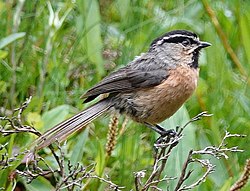 |
White-browed tit | Poecile superciliosus | central China and Tibet. |
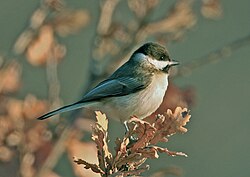 |
Sombre tit | Poecile lugubris | southeast Europe and southwest Asia |
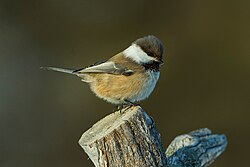 |
Grey-headed chickadee (North American name) or Siberian tit (European name) | Poecile cinctus | subarctic Scandinavia and northern Asia, and also into North America in Alaska and the far northwest of Canada |
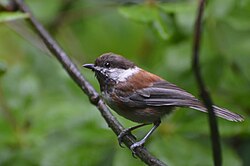 |
Chestnut-backed chickadee | Poecile rufescens | Pacific Northwest of the United States and western Canada, from southern Alaska to southwestern California |
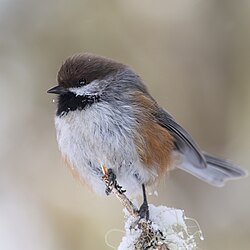 |
Boreal chickadee | Poecile hudsonicus | Canada, Alaska, and northernmost portions of the lower 48 United States |
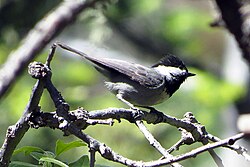 |
Mexican chickadee | Poecile sclateri | Mexico |
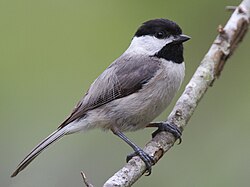 |
Carolina chickadee | Poecile carolinensis | United States from New Jersey west to southern Kansas and south to Florida and Texas |
 |
Black-capped chickadee | Poecile atricapillus | Across North America, from New England to Newfoundland in the east, and from Washington to Alaska in the west |
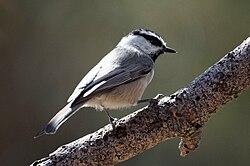 |
Mountain chickadee | Poecile gambeli | western United States |
 |
Père David's tit | Poecile davidi | central China in southern Gansu, western Hubei, southern Shaanxi and Sichuan |
 |
Black-bibbed tit | Poecile hypermelaenus | central and eastern China to southeast Tibet and western Myanmar. |
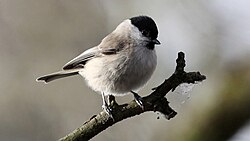 |
Marsh tit | Poecile palustris | temperate Europe and northern Asia |
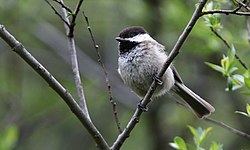 |
Sichuan tit | Poecile weigoldicus | central China |
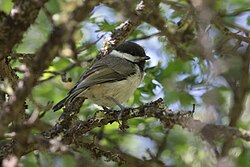 |
Caspian tit | Poecile hyrcanus | northern Iran, just extending into Azerbaijan. |
 |
Willow tit | Poecile montanus | temperate and subarctic Europe and northern Asia |
All the species are roughly similar in size, ranging from 11–15 cm, with marsh, willow, and black-bibbed tits marginally the smallest (11–13 cm), and sombre tit and mountain chickadee marginally the largest (13–15 cm). The plumage pattern is also broadly similar across the genus, with a black or dark brown crown and bib, whitish or pale buffy cheeks, and whitish to buffy underparts. Two species (white-browed tit and mountain chickadee) differ in having a white supercilium. The back and wings are brown to grey-brown or reddish brown, in some with pale fringes on the secondary feathers.9
Behaviour
Many species have alarm calls with a distinctive "chick-a-dee-dee-dee" format, which gives rise to the name 'chickadee'; the number of "dees" depends on the predator and the risk it poses, with more "dees" for high risk predators such as small owls.10
Ecology
All are birds of mature woodlands and forests, often with a preference for old-growth habitats with plentiful tree cavities for nesting; many, but not all, readily adapt to human provision of food and nestboxes.11
Several species, including Siberian, marsh and willow tits in Eurasia and mountain chickadee in North America, are food-caching birds. Siberian tit, living in the coldest environment, is the greatest hoarder, with individual birds storing up to half a million food items throughout each year for winter use.12 Mountain chickadees can hide as many as 80,000 individual seeds each, which they retrieve during the winter. Their ability to do so depends on their spatial memory of the locations. Birds that live in harsher conditions, where their ability to remember the location of food is more important, have been found to have better memory abilities, a larger hippocampus, and more neurons than chickadees that live in milder climates where food sources are easier to find without relying on memory.1314
In culture
The chickadee (specifically the black-capped chickadee P. atricapillus) is the official bird for the US state of Massachusetts,15 the Canadian province of New Brunswick,16 as well as the cities of Calgary, Alberta,17 and Regina, Saskatchewan.18 The chickadee is also the state bird of Maine, but a species has never been specified. A proposed bill in 2019 would have named the black-capped chickadee as the official species for Maine, but was unanimously voted down in committee.1920 The de facto species for Maine remains the black-capped.
References
References
- Gosler, A.; Clement, P.; Bonan, A. (2019) [2007]. del Hoyo, J.; Elliott, A.; Sargatal, J.; Christie, D.A.; de Juana, E. (eds.). "Tits and Chickadees (Paridae)". Handbook of the Birds of the World Alive. Lynx Edicions. doi:10.2173/bow.parida1.01. S2CID 216446005. Retrieved 27 August 2019.
- Gill, F.B.; Slikas, B.; Sheldon, F.H. (2005). "Phylogeny of titmice (Paridae): II. Species relationships based on sequences of the mitochondrial cytochrome-b gene". Auk. 122 (1): 121–143. doi:10.1642/0004-8038(2005)122[0121:POTPIS]2.0.CO;2.
- Kaup, Johann Jakob (1829). Skizzirte Entwickelungs-Geschichte und natürliches System der europäischen Thierwelt (in German). Vol. c. 1. Darmstadt: Carl Wilhelm Leske. p. 114.
- Gray (1842). Appendix to a List of the Genera of Birds (2nd ed.). London: R. and J.E. Taylor. p. 8.
- Dickinson, E.C.; Christidis, L., eds. (2014). The Howard & Moore Complete Checklist of the Birds of the World. Vol. 2: Passerines (4th ed.). Eastbourne, UK: Aves Press. p. 428. ISBN 978-0-9568611-2-2.
- Jobling, J.A. (2018). del Hoyo, J.; Elliott, A.; Sargatal, J.; Christie, D.A.; de Juana, E. (eds.). "Key to Scientific Names in Ornithology". Handbook of the Birds of the World Alive. Lynx Edicions. Retrieved 15 May 2018.
- Tritsch, Christian; Martens, Jochen; Sun, Yue-Hua; Heim, Wieland; Strutzenberger, Patrick; Päckert, Martin (2017). "Improved sampling at the subspecies level solves a taxonomic dilemma – A case study of two enigmatic Chinese tit species (Aves, Passeriformes, Paridae, Poecile)". Molecular Phylogenetics and Evolution. 107: 538–550. Bibcode:2017MolPE.107..538T. doi:10.1016/j.ympev.2016.12.014. PMID 27965081.
- Gill, Frank; Donsker, David (eds.). "Waxwings and their allies, tits & penduline tits". World Bird List Version 6.1. International Ornithologists' Union. Retrieved 15 February 2016.
- Hoyo, Josep del (2020). All the birds of the world. Barcelona: Lynx edicions. pp. 574–575. ISBN 978-84-16728-37-4.
- "Chirpy chickadees signal deadliness of predators". New Scientist. 23 June 2005. Retrieved 6 March 2019.
- Harrap, Simon; Quinn, David (1996). Tits, Nuthatches & Treecreepers. London: Christopher Helm. pp. 237–294. ISBN 0-7136-3964-4.
- Harrap, Simon; Quinn, David (1996). Tits, Nuthatches & Treecreepers. London: Christopher Helm. p. 287. ISBN 0-7136-3964-4.
- Mason, Betsy (5 September 2019). "Total recall: A brilliant memory helps chickadees survive". Knowable Magazine. doi:10.1146/knowable-090519-1. Retrieved 24 February 2022.
- Pravosudov, Vladimir V.; Roth II, Timothy C. (23 November 2013). "Cognitive Ecology of Food Hoarding: The Evolution of Spatial Memory and the Hippocampus". Annual Review of Ecology, Evolution, and Systematics. 44 (1): 173–193. doi:10.1146/annurev-ecolsys-110512-135904. ISSN 1543-592X. Retrieved 24 February 2022.
- Massachusetts Facts Secretary of the Commonwealth. Retrieved 6 March 2019.
- Government of New Brunswick, Canada (2020-06-17). "NB Symbols". www2.gnb.ca. Retrieved 2022-08-17.
- Villani, Mark (14 May 2022). "Tweet it out! Calgary names official bird". ctvnews. Retrieved 2022-05-18.
- "Regina's Official Bird!". beheard.regina.ca. Retrieved 2025-03-08.
- "Maine lawmakers end the flap over Maine's state bird". Press Herald. 2019-03-06. Retrieved 2024-04-11.
- WGME (2019-03-07). "Lawmakers kill bill over Maine's state bird". WGME. Retrieved 2024-04-11.