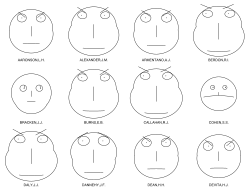
Chernoff faces, invented by applied mathematician, statistician, and physicist Herman Chernoff in 1973, display multivariate data in the shape of a human face. The individual parts, such as eyes, ears, mouth, and nose, represent values of the variables by their shape, size, placement, and orientation. The idea behind using faces is that humans readily recognize them and notice small changes. Chernoff faces handle each variable differently. Because the features of the faces vary in perceived importance, the way variables are mapped to features should be carefully chosen (e.g., eye size and eyebrow slant have been found to carry significant weight).1 Robert J. K. Jacob used Chernoff faces to encode multivariate data for rapid visual parsing.2
Detail
Chernoff faces themselves can be plotted on a standard X–Y graph; the faces can be positioned X–Y based on the two most important variables, and then the faces themselves represent the rest of the dimensions for each item. Edward Tufte, presenting such a diagram, says that this kind of Chernoff-face graph would "reduce well, maintaining legibility even with individual areas of 0.05 square inches as shown ... with cartoon faces and even numbers becoming data measures, we would appear to have reached the limit of graphical economy of presentation, imagination, and let it be admitted, eccentricity".3
Extensions
Asymmetrical faces
In 1981, Bernhard Flury and Hans Riedwyl suggested "asymmetrical" Chernoff faces;4 since a face has vertical symmetry (around the y axis), the left side of the face is identical to the right and is basically wasted space – a point also made by Tufte.5 One could have the 18 variables that specify the left be one set of data, but use a different set of data for the right side of the face, allowing one face to depict 35 different measurements. They present results showing that such asymmetrical faces are useful in visualizing databases of identical twins, for example, and are useful in grouping as pairs of Chernoff faces would be.4
Chernoff fish
Julie Rodriguez and Piotr Kaczmarek use "Chernoff fish", where various parts of a cartoon fish are used to encode different financial details.6
In literature
In Peter Watts' novel Blindsight (2006), a transhuman character is seen using a variant of Chernoff faces. This use is explained by the character as a more efficient method of representing data, for a large portion of the human brain is devoted to facial recognition. 7
In the 2014 sci-fi short story "Degrees of Freedom" by Karl Schroeder, Chernoff faces make a prominent appearance as a future technology, supporting the communication of aggregate sentiment and perspective.8
References
References
- Morris, Christopher J.; Ebert, David S.; Rheingans, Penny L. (2000). "Experimental analysis of the effectiveness of features in Chernoff faces". Proceedings Volume 3905, 28th AIPR Workshop: 3D Visualization for Data Exploration and Decision Making. doi:10.1117/12.384865.
- Rousuck, J. Wynn (August 25, 1974). "Computer Faces That 'Talk'". The Sun. Baltimore, MD. p. M12.
- Edward R. Tufte, The Visual Display of Quantitative Information, p. 142.
- Flury, Bernhard; Riedwyl, Hans (December 1981). "Graphical Representation of Multivariate Data by Means of Asymmetrical Faces". Journal of the American Statistical Association. 76 (376). American Statistical Association: 757–765. doi:10.2307/2287565. JSTOR 2287565.
- Edward R. Tufte, The Visual Display of Quantitative Information, p. 97: "Halves may be easier to sort (by matching the right half of an unsorted face to the left half of a sorted face) than full faces. Or else an asymmetrical full face can be used to report additional variables (Flury & Riedwyl 1981). Bilateral symmetry doubles the space consumed by the design in a graph, without adding new information."
- Visualizing Financial Data. John Wiley & Sons. May 2, 2016. ISBN 978-1-118-90785-6.
- Peter Watts. "Blindsight". Retrieved April 19, 2021.
- Karl Schroeder. "End notes from Karl Schroeder's "Degrees of Freedom"". Archived from the original on March 24, 2018. Retrieved March 23, 2018.
Other sources
- Chernoff, Herman (1973). "The Use of Faces to Represent Points in K-Dimensional Space Graphically" (PDF). Journal of the American Statistical Association. 68 (342). American Statistical Association: 361–368. doi:10.2307/2284077. JSTOR 2284077. Archived from the original (PDF) on April 15, 2012.
Further reading
Further reading
- "Facial Representation of Multivariate Data", David L. Huff, Vijay Mahajan and William C. Black. Journal of Marketing, Vol. 45, No. 4 (Autumn, 1981), pp. 53–59.Published by: American Marketing Association
- "FACES-A FORTRAN Program for Generating Chernoff-Type Faces on a Line Printer", Danny W. Turner and F. Eugene Tidmore. The American Statistician, Vol. 34, No. 3 (Aug., 1980), p. 187 Published by: American Statistical Association
- "Representing Points in Many Dimensions by Trees and Castles", B. Kleiner and J. A. Hartigan. Journal of the American Statistical Association, Vol. 76, No. 374 (Jun., 1981), pp. 260–269. Published by the American Statistical Association
- Gonick, L. and Smith, W. The Cartoon Guide to Statistics. New York: Harper Perennial, p. 212, 1993.
- Moriarity, S. (1979). "Communicating financial information through multidimensional graphics". Journal of Accounting Research 17, 205-224.
- Stock, D. and Watson, C. (1984). "Human judgment accuracy, multidimensional graphics, and humans versus models". Journal of Accounting Research 22, 192-206.
- Information Visualization: Perception for Design (2004), Ware C.
- "The Empathic Visualisation Algorithm: Chernoff Faces Revisited" (218)[1]
- "An empirical evaluation of Chernoff faces, star glyphs, and spatial visualizations for binary data", Michael D. Lee, Rachel E. Reilly, Marcus E. Butavicius. ACM International Conference Proceeding Series; Vol. 142, Proceedings of the Asia-Pacific symposium on Information visualisation - Volume 24
- "Graphical representation of multivariate data using Chernoff faces", Raciborski 2009, The Stata Journal 9, Number 3, pp. 374–387
- Jan Fazlagić, Windham Loopesko, Leszek Matuszak, Rigby Johnson. Perspectives and good practices in visualization of knowledge about public entities // Information Visualization Techniques in the Social Sciences and Humanities / Grzegorz Osinski, Veslava Osińska. — IGI Global, 2018. — P. 199−214. — ISBN 978-1-5225-4991-8.
External links
External links
- "Professor Puts a Face on the Performance of Baseball Managers" -(The New York Times; Chernoff faces generated from manager performance data)
- "A Critique of Chernoff Faces" Archived 2011-12-21 at the Wayback Machine - Robert Kosara, published February 25, 2007
- Java visualization
- Example of urban living conditions in LA
- Example and code for the R statistical software environment
- Example and code for Python using the matplotlib library
- ChernoffFace package in Python using the matplotlib library
- Function ChernoffFace in Wolfram Language (Mathematica) at Wolfram Function Repository
- Example code for MATLAB using Statistics and Machine Learning Toolbox.
- "Mapping Quality of Life with Chernoff Faces", Joseph G. Spinelli and Yu Zhou
- "SUGI 26: Escaping Flatland: Chernoff's Faces Revisited" -(modifying FACES for more aesthetic output)
- "Faces 2.0" Archived 2008-09-27 at the Wayback Machine -(a Mac OS X screensaver which generates random Chernoff faces)
- NovoSpark Visualizer - an advanced visualization tool that enables qualitative analysis of multidimensional data through the exploration of a graphical image.
- "How to visualize data with cartoonish faces ala Chernoff" (Flowing Data)
- Baseball faces - at the Institute for Quantitative Social Science at Harvard University