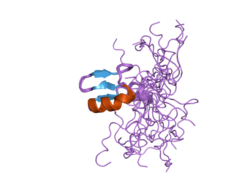
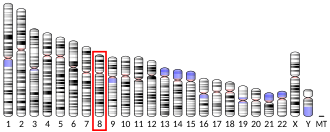



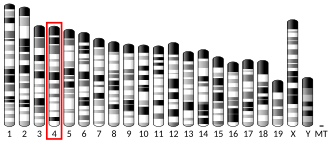

Chromodomain-helicase-DNA-binding protein 7 is an ATP-dependent 'chromatin' or 'nucleosome' remodeling factor 5 that in humans is encoded by the CHD7 gene.67
CHD7 is an ATP-dependent chromatin remodeler homologous to the Drosophila trithorax-group protein Kismet.8 Mutations in CHD7 are associated with CHARGE syndrome.9 This protein belongs to a larger group of ATP-dependent chromatin remodeling complexes, the CHD subfamily.
Clinical
Mutations in this gene have been associated with the CHARGE syndrome.91011
References
References
- GRCh38: Ensembl release 89: ENSG00000171316 – Ensembl, May 2017
- GRCm38: Ensembl release 89: ENSMUSG00000041235 – Ensembl, May 2017
- "Human PubMed Reference:". National Center for Biotechnology Information, U.S. National Library of Medicine.
- "Mouse PubMed Reference:". National Center for Biotechnology Information, U.S. National Library of Medicine.
- Bouazoune K, Kingston RE (November 2012). "Chromatin remodeling by the CHD7 protein is impaired by mutations that cause human developmental disorders". Proceedings of the National Academy of Sciences of the United States of America. 109 (47): 19238–19243. Bibcode:2012PNAS..10919238B. doi:10.1073/pnas.1213825109. PMC 3511097. PMID 23134727.
- Nagase T, Kikuno R, Ishikawa KI, Hirosawa M, Ohara O (February 2000). "Prediction of the coding sequences of unidentified human genes. XVI. The complete sequences of 150 new cDNA clones from brain which code for large proteins in vitro". DNA Research. 7 (1): 65–73. doi:10.1093/dnares/7.1.65. PMID 10718198. S2CID 22402957.
- "Entrez Gene: chromodomain helicase DNA binding protein 7".
- Bajpai R, Chen DA, Rada-Iglesias A, Zhang J, Xiong Y, Helms J, et al. (February 2010). "CHD7 cooperates with PBAF to control multipotent neural crest formation". Nature. 463 (7283): 958–962. Bibcode:2010Natur.463..958B. doi:10.1038/nature08733. PMC 2890258. PMID 20130577.
- Vissers LE, van Ravenswaaij CM, Admiraal R, Hurst JA, de Vries BB, Janssen IM, et al. (September 2004). "Mutations in a new member of the chromodomain gene family cause CHARGE syndrome". Nature Genetics. 36 (9): 955–957. doi:10.1038/ng1407. PMID 15300250.
- Lalani SR, Safiullah AM, Fernbach SD, Harutyunyan KG, Thaller C, Peterson LE, et al. (February 2006). "Spectrum of CHD7 mutations in 110 individuals with CHARGE syndrome and genotype-phenotype correlation". American Journal of Human Genetics. 78 (2): 303–314. doi:10.1086/500273. PMC 1380237. PMID 16400610.
- Zentner GE, Layman WS, Martin DM, Scacheri PC (March 2010). "Molecular and phenotypic aspects of CHD7 mutation in CHARGE syndrome". American Journal of Medical Genetics. Part A. 152A (3): 674–686. doi:10.1002/ajmg.a.33323. PMC 2918278. PMID 20186815.
Further reading
Further reading
- Delahaye A, Sznajer Y, Lyonnet S, Elmaleh-Bergès M, Delpierre I, Audollent S, et al. (August 2007). "Familial CHARGE syndrome because of CHD7 mutation: clinical intra- and interfamilial variability". Clinical Genetics. 72 (2): 112–121. doi:10.1111/j.1399-0004.2007.00821.x. PMID 17661815. S2CID 8143298.
- Van de Laar I, Dooijes D, Hoefsloot L, Simon M, Hoogeboom J, Devriendt K (November 2007). "Limb anomalies in patients with CHARGE syndrome: an expansion of the phenotype". American Journal of Medical Genetics. Part A. 143A (22): 2712–2715. doi:10.1002/ajmg.a.32008. PMID 17937444. S2CID 21353716.
- Holak HM, Kohlhase J, Holak SA, Holak NH (June 2008). "New recognized ophthalmic morphologic anomalies in CHARGE syndrome caused by the R2319C mutation in the CHD7 gene". Ophthalmic Genetics. 29 (2): 79–84. doi:10.1080/13816810801918391. PMID 18484313. S2CID 205807551.
- Sanlaville D, Verloes A (April 2007). "CHARGE syndrome: an update". European Journal of Human Genetics. 15 (4): 389–399. doi:10.1038/sj.ejhg.5201778. PMID 17299439.
- Kim HG, Kurth I, Lan F, Meliciani I, Wenzel W, Eom SH, et al. (October 2008). "Mutations in CHD7, encoding a chromatin-remodeling protein, cause idiopathic hypogonadotropic hypogonadism and Kallmann syndrome". American Journal of Human Genetics. 83 (4): 511–519. doi:10.1016/j.ajhg.2008.09.005. PMC 2561938. PMID 18834967.
- Dagle JM, Lepp NT, Cooper ME, Schaa KL, Kelsey KJ, Orr KL, et al. (April 2009). "Determination of genetic predisposition to patent ductus arteriosus in preterm infants". Pediatrics. 123 (4): 1116–1123. doi:10.1542/peds.2008-0313. PMC 2734952. PMID 19336370.
- Wincent J, Schulze A, Schoumans J (2009). "Detection of CHD7 deletions by MLPA in CHARGE syndrome patients with a less typical phenotype". European Journal of Medical Genetics. 52 (4): 271–272. doi:10.1016/j.ejmg.2009.02.005. PMID 19248844.
- Wincent J, Holmberg E, Strömland K, Soller M, Mirzaei L, Djureinovic T, et al. (July 2008). "CHD7 mutation spectrum in 28 Swedish patients diagnosed with CHARGE syndrome". Clinical Genetics. 74 (1): 31–38. doi:10.1111/j.1399-0004.2008.01014.x. PMID 18445044. S2CID 205406725.
- Gennery AR, Slatter MA, Rice J, Hoefsloot LH, Barge D, McLean-Tooke A, et al. (July 2008). "Mutations in CHD7 in patients with CHARGE syndrome cause T-B + natural killer cell + severe combined immune deficiency and may cause Omenn-like syndrome". Clinical and Experimental Immunology. 153 (1): 75–80. doi:10.1111/j.1365-2249.2008.03681.x. PMC 2432100. PMID 18505430.
- Tellier AL, Cormier-Daire V, Abadie V, Amiel J, Sigaudy S, Bonnet D, et al. (April 1998). "CHARGE syndrome: report of 47 cases and review". American Journal of Medical Genetics. 76 (5): 402–409. doi:10.1002/(SICI)1096-8628(19980413)76:5<402::AID-AJMG7>3.0.CO;2-O. PMID 9556299.
- Jongmans MC, van Ravenswaaij-Arts CM, Pitteloud N, Ogata T, Sato N, Claahsen-van der Grinten HL, et al. (January 2009). "CHD7 mutations in patients initially diagnosed with Kallmann syndrome--the clinical overlap with CHARGE syndrome". Clinical Genetics. 75 (1): 65–71. doi:10.1111/j.1399-0004.2008.01107.x. PMC 2854009. PMID 19021638.
- Jongmans MC, Hoefsloot LH, van der Donk KP, Admiraal RJ, Magee A, van de Laar I, et al. (January 2008). "Familial CHARGE syndrome and the CHD7 gene: a recurrent missense mutation, intrafamilial recurrence and variability". American Journal of Medical Genetics. Part A. 146A (1): 43–50. doi:10.1002/ajmg.a.31921. PMID 18074359. S2CID 24479591.
- Vuorela PE, Penttinen MT, Hietala MH, Laine JO, Huoponen KA, Kääriäinen HA (October 2008). "A familial CHARGE syndrome with a CHD7 nonsense mutation and new clinical features". Clinical Dysmorphology. 17 (4): 249–253. doi:10.1097/MCD.0b013e328306a704. PMID 18978652. S2CID 35257043.
- Bergman JE, de Wijs I, Jongmans MC, Admiraal RJ, Hoefsloot LH, van Ravenswaaij-Arts CM (2008). "Exon copy number alterations of the CHD7 gene are not a major cause of CHARGE and CHARGE-like syndrome". European Journal of Medical Genetics. 51 (5): 417–425. doi:10.1016/j.ejmg.2008.03.003. PMID 18472328.
- Lee YW, Kim SC, Shin YL, Kim JW, Hong HS, Lee YK, et al. (March 2009). "Clinical and genetic analysis of the CHD7 gene in Korean patients with CHARGE syndrome". Clinical Genetics. 75 (3): 290–293. doi:10.1111/j.1399-0004.2008.01127.x. PMID 19159393. S2CID 43480931.
- Qi Q, Yi L, Yang C, Chen H, Shen L, Mo X, et al. (December 2008). "[Mutation analysis of the CHD7 gene in patients with congenital heart disease]". Zhonghua Yi Xue Yi Chuan Xue Za Zhi = Zhonghua Yixue Yichuanxue Zazhi = Chinese Journal of Medical Genetics. 25 (6): 637–641. PMID 19065520.
- Writzl K, Cale CM, Pierce CM, Wilson LC, Hennekam RC (2007). "Immunological abnormalities in CHARGE syndrome". European Journal of Medical Genetics. 50 (5): 338–345. doi:10.1016/j.ejmg.2007.05.002. PMID 17684005.
- Nakajima D, Okazaki N, Yamakawa H, Kikuno R, Ohara O, Nagase T (June 2002). "Construction of expression-ready cDNA clones for KIAA genes: manual curation of 330 KIAA cDNA clones". DNA Research. 9 (3): 99–106. CiteSeerX 10.1.1.500.923. doi:10.1093/dnares/9.3.99. PMID 12168954.
- Vuorela P, Ala-Mello S, Saloranta C, Penttinen M, Pöyhönen M, Huoponen K, et al. (October 2007). "Molecular analysis of the CHD7 gene in CHARGE syndrome: identification of 22 novel mutations and evidence for a low contribution of large CHD7 deletions". Genetics in Medicine. 9 (10): 690–694. doi:10.1097/GIM.0b013e318156e68e. PMID 18073582.
- Layman WS, McEwen DP, Beyer LA, Lalani SR, Fernbach SD, Oh E, et al. (June 2009). "Defects in neural stem cell proliferation and olfaction in Chd7 deficient mice indicate a mechanism for hyposmia in human CHARGE syndrome". Human Molecular Genetics. 18 (11): 1909–1923. doi:10.1093/hmg/ddp112. PMC 2678924. PMID 19279158.
- Buck C, Balasubramanian R, Crowley, Jr WF (2013-07-18). Isolated Gonadotropin-Releasing Hormone (GnRH) Deficiency. University of Washington, Seattle. PMID 20301509. NBK1334. In Adam MP, Everman DB, Mirzaa GM, Pagon RA, Wallace SE, Gripp KW, et al. (1993). Pagon RA, Bird TD, Dolan CR (eds.). GeneReviews. Seattle WA: University of Washington, Seattle. PMID 20301295.
- Lalani SR, Hefner MA, Belmont JW, Davenport SL (2012-02-02). "CHD7 Disorder". CHARGE Syndrome. University of Washington, Seattle. PMID 20301296. NBK1117. In GeneReviews
- Bardakjian T, Weiss A, Schneider AS (2006-05-26). "Microphthalmia/Anophthalmia/Coloboma Spectrum – RETIRED CHAPTER, FOR HISTORICAL REFERENCE ONLY". Anophthalmia/Microphthalmia Overview. University of Washington, Seattle. PMID 20301552. NBK1378. In GeneReviews
External links
External links
- CHD7+protein,+human at the U.S. National Library of Medicine Medical Subject Headings (MeSH)
- Human CHD7 genome location and CHD7 gene details page in the UCSC Genome Browser.