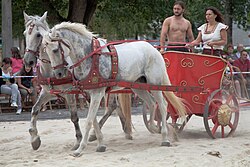

A chariot is a type of vehicle similar to a cart, driven by a charioteer, usually using horsesnote 1 to provide rapid motive power. The oldest known chariots have been found in burials of the Sintashta culture in modern-day Chelyabinsk Oblast, Russia, dated to c. 1950–1880 BC12 and are depicted on cylinder seals from Central Anatolia in Kültepe dated to c. 1900 BC.2 The critical invention that allowed the construction of light, horse-drawn chariots was the spoked wheel.
The chariot was a fast, light, open, two-wheeled conveyance drawn by two or more equids (usually horses) that were hitched side by side, and was little more than a floor with a waist-high guard at the front and sides. It was initially used for ancient warfare during the Bronze and Iron Ages, but after its military capabilities had been superseded by light and heavy cavalries, chariots continued to be used for travel and transport, in processions, for games, and in races.
Etymology
The word "chariot" comes from the Latin term carrus through French chariot, a loanword from Gaulish karros.3
In ancient Rome, a biga described a chariot requiring two horses, a triga three, and a quadriga four.
Origins
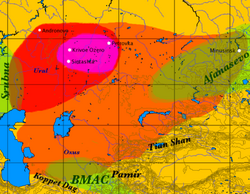
Chariots emerged in the early 2nd millennium BC following earlier developments in wheeled transport and domestication of the horse. The earliest fully developed spoke-wheeled horse chariots are from the chariot burials of the Andronovo (Timber-Grave) sites of the Sintashta-Petrovka Proto-Indo-Iranian culture in modern Russia and Kazakhstan from around 2000 BC.1 However, Littauer and Crouwel (1996) and Raulwing and Burmeister (2012) disagree that the Sintashta culture vehicle finds are true chariots, but rather classed as carts.45
Indo-European world
Hittites
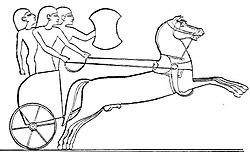
The oldest testimony of chariot warfare in the ancient Near East is the Old Hittite Anitta text (18th century BC), which mentions 40 teams of horses at the siege of Salatiwara. Since the text mentions teams rather than chariots, the existence of chariots in the 18th century BC is uncertain. The first certain attestation of chariots in the Hittite empire dates to the late 17th century BC (Hattusili I). A Hittite horse-training text is attributed to Kikkuli the Mitanni (15th century BC).6
The Hittites were renowned charioteers. They developed a chariot design that had lighter wheels, typically with four spokes, and wide enough to carry three warriors. The wheels were placed near the center of the vehicle, improving balance. One warrior usually steered, the second served as the primary archer, and the third acted as a shield-bearer or close-combat fighter.
Chariots played a major role in Late Bronze Age warfare, including in large scale engagements such as the Battle of Kadesh (c. 1274 BC) between the Hittites and the Egyptian Empire.7
Bronze Age Indian subcontinent
According to Erwin Neumayer, some second-millennium BC rock paintings depict spoked-wheel horse-drawn chariots.8 Petroglyphs in the Vindhya Range, including at Morhana Pahar, depict vehicles interpreted by some researchers as chariots.9: 87 The very realistic chariots carved into the Sanchi stupas are dated to roughly the 1st century CE.
Bronze Age solid-disk wheel carts were found in 2018 at Sinauli, which were interpreted by director of excavations Sanjay Manjul as horse-pulled "chariots", predating the arrival of the horse-centered Indo-Aryans.1011 According to Asko Parpola, the Sinauli vehicles were ox-drawn carts rather than true chariots, as they lack spoked wheels, were too heavy to be pulled by horses, and the excavation included numerous artifacts from oxen and none from horses.12: 185
Horse-drawn chariots, as well as their cult and associated rituals, were spread by the Indo-Iranians,13 and horses and horse-drawn chariots were introduced in India by the Indo-Aryans.1415: 12, 21 16
Persia


The Persians succeeded Elam in the mid 1st millennium. They may have been the first to yoke four horses to their chariots. They also used scythed chariots. Cyrus the Younger employed these chariots in large numbers at the Battle of Cunaxa.
Herodotus mentions that the Ancient Libyan and the Ancient Indian (Sattagydia, Gandhara and Hindush) satrapies supplied cavalry and chariots to Xerxes the Great's army. However, by this time, cavalry was far more effective and agile than the chariot, and the defeat of Darius III at the Battle of Gaugamela (331 BC), where the army of Alexander simply opened their lines and let the chariots pass and attacked them from behind, marked the end of the era of chariot warfare (barring the Seleucid and Pontic powers, India, China, and the Celtic peoples).
Near East
Early wheeled vehicles in Mesopotamia and the Near East in the 3rd millennium BC were heavy solid-wheeled carts and wagons drawn by oxen or equids, and were technologically distinct from the later light horse-drawn chariots.
Chariots were introduced in the Near East in the 17(18)th–16th centuries BC.17 Some scholars argue that the horse chariot was most likely a product of the ancient Near East early in the 2nd millennium BC.18 Archaeologist Joost Crouwel writes that "Chariots were not sudden inventions, but developed out of earlier vehicles that were mounted on disk or cross-bar wheels. This development can best be traced in the Near East, where spoke-wheeled and horse-drawn chariots are first attested in the earlier part of the second millennium BC..." and were illustrated on a Syrian cylinder seal dated to either the 18th or 17th century BC.19
Egypt
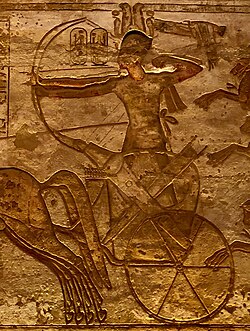
Chariot use made its way into Egypt around 1650 BC during the Hyksos invasion of Egypt and establishment of the Fourteenth Dynasty.6 The chariot and horse were used extensively in Egypt by the Hyksos invaders from the 16th century BC onwards. In the remains of Egyptian and Assyrian art, there are numerous representations of chariots, which display rich ornamentation. The chariots of the Egyptians and Assyrians, with whom the bow was the principal arm of attack, were richly mounted with quivers full of arrows. The Egyptians invented the yoke saddle harnessing method around 1500 BC. As a general rule, the Egyptians used chariots as mobile archery platforms. Chariots always had two men, with the driver steering the chariot with his reins while the main archer aimed his bow and arrow at any targets within range. The best preserved examples of Egyptian chariots are the four specimens from the tomb of Tutankhamun.
Ancient Canaan and Israel
Chariots are frequently mentioned in the Hebrew Tanakh and the Greek Old Testament, respectively, particularly by the prophets, as instruments of war or as symbols of power or glory. First mentioned in the story of Joseph (Genesis 50:9), "Iron chariots" are mentioned also in Joshua (17:16, 18) and Judges (1:19,4:3, 13) as weapons of the Canaanites and Israelites. 1 Samuel 13:5 mentions chariots of the Philistines, who are sometimes identified with the Sea Peoples or early Greeks.
Small domestic horses may have been present in the northern Negev before 3000 BC.20 Jezreel (city) has been identified as the chariot base of King Ahab.21 And a decorated bronze tablet thought to be the head of a lynchpin of a Canaanite chariot was found at a site that may be Sisera's fortress Harosheth Haggoyim.2223
Urartu
In Urartu (860–590 BC), the chariot was used by both the nobility and the military. In Erebuni (Yerevan), King Argishti of Urartu is depicted riding on a chariot which is pulled by two horses. The chariot has two wheels and each wheel has about eight spokes. This type of chariot was used around 800 BC.
Bronze-Age Europe
As David W. Anthony writes in his book The Horse, the Wheel, and Language, in Eastern Europe, the earliest well-dated depiction of a wheeled vehicle (a wagon with two axles and four wheels) is on the Bronocice pot (c. 3500 BC). It is a clay pot excavated in a Funnelbeaker settlement in Swietokrzyskie Voivodeship in Poland.24 The oldest securely dated real wheel-axle combination in Eastern Europe is the Ljubljana Marshes Wheel (c. 3150 BC).25
Greece
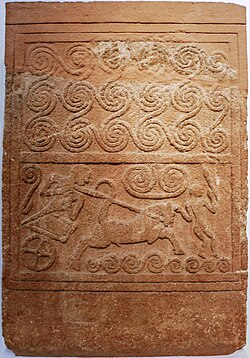
The later Greeks of the first millennium BC had a (still not very effective) cavalry arm, and the rocky terrain of the Greek mainland was unsuitable for wheeled vehicles. The chariot was heavily used by the Mycaenean Greeks, most probably adopted from the Hittites, around 1600 BC. Linear B tablets from Mycenaean palaces record large inventories of chariots, sometimes with specific details as to how many chariots were assembled or not (i.e. stored in modular form). On a gravestone from the royal Shaft-grave V in Mycenae dated LH II (about 1500 BC) there is one of the earliest depiction of the chariot in Achaean art. This sculpture shows a single man driving a two-wheeled small box chariot. Later the vehicles were used in games and processions, notably for races at the Olympic and Panathenaic Games and other public festivals in ancient Greece, in hippodromes and in contests called agons. They were also used in ceremonial functions, as when a paranymph, or friend of a bridegroom, went with him in a chariot to fetch the bride home.
Herodotus (Histories, 5. 9) Reports that chariots were widely used in the Pontic–Caspian steppe by the Sigynnae.
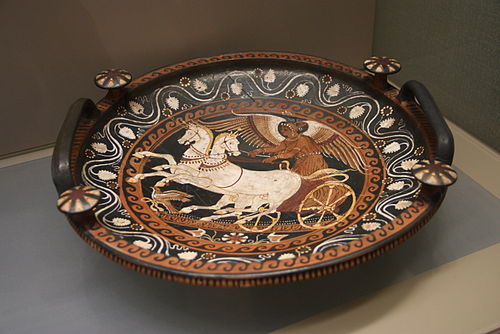
Greek chariots were made to be drawn by two horses attached to a central pole. If two additional horses were added, they were attached on each side of the main pair by a single bar or trace fastened to the front or prow of the chariot, as may be seen on two prize vases in the British Museum from the Panathenaic Games at Athens, Greece, in which the driver is seated with feet resting on a board hanging down in front close to the legs of the horses. The biga itself consists of a seat resting on the axle, with a rail at each side to protect the driver from the wheels. Greek chariots appear to have lacked any other attachment for the horses, which would have made turning difficult.
The body or basket of the chariot rested directly on the axle (called beam) connecting the two wheels. There was no suspension or springs, making this an uncomfortable form of transport. At the front and sides of the basket was a semicircular guard about 3 ft (1 m) high, to give some protection from enemy attack. At the back the basket was open, making it easy to mount and dismount. There was no seat, and generally only enough standing room for the driver and one other person.
The reins were made of leather and ornamented with studs of ivory or metal. The reins passed through rings attached to the collar bands or yoke, and were long enough to be tied round the waist of the charioteer, allowing him to use his hands for weapons.
The wheels and basket of the chariot were usually of wood, strengthened in places with bronze or iron. The wheels had four to eight spokes, and tires of bronze or iron. Due to the widely spaced spokes, the rim of the chariot wheel was held in tension over comparatively large spans. While this provided a small measure of shock absorption, it also necessitated the removal of the wheels when the chariot was not in use, to prevent deforming under the weight of the vehicle.26 Most other nations of this time had chariots of similar design to the Greeks, the chief differences being the fittings.
- Greek chariot scenes in art, 8th to 4th centuries BC
-
 Procession of chariots on an amphora from Athens (c. 720–700 BC).
 -
 Greek relief of an armed warrior and his driver (4th century BC)
 -
Northern Europe
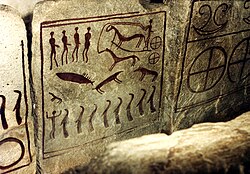
The Kivik grave is an archaeological find in Sweden with several petroglyphs from the Nordic Bronze Age. One stone slab depicts a two-wheeled vehicle often interpreted as a biga chariot.27
Western Europe
Some 20 iron-aged chariot burials have been excavated in Britain, roughly dating from between 500 BC and 100 BC. Virtually all of them were found in East Yorkshire – the exception was a find in 2001 in Newbridge, 10 km west of Edinburgh.
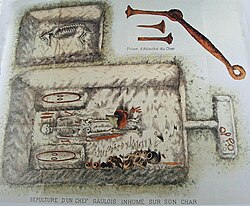
The Celtic chariot, which may have been called karbantos in Gaulish (compare Latin carpentum),2829 was a biga that measured approximately 2 m (6 ft 6+3⁄4 in) in width and 4 m (13 ft 1+1⁄2 in) in length.
British chariots were open in front. Julius Caesar provides the only significant eyewitness report of British chariot warfare:
Their mode of fighting with their chariots is this: firstly, they drive about in all directions and throw their weapons and generally break the ranks of the enemy with the very dread of their horses and the noise of their wheels; and when they have worked themselves in between the troops of horse, leap from their chariots and engage on foot. The charioteers in the meantime withdraw some little distance from the battle, and so place themselves with the chariots that, if their masters are overpowered by the number of the enemy, they may have a ready retreat to their own troops. Thus they display in battle the speed of horse, [together with] the firmness of infantry; and by daily practice and exercise attain to such expertness that they are accustomed, even on a declining and steep place, to check their horses at full speed, and manage and turn them in an instant and run along the pole, and stand on the yoke, and thence betake themselves with the greatest celerity to their chariots again.30

Chariots could also be used for ceremonial purposes. According to Tacitus (Annals 14.35), Boudica, queen of the Iceni and a number of other tribes in a formidable uprising against the occupying Roman forces, addressed her troops from a chariot in 61:
- "Boudicca curru filias prae se vehens, ut quamque nationem accesserat, solitum quidem Britannis feminarum ductu bellare testabatur"
- Boudicca, with her daughters before her in a chariot, went up to tribe after tribe, protesting that it was indeed usual for Britons to fight under the leadership of women.
The last mention of chariot use in battle seems to be at the Battle of Mons Graupius, somewhere in modern Scotland, in 84 CE. From Tacitus (Agricola 1.35–36) "The plain between resounded with the noise and with the rapid movements of chariots and cavalry." The chariots did not win even their initial engagement with the Roman auxiliaries: "Meantime the enemy's cavalry had fled, and the charioteers had mingled in the engagement of the infantry."
Later through the centuries, the chariot was replaced by the "war wagon". The "war wagon" was a medieval development used to attack rebel or enemy forces on battle fields. The wagon was given slits for archers to shoot enemy targets, supported by infantry using pikes and flails and later for the invention of gunfire by hand-gunners; side walls were used for protection against archers, crossbowmen, the early use of gunpowder and cannon fire.
It was especially useful during the Hussite Wars, c. 1420, by Hussite forces rebelling in Bohemia. Groups of them could form defensive works, but they also were used as hardpoints for Hussite formations or as firepower in pincer movements. This early use of gunpowder and innovative tactics helped a largely peasant infantry stave off attacks by the Holy Roman Empire's larger forces of mounted knights.
Etruria
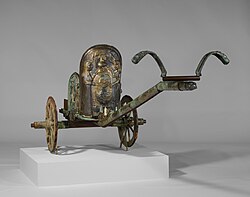
The only intact Etruscan chariot dates to c. 530 BC and was uncovered as part of a chariot burial at Monteleone di Spoleto. Currently in the collection of the Metropolitan Museum of Art,31 it is decorated with bronze plates decorated with detailed low-relief scenes, commonly interpreted as depicting episodes from the life of Achilles.32
Rome
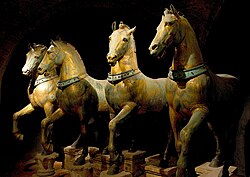
In the Roman Empire, chariots were no longer used in warfare. They were used in chariot racing in the Roman circuses, and in triumphal processions, where they were typically drawn by four horses—a configuration known as a quadriga. A three-horse chariot was a triga, and a two-horse chariot a biga.
There were four factions of charioteers, distinguished by the colour of their costumes. The main centre of chariot racing was the Circus Maximus. The track could hold 12 chariots, and the two sides of the track were separated by a raised median termed the spina. Chariot races continued to enjoy great popularity until their decline in the 6th century.3334
Ancient China
The earliest archaeological evidence of chariots in China, a chariot burial site discovered in 1933 at Hougang, Anyang in Henan, dates to the rule of King Wu Ding of the Late Shang (c. 1250 BC). Oracle bone inscriptions suggest that the western enemies of the Shang used limited numbers of chariots in battle, but the Shang themselves used them only as mobile command-vehicles and in royal hunts.35
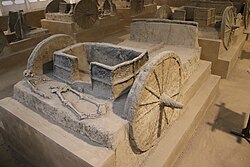
During the Shang dynasty, members of the royal family were buried with a complete household and servants, including a chariot, horses, and a charioteer. A Shang chariot was often drawn by two horses, but four-horse variants are occasionally found in burials.
Jacques Gernet claims that the Zhou dynasty, which conquered the Shang ca. 1046 BC, made more use of the chariot than did the Shang and "invented a new kind of harness with four horses abreast".36 The crew consisted of an archer, a driver, and sometimes a third warrior who was armed with a spear or dagger-axe. From the 8th to 5th centuries BC the Chinese use of chariots reached its peak. Although chariots appeared in greater numbers, infantry often defeated charioteers in battle.
Massed-chariot warfare became all but obsolete after the Warring-States period (476–221 BC). The main reasons were increased use of the crossbow, use of long halberds up to 18 feet (5.49 m) long and pikes up to 22 feet (6.71 m) long, and the adoption of standard cavalry units, and the adaptation of mounted archery from nomadic cavalry, which were more effective. Chariots would continue to serve as command posts for officers during the Qin dynasty (221–206 BC) and the Han dynasty (206 BC–220 AD), while armored chariots were also used during the Han dynasty against the Xiongnu Confederation in the Han–Xiongnu War (133 BC to 89 AD), specifically at the Battle of Mobei (119 BC).
Before the Han dynasty, the power of Chinese states and dynasties was often measured by the number of chariots they were known to have. A country of a thousand chariots ranked as a medium country, and a country of ten thousand chariots ranked as a huge and powerful country.3738
-
 Model of a chariot, Warring States period
 -
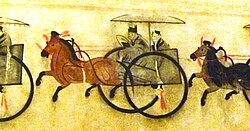 Powerful landlord in chariot (Eastern Han, 25–220 AD, Anping County, Hebei).
 -
 Han dynasty bronze models of cavalry and chariots
 -
 Model recreation of Han dynasty chariot, from Tomb of Liu Sheng
Mythology and religion

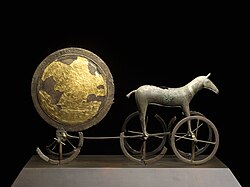
Chariots appear widely in the mythologies and religious traditions of many ancient cultures, often associated with solar deities, divine warriors, or royal symbolism. Chariots are an important part of both Hindu and Persian mythology, with most of the gods in their pantheon portrayed as riding them.
In the Rigveda, Indra is described as strong willed, armed with a thunderbolt, riding a chariot.39 Among Rigvedic deities, notably the Vedic Sun god Surya rides on a one spoked chariot driven by his charioteer Aruṇa. Ushas (the dawn) rides in a chariot, as well as Agni in his function as a messenger between gods and men.
The Jain Bhagavi Sutra states that Indian troops used a chariot with a club or mace attached to it during the war against the Licchavis during the reign of Ajatashatru of Magadha.4041
According to Greek mythology, the chariot was invented by Erichthonius of Athens to conceal his feet, which were those of a dragon.42 The most notable appearance of the chariot in Greek mythology occurs when Phaëton, the son of Helios, in an attempt to drive the chariot of the sun, managed to set the earth on fire. This story led to the archaic meaning of a phaeton as one who drives a chariot or coach, especially at a reckless or dangerous speed. Plato, in his Chariot Allegory, depicted a chariot drawn by two horses, one well behaved and the other troublesome, representing opposite impulses of human nature; the task of the charioteer, representing reason, was to stop the horses from going different ways and to guide them towards enlightenment.
The Trundholm sun chariot (Denmark, c. 1500-1300 BC) is a Nordic Bronze Age statue representing a sun chariot.43
Chariots play an important role in Irish mythology surrounding the hero Cú Chulainn.44
Notes
Notes
- There were rare exceptions to the use of horses to pull chariots, for instance, the lion-pulled chariot described by Plutarch in his Life of Antony.
References
References
- Kuznetsov, P.F. (1 September 2006). "The emergence of Bronze Age chariots in eastern Europe". Antiquity. 80 (309): 638–645. doi:10.1017/s0003598x00094096. ISSN 0003-598X. S2CID 162580424.
- Lindner, Stephan (April 2020). "Chariots in the Eurasian Steppe: a Bayesian approach to the emergence of horse-drawn transport in the early second millennium BC". Antiquity. 94 (374): 361–380. doi:10.15184/aqy.2020.37. ISSN 0003-598X. S2CID 216205961.
- "Definition of CHARIOT". www.merriam-webster.com. 27 May 2023. Retrieved 5 June 2023.
- Littauer, Mary Aiken; Crouwel, Joost H. (1996). "The origin of the true chariot". Antiquity. 70 (270): 938–939. doi:10.1017/S0003598X00084192. S2CID 161568465 – via Cambridge University Press.
- Raulwing, P.; Burmeister, S. (2012). "Chariotry, ancient Near East and Egypt". The Encyclopedia of Ancient History. doi:10.1002/9781444338386.wbeah24050. ISBN 9781444338386 – via Wiley Online Library.
- Morillo, Stephen. War in World History: Society, Technology, and War from Ancient Times to the Present. Vol. 1. McGraw-Hill Higher Education. ISBN 978-0-07-739166-9.
- Ralby, Aaron (2013). "Battle of Kadesh, c. 1274 BC: Clash of Empires". Atlas of Military History. Parragon. pp. 54–55. ISBN 978-1-4723-0963-1. OL 31884299M.
- Neumayer, Erwin (2013). Prehistoric Rock Art of India. OUP India. ISBN 978-0198060987.
- Sparreboom, M. (1985), Chariots in the Veda. (Memoirs of the Kern Institute, Leiden, 3), Leiden: Brill Academic Publishers, ISBN 90-04-07590-9
- Vasudha Venugopal ET bureau, https://economictimes.indiatimes.com/news/politics-and-nation/mahabharata-much-older-say-asi-archaeologists/articleshow/71658119.cms Mahabharata much older, say ASI Archaeologists , The Economic Times
- Subramanian, T. S. (28 September 2018). "Royal burial in Sanauli". Frontline.
- Parpola, Asko (2020). "Royal "Chariot" Burials of Sanauli near Delhi and Archaeological Correlates of Prehistoric Indo-Iranian Languages". Studia Orientalia Electronica. 8: 176. doi:10.23993/store.98032.
- Kuz'mina 2007, pp. 321–322.
- Flood 1996, p. 34.
- Witzel, Michael (2001), "Autochthonous Aryans? The Evidence from Old Indian and Iranian Texts" (PDF), Electronic Journal of Vedic Studies, 7 (3): 1–115
- Olson 2007, p. 11.
- Kuz'mina 2007, p. 321.
- Raulwing 2000.
- Joost Crouwel (2013). "Studying the Six Chariots from the Tomb of Tutankhamun – An Update". In Veldmeijer, Andre J.; Ikram, Salima (eds.). Chasing Chariots: Proceedings of the First International Chariot Conference (Cairo 2012). Sidestone Press. p. 74. ISBN 978-9088902093.
- Thomas E. Levy, David Alon, Yorke Rowan, Edwin C. M. van den Brink, Caroline Grigson, Augustin Holl, Patricia Smith, Paul Goldberg, Alan J. Witten, Eric Kansa, John Moreno, Yuval Yekutieli, Naomi Porat, Jonathan Golden, Leslie Dawson, and Morag Kersel, "Egyptian-Canaanite Interaction at Nahal Tillah, Israel (ca. 4500–3000 B.C.E.): An Interim Report on the 1994–1995 Excavations", Bulletin of the American Schools of Oriental Research, 307/August 1997, pp. 1–51
- David Ussishkin, "Jezreel – Where Jezebel Was Thrown to the Dogs", Biblical Archaeology Review, July / August 2010.
- "Archaeological mystery solved" Archived 2010-07-05 at the Wayback Machine, University of Haifa press release, July 1, 2010.
- "Long time archaeological riddle solved". The Jerusalem Post. 2 July 2010. ISSN 0792-822X. Retrieved 1 August 2023.
- Anthony 2007, p. 67.
- Gasser, Aleksander (March 2003). "World's Oldest Wheel Found in Slovenia". Government Communication Office of the Republic of Slovenia. Archived from the original on 26 August 2016. Retrieved 29 November 2015.
- Gordon, J. E. (1978). Structures, or Why Things Don't Fall Down. London: Pelican. p. 146. ISBN 9780140219616.
- "Kiviksgraven". The Norwegian Property Agency (in Swedish). Archived from the original on 28 December 2019.
- Karl, Raimund (2006). "Chariot and wagon". In Koch, John T (ed.). Celtic Culture: A Historical Encyclopedia. Vol. 2. Santa Barbara, California: ABC-CLIO. p. 401. ISBN 1-85109-440-7. Retrieved 29 August 2014.
- Delamarre, Xavier (2003). Dictionnaire de la langue gauloise (in French). Paris: Éditions Errance. ISBN 2-87772-369-0.
- "The Project Gutenberg EBook of "De Bello Gallico" and Other Commentaries by Caius Julius Caesar, translated by W. A. MacDevitt (1915)".
- "METmuseum.org".
- The Golden Chariot of Achilles Archived March 16, 2008, at the Wayback Machine
- Cassel, Elaine; Bernstein, Douglas A. (3 April 2007). Criminal Behavior. Psychology Press. p. 121. ISBN 978-1-135-61476-8. OL 7938153M.
- Cameron, Alan (1976). Circus Factions: Blues and Greens at Rome and Byzantium. Clarendon Press. p. 308. ISBN 978-0-19-814804-3. OL 15125725M.
- Shaughnessy, Edward L. (1988). "Historical Perspectives on The Introduction of The Chariot Into China". Harvard Journal of Asiatic Studies. 48 (1): 189–237. doi:10.2307/2719276. JSTOR 2719276.
- Gernet, Jacques (1996). A History of Chinese Civilization (2nd ed.). Cambridge University Press. p. 51. ISBN 0-521-49781-7.
- [Mencius · Liang Hui Huang (King the Hui of Liang, Hui is a posthumous name) Volume One] 'The kingslayer of a country of ten thousands chariots, must be the house of thousand chariots. The kingslayer of a country of thousand chariots, must be the house of hundred chariots.' [Zhao Qi's note] Zhao Qi's note: ' Ten thousands chariots, is the son of heaven (King of Zhou).'
- [Zhan Guo Ce·Zhao Ce] 'Nowadays, Kingdom of Qin is a country of ten thousands chariots, Kingdom of Liang (Kingdom of Wei, 'Da Liang' is the capital of Wei) is also a country of ten thousands chariots.'
- "Rig Veda: Rig-Veda, Book 5: Hymn XXXVI. Indra". www.sacred-texts.com. Retrieved 24 February 2020.
- Nefiodkin, Alexander K. (2004). "On the Origin of the Scythed Chariots". Historia: Zeitschrift für Alte Geschichte. 53 (3): 369–378.
- Scharfe, Hartmut (2022). The State in Indian Tradition. Brill. p. 193. ISBN 978-9004491441.
- Brewer, E. Cobham. Dictionary of Phrase & Fable. Char'iot. Bartleby.com: Great Books Online – Encyclopedia, Dictionary, Thesaurus and hundreds more. Retrieved March 5, 2008.
- "The Sun Chariot". Nationalmuseet.
- Crowe, J. O'Beirne (1871), O'Beirne Crowe, J. (ed.), "Siabur-Charpat Con Culaind. From "Lebor na h-Uidre" (Fol. 37, et seqq.), a Manuscript of the Royal Irish Academy", Journal of the Royal Historical and Archaeological Association of Ireland, 4th series 4, 1 (2): 371–448, JSTOR 25506590
Sources
- Anthony, David W. (2007), The Horse, The Wheel and Language: How Bronze-Age Riders from the Eurasian Steppes Shaped the Modern World, Princeton: Princeton University Press, ISBN 9780691058870
- Anthony, David W. (2010), The Horse, the Wheel, and Language: How Bronze-Age Riders from the Eurasian Steppes Shaped the Modern World, Princeton University Press, ISBN 978-1400831104
- Flood, Gavin D. (1996), An Introduction to Hinduism, Cambridge University Press
- Kuz'mina (2007), Mallory, J (ed.), The Origin of the Indo-Iranians, Brill, doi:10.1163/ej.9789004160545.i-763, ISBN 9789047420712
- Olson, Carl (2007), The Many Colors of Hinduism: A Thematic-historical Introduction, Rutgers University Press
- Raulwing, Peter (2000), Horses, Chariots and Indo-Europeans: Foundations and Methods of Chariotry Research from the Viewpoint of Comparative Indo-European Linguistics, Budapest: Archaeolingua, ISBN 9638046260
Further reading
Further reading
- Chamberlin, J. Edward. Horse: How the horse has shaped civilizations. N.Y.: United Tribes Media Inc., 2006 (ISBN 0-9742405-9-1).
- Cotterell, Arthur. Chariot: From chariot to tank, the astounding rise and fall of the world's first war machine. Woodstock & New York: The Overlook Press, 2005 (ISBN 1-58567-667-5).
- Crouwel, Joost H. Chariots and other means of land transport in Bronze Age Greece (Allard Pierson Series, 3). Amsterdam: Allard Pierson Museum, 1981 (ISBN 90-71211-03-7).
- Crouwel, Joost H. Chariots and other wheeled vehicles in Iron Age Greece (Allard Pierson Series, 9). Amsterdam: Allard Pierson Museum:, 1993 (ISBN 90-71211-21-5).
- Drews, Robert. The coming of the Greeks: Indo-European conquests in the Aegean and the Near East. Princeton: Princeton University Press, 1988 (hardcover, ISBN 0-691-03592-X); 1989 (paperback, ISBN 0-691-02951-2).
- Drews, Robert. The end of the Bronze Age: Changes in warfare and the catastrophe ca. 1200 B.C. Princeton: Princeton University Press, 1993 (hardcover, ISBN 0-691-04811-8); 1995 (paperback, ISBN 0-691-02591-6).
- Drews, Robert. Early riders: The beginnings of mounted warfare in Asia and Europe. N.Y.: Routledge, 2004 (ISBN 0-415-32624-9).
- Fields, Nic; Brian Delf (illustrator). Bronze Age War Chariots (New Vanguard). Oxford; New York: Osprey Publishing, 2006 (ISBN 978-1841769448).
- Greenhalg, P A L. Early Greek warfare; horsemen and chariots in the Homeric and Archaic Ages. Cambridge University Press, 1973. (ISBN 9780521200561).
- Ikibeş, Samet (12 December 2024). Chariots Throughout History and Their Description in The Shahnameh. Harp Tarihi Dergisi. 10.https://doi.org/10.61348/htde.1550009
- Kulkarni, Raghunatha Purushottama. Visvakarmiya Rathalaksanam: Study of Ancient Indian Chariots: with a historical note, references, Sanskrit text, and translation in English. Delhi: Kanishka Publishing House, 1994 (ISBN 978-8173-91004-3)
- Lee-Stecum, Parshia (October 2006). "Dangerous Reputations: Charioteers and Magic in Fourth-Century Rome". Greece & Rome. 53 (2): 224–234. doi:10.1017/S0017383506000295. ISSN 0017-3835. S2CID 162107855.
- Littauer, Mary A.; Crouwel, Joost H. Chariots and related equipment from the tomb of Tutankhamun (Tutankhamun's Tomb Series, 8). Oxford: The Griffith Institute, 1985 (ISBN 0-900416-39-4).
- Littauer, Mary A.; Crouwel, Joost H.; Raulwing, Peter (Editor). Selected writings on chariots and other early vehicles, riding and harness (Culture and history of the ancient Near East, 6). Leiden: Brill Academic Publishers, 2002 (ISBN 90-04-11799-7).
- Moorey, P.R.S. "The Emergence of the Light, Horse-Drawn Chariot in the Near-East c. 2000–1500 B.C.", World Archaeology, Vol. 18, No. 2. (1986), pp. 196–215.
- Piggot, Stuart. The earliest wheeled transport from the Atlantic Coast to the Caspian Sea. Ithaca, New York: Cornell University Press, 1983 (ISBN 0-8014-1604-3).
- Piggot, Stuart. Wagon, chariot and carriage: Symbol and status in the history of transport. London: Thames & Hudson, 1992 (ISBN 0-500-25114-2).
- Pogrebova M. The emergence of chariots and riding in the South Caucasus in Oxford Journal of Archaeology, Volume 22, Number 4, November 2003, pp. 397–409.
- Sandor, Bela I. The rise and decline of the Tutankhamun-class chariot in Oxford Journal of Archaeology, Volume 23, Number 2, May 2004, pp. 153–175.
- Sandor, Bela I. Tutankhamun's chariots: Secret treasures of engineering mechanics in Fatigue & Fracture of Engineering Materials & Structures, Volume 27, Number 7, July 2004, pp. 637–646.
- Taylor, William Timothy Treal; Barrón-Ortiz, Christina Isabelle (2 April 2021). "Rethinking the evidence for early horse domestication at Botai". Scientific Reports. 11 (1). Nature: 7440. Bibcode:2021NatSR..11.7440T. doi:10.1038/s41598-021-86832-9. ISSN 2045-2322. PMC 8018961. PMID 33811228.
- Wilford, John Noble (22 February 1994). "Remaking the Wheel: Evolution of the Chariot". The New York Times. Retrieved 29 July 2015.
External links
External links
- Quotations related to Chariot at Wikiquote
- . Encyclopædia Britannica. Vol. 5 (11th ed.). 1911.