Champaran | |
|---|---|
Region | |
 Map and landscape of the Champaran region | |
Champaran Location in Bihar, India Show map of IndiaChamparan Champaran (Bihar) Show map of Bihar | |
| Coordinates: 26°21′19″N 85°07′22″E / 26.355173°N 85.122784°E / 26.355173; 85.122784 | |
| Country |  India India |
| State | Bihar |
| Time zone | UTC+5:30 (IST) |
Champaran is a historical and cultural region in the northwestern part of Bihar, India. It forms part of the Bhojpuri-speaking belt.1
The region is divided into two districts:
Champaran is internationally known for the Champaran Satyagraha of 1917 led by Mahatma Gandhi, which became an important movement in the Indian independence struggle.2
History
Champaran is identified with the Champāraṇya mentioned in the Bheraghat inscription as a place described as "devastated" by the Kalachuri king Yashaḥkarṇa (11th/12th century).3
During British rule, Champaran was established as a district in 1866 after separation from Saran district, with Motihari as its administrative headquarters.4 During the Mughal and pre-modern period, the region was administered under pargana and estate-based systems rather than modern district structures. According to regional traditions and local historical accounts, several settlements in Champaran developed along trade and travel routes connecting Tirhut and northern Bihar. Among these, Mehsi emerged as an important settlement on the Muzaffarpur–Motihari route and became known locally as the "Gateway of Champaran" because it served as one of the eastern entry points into the Champaran region.5 Mehsi historically developed as a local market settlement due to its strategic geographical location and transport connectivity. Local traditions also associate the town with the Mehsi Dargah (Sayyadana khawaja Mirza Abdul Halim Shah chishti R.A Dargah)6, an important religious and cultural site reflecting the syncretic heritage of the region.7 According to local traditions, the dargah is believed to date back several centuries and is regarded as one of the oldest religious sites in the Mehsi area. Some local accounts describe the shrine as nearly one thousand years old, although this claim has not been confirmed through archaeological or academic historical research.
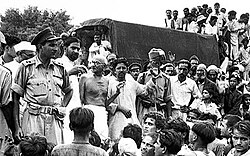
During the Champaran Satyagraha of 1917, the route passing through Mehsi formed part of the travel corridor used by Mahatma Gandhi while travelling between Muzaffarpur and Motihari.8
The development of Champaran’s administrative importance is associated with different towns over time:
- Mehsi – Historically important settlement and trade route centre in eastern Champaran.
- Motihari – Established as the official headquarters of Champaran district after 1866 under British administration.9
- Bettiah – Developed as the principal administrative centre of western Champaran and associated with the Bettiah Raj estate.10
According to local traditions, the Mehsi Dargah (Dargah of Mirza Halim Shah) is an important religious site in the region and is associated with the cultural heritage of Mehsi.11
In 1917, Mahatma Gandhi led a satyagraha movement in the Champaran district against the policies enforced by European landowners and the colonial government. These policies coerced local farmers into cultivating indigo at unfairly low prices. In response to Gandhi's leadership, the British authorities initially arrested him but later released him, subsequently amending the laws to alleviate the plight of the peasants. This marked Gandhi's first campaign in India and a significant milestone in the Indian independence movement.12
Geography
Champaran lies in the fertile plains of northern Bihar and is shaped by rivers such as the Gandak.
Culture
The region forms part of the Bhojpuri cultural area, known for folk music, festivals, fairs, and rural traditions.
Economy
Agriculture remains the primary economic activity in Champaran, along with sugarcane cultivation, food crops, horticulture, and small-scale industries. Mehsi is locally known for agriculture, fruit production, and trade activities.13
See also
See also
People
- Batak Mian - A cook who saved the life of Mahatma Gandhi
- Manoj Bajpai –
- Dinesh Bhramar – poet and noted figure in Hindi and Bhojpuri literature
- Anuranjan Jha – Indian journalist
- Prakash Jha – Indian filmmaker
- Ramesh Chandra Jha – Indian poet, novelist and freedom fighter
- Abdullah Khan – novelist and screenwriter
- Ravish Kumar – Indian journalist
- Gopal Singh Nepali – Indian poet of Hindi literature, Bollywood lyricist
- George Orwell – English novelist, essayist, journalist and critic
- Kedar Pandey – Congress leader and ex-Chief Minister of Bihar
- Afroz Alam Sahil – Indian journalist
- Raj Kumar Shukla – indigo cultivator, activist
- Radha Mohan Singh – Indian politician
- Sanjeev K Jha – Indian script writer, filmmaker
The Literary History of Champaran
Freedom Fighter and author Ramesh Chandra Jha was the first person who penned down the rich literary history of Champaran. His research based books including Champaran Ki Sahitya Sadhana (चम्पारन की साहित्य साधना) (1958), Champaran:Literature & Literary Writers (चम्पारन: साहित्य और साहित्यकार) (1967) and Apne Aur Sapne:A Literary Journey Of Champaran (अपने और सपने: चम्पारन की साहित्य यात्रा) (1988) meticulously document the rich literary heritage and history of Champaran, Bihar. These seminal books continue to serve as foundational reference points for researchers, scholars, Ph.D. students, and journalists alike. Jha's insightful exploration and preservation of Champaran's historical and literary legacy have solidified his place as a cornerstone in the field of literary research.14
References
References
- "History of Champaran". Government of Bihar. Retrieved 15 May 2026.
- "Champaran Satyagraha". Encyclopaedia Britannica. Retrieved 15 May 2026.
- Sircar, D. C. (1952). "Bangaon Plate of Vigrahapala III; Regnal Year 17". Epigraphia Indica. 29: 48–57. Retrieved 13 December 2024.
- "East Champaran History". Government of Bihar. Retrieved 15 May 2026.
- "Mehsi Block". Government of Bihar. Retrieved 15 May 2026.
- "Three-day Urs mela begins at Mehasi". The Times of India. 30 November 2009. Retrieved 19 May 2026.
- "Dargah of Mirza Halim Shah, Mehsi". Retrieved 15 May 2026.
- "Champaran Satyagraha". Encyclopaedia Britannica. Retrieved 15 May 2026.
- "East Champaran History". Government of Bihar. Retrieved 15 May 2026.
- "West Champaran District". Government of Bihar. Retrieved 15 May 2026.
- "Dargah of Mirza Halim Shah, Mehsi". Retrieved 15 May 2026.
- Chandra, Bipin. History of Modern India. India.
- "East Champaran District". Government of Bihar. Retrieved 15 May 2026.
- Apne Aur Sapne : Online PDF book at Archive.org
Further reading
Further reading
- "Champaran Gramodyog Sansthan". Archived from the original on 1 June 2013. Retrieved 22 September 2012.
- Singh, Shankar Dayal. Gandhi's first step: Champaran movement, by B.R. Pub. Corp., 1994. ISBN 81-7018-834-2.
- Chakrabarti D.K. (1996b). From Purnea to Champaran: The distribution of sites in the north Bihar plains. South Asian Studies, 12:pp. 147–158