 | |
 | |
| Names | |
|---|---|
| Preferred IUPAC name
Chalcone2 | |
| Systematic IUPAC name
(2E)-1,3-Diphenylprop-2-en-1-one | |
| Other names
Chalkone
Benzylideneacetophenone Phenyl styryl ketone benzalacetophenone β-phenylacrylophenone γ-oxo-α,γ-diphenyl-α-propylene α-phenyl-β-benzoylethylene. | |
| Identifiers | |
3D model (JSmol)
|
|
| ChEBI | |
| ChemSpider |
|
| ECHA InfoCard | 100.002.119 |
PubChem CID
|
|
| UNII | |
CompTox Dashboard (EPA)
|
|
| |
| |
| Properties | |
| C15H12O | |
| Molar mass | 208.260 g·mol−1 |
| Appearance | pale yellow solid |
| Density | 1.071 g/cm3 |
| Melting point | 55 to 57 °C (131 to 135 °F; 328 to 330 K) |
| Boiling point | 345 to 348 °C (653 to 658 °F; 618 to 621 K) |
| −125.7·10−6 cm3/mol | |
Except where otherwise noted, data are given for materials in their standard state (at 25 °C [77 °F], 100 kPa).
| |


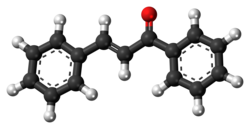
Chalcone is the organic compound C6H5C(O)CH=CHC6H5. It is an α,β-unsaturated ketone. A variety of important biological compounds are known collectively as chalcones or chalconoids.3 They are widely known bioactive substances, fluorescent materials, and chemical intermediates.
Chemical properties
Chalcones have two absorption maxima at 280 nm and 340 nm.4
Biosynthesis
Chalcones and chalconoids are synthesized in plants as secondary metabolites. The enzyme chalcone synthase, a type III polyketide synthase, is responsible for the biosynthesis of these compounds. The enzyme is found in all "higher" (vascular) and several "lower" (non-vascular) plants.5
Laboratory synthesis
Chalcone is usually prepared by an aldol condensation between benzaldehyde and acetophenone. 6 7

This reaction, which can be carried out without any solvent, is so reliable that it is often given as an example of green chemistry in undergraduate education.8
Potential pharmacology
Chalcones and their derivatives demonstrate a wide range of biological activities including anti-inflammation.9 Some 2′-amino chalcones have been studied as potential antitumor agents.1011 Chalcones are of interest in medicinal chemistry and have been described as a privileged scaffold.5
Uses
Medicinal uses
In medicinal chemistry, chalcones have been used as:
Industrial uses
In chemical industries, they are employed as:
- liquid crystals
- fluorescent chemical scaffolds
- metal sensors
- corrosion inhibitors
- plant hormones12
Uses in organic chemistry
Chalcones have been used as intermediates in heterocyclic synthesis, especially in the synthesis of pyrazoles and aurones.12
In the Johnson–Corey–Chaykovsky reaction, chalcone reacts with dimethylsulfoxonium methylide to give 1-phenyl-2-benzoylcyclopropane [15295-43-9] [1145-91-1] in 95% yield.13 A Leuckart reaction or ammonium acetate in the presence of sodium cyanoborohydride would be predicted to give Phenyl(2-phenylcyclopropyl)methanamine [1559116-96-9]. Alternatively if a reductive amination of the ketone with methylamine is performed one would instead get the secondary amine N-Me [1559367-56-4].

These compounds have the same trans-stereochemistry as was observed for tranylcypromine although their exact mode of pharmacology is still lacking. Lastly, it was discovered that if a hydrazine is prepared from the ketone (ala pheniprazine) one gets a compound that is called [Phenyl-(2-phenylcyclopropyl)methyl]hydrazine (PC105199424).
References
References
- Merck Index, 11th Edition, 2028
- "Front Matter". Nomenclature of Organic Chemistry: IUPAC Recommendations and Preferred Names 2013 (Blue Book). Cambridge: The Royal Society of Chemistry. 2014. p. 722. doi:10.1039/9781849733069-FP001. ISBN 978-0-85404-182-4.
- Tomás-Barberán, Francisco A.; Clifford, Michael N. (2000). "Flavanones, Chalcones and Dihydrochalcones - Nature, Occurrence and Dietary Burden". Journal of the Science of Food and Agriculture. 80 (7): 1073–1080. Bibcode:2000JSFA...80.1073T. doi:10.1002/(SICI)1097-0010(20000515)80:7<1073::AID-JSFA568>3.0.CO;2-B.
- Song, Dong-mee; Jung, Kyoung-Hoon; Moon, Ji-hye; Shin, Dong-Myung (2003). "Photochemistry of chalcone and the application of chalcone-derivatives in photo-alignment layer of liquid crystal display". Optical Materials. 21 (1–3): 667–71. Bibcode:2003OptMa..21..667S. doi:10.1016/S0925-3467(02)00220-3.
- Zhuang, Chunlin; Zhang, Wen; Sheng, Chunquan; Zhang, Wannian; Xing, Chengguo; Miao, Zhenyuan (28 June 2017). "Chalcone: A Privileged Structure in Medicinal Chemistry". Chemical Reviews. 117 (12): 7762–7810. doi:10.1021/acs.chemrev.7b00020. PMC 6131713. PMID 28488435.
- Sîrbu, Dumitru; Marin, Ion (2011). "Synthesis and IR, NMR caracterisation of new p-(N,N-diphenylamino) chalcones". Chemistry Journal of Moldova. General, Industrial and Ecological Chemistry. 6 (1): 86–89.
- E. P. Kohler, H. M. Chadwell (1922). "Benzalacetophenone". Organic Syntheses. 2: 1. doi:10.15227/orgsyn.002.0001.
- Palleros, Daniel R (2004). "Solvent-Free Synthesis of Chalcones". Journal of Chemical Education. 81 (9): 1345. Bibcode:2004JChEd..81.1345P. doi:10.1021/ed081p1345.
- Mahapatra, Debarshi Kar; Bharti, Sanjay Kumar; Asati, Vivek (2017). "Chalcone Derivatives: Anti-inflammatory Potential and Molecular Targets Perspectives". Current Topics in Medicinal Chemistry. 17 (28): 3146–3169. doi:10.2174/1568026617666170914160446. PMID 28914193.
- Xia, Yi; Yang, Zheng-Yu; Xia, Peng; Bastow, Kenneth F.; Nakanishi, Yuka; Lee, Kuo-Hsiung (2000). "Antitumor agents. Part 202: Novel 2′-amino chalcones: design, synthesis and biological evaluation". Bioorganic & Medicinal Chemistry Letters. 10 (8): 699–701. doi:10.1016/S0960-894X(00)00072-X. ISSN 0960-894X. PMID 10782667.
- Santos, Mariana B.; Pinhanelli, Vitor C.; Garcia, Mayara A.R.; Silva, Gabriel; Baek, Seung J.; França, Suzelei C.; Fachin, Ana L.; Marins, Mozart; Regasini, Luis O. (2017). "Antiproliferative and pro-apoptotic activities of 2′- and 4′-aminochalcones against tumor canine cells" (PDF). European Journal of Medicinal Chemistry. 138: 884–889. doi:10.1016/j.ejmech.2017.06.049. hdl:11449/174929. ISSN 0223-5234. PMID 28738308.
- Nayak, Yogeesha N.; Gaonkar, Santosh L.; Sabu, Mariya (2023-01-04). "Chalcones: Versatile intermediates in heterocyclic synthesis". Journal of Heterocyclic Chemistry. 60 (8) jhet.4617. doi:10.1002/jhet.4617. ISSN 0022-152X. S2CID 255212828.
- Corey, E. J.; Chaykovsky, Michael. (March 1962). "Dimethylsulfoxonium Methylide". Journal of the American Chemical Society. 84 (5): 867–868. Bibcode:1962JAChS..84..867C. doi:10.1021/ja00864a040.