Article · Wikipedia archive·Last revised Jun 12, 2026
Chain letter
A chain letter is a message that attempts to convince the recipient to make a number of copies and pass them on to a certain number of recipients. The "chain" is an exponentially growing pyramid that cannot be sustained.
A chain letter is a message that attempts to convince the recipient to make a number of copies and pass them on to a certain number of recipients. The "chain" is an exponentially growing pyramid (a tree graph) that cannot be sustained.
Hoaxes: Hoaxes attempt to trick or defraud users. A hoax could be malicious, instructing users to delete a file necessary to the operating system by claiming it is a virus. It could also be a scam that convinces users to spread the letter to other people for a specific reason, or send money or personal information. Phishing attacks could fall into this category. Get-rich-quick pyramid schemes promising a substantial return for sending money to people on a list are a common form of hoax chain letter.
Luck- or superstition-based letters: These letters promise good luck for forwarding the message or threaten bad luck (or even death) if the chain is broken or the letter is not forwarded. These often prey on superstition. This category includes urban legends designed to be redistributed, usually warning users of a threat or claiming to be notifying them of important or urgent information. Another common form are emails that promise users monetary rewards for forwarding the message or suggest that they are signing something that will be submitted to a particular group. These usually have no negative effect aside from wasted time and potential anxiety for the recipient.
In the United States, chain letters that request money or other items of value and promise a substantial return to the participants (such as the infamous Make Money Fast scheme) are illegal.1 Some colleges and military bases have passed regulations stating that in the private mail of college students and military personnel, respectively, chain letters are not authorized and will be thrown out. However, it is often difficult to distinguish chain letters from genuine correspondence.
Channels
Print
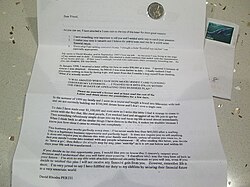
Printed Australian chain letter from 2006, with a five-cent coin taped to it as what it calls a "financial eye-catcher" source ↗
The oldest known channel for chain letters is written, or printed, on letters on paper. These might be exchanged hand-to-hand or distributed through the mail.
Early examples and precursors
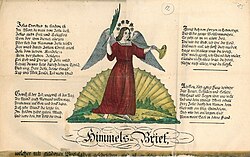
In Europe, letters known as "Himmelsbrief" (English: Heaven Letters; German: Himmelsbrief) existed, with examples dating back as early as the 6th century.2 Purported to have fallen from heaven, delivered by God or an agent thereof, they often urged adherence to Christian teachings and promised protection from misfortune to those who possessed the letter.2 By the 20th century, these evolved to include instructions: copying the letter and sending it to a set number of people would bring good fortune, while failing to do so would bring misfortune.3 Eventually, the religious elements faded, leaving simple instructions to circulate the letter for good luck or face bad luck.3 Already in the nineteenth century, similar chain letters were known to have circulated among Muslim pilgrims going on the hajj to Mecca. Those chain letters promised blessings or curses and required replication.4
An example of a "Heaven Letter" (Himmelsbrief) from around 1800 source ↗
One notorious early example of a money-based chain letter was the "Prosperity Club" or "Send-a-Dime" letter. This letter started in Denver, Colorado in 1935, based on an earlier luck letter. It instructed recipients to send a dime to the person at the top of a list of names, remove that name, add their own to the bottom, and mail the letter to five others, warning of misfortune for breaking the chain.56 It soon swamped the Denver post office with up to 100,000 letters per day before spilling into St. Louis and other cities.56 Some consider this a precursor to the Japanese "Fukou no Tegami" (Unlucky Letter).5
In 1964, the head of the United States Postal Inspection Service ordered a nationwide crackdown on violators of postal fraud and lottery laws due to an increase of chain letters reported around college towns in the United States.7 The typical letters included a list of names and instructed the recipient to send money to the name at the top of the list, remove that name, add their own name to the bottom of the list, and forward the letters to two more people.7
Chain letters in Japan
A modern example of a handwritten "Fukou no Tegami" (Unlucky Letter) source ↗
Japan has a long history of practices resembling chain letters, often tied to warding off misfortune or attracting good luck through specific, shared actions. During the Edo period (Bunsei era, 1818–1830), sending printed images of Daikokuten with instructions to distribute them to 100 homes for good luck became popular, eventually banned by the shogunate but resurfacing in the early Meiji period.8910 Other historical examples include rumors in 1813 that seeing a specific star meant death unless one ate botamochi,1112 and rumors during World War II involving the mythical creature Kudan predicting protection from air raids if one ate azuki rice or ohagi, or Takami Jun's diary entry about eating only rakkyō for breakfast to avoid bombings, provided the information was shared.111314 This cultural background of sharing methods to attract luck or avoid disaster is seen as a foundation for the later popularity of chain letters in Japan.11
Kōun no Tegami (幸運の手紙 - Lucky Letter)
An English-language "Lucky Letter" reported in the Tokyo Asahi Shimbun, 20 November 1922 source ↗
Beginning around 1922 in Tokyo, "Kōun no Tegami" (幸運の手紙 - Lucky Letter), also called "Kōun no Hagaki" (Lucky Postcard), became popular.1516 Believed to originate from the "Lucky Chain" game popular in Europe during World War I or similar chain letters in the US,161718 these letters were translated into Japanese.18 A 30 January 1922, Tokyo Asahi Shimbun article mentions a postcard mailed from London, suggesting foreign origins.1920
A Japanese "Lucky Letter" titled "For Good Fortune" (幸運之為に), featured in the Tokyo Asahi Shimbun, 27 January 1922 source ↗
These letters promised great fortune if the recipient copied the text onto a certain number of postcards (e.g., nine) and sent them to others within a time limit (e.g., 24 hours), but threatened "great misfortune" (大悪運, dai-aku'un) if the chain was broken.212223 Some included harsh warnings like "great disaster within 24 hours" for breaking the chain.24 The letters often mentioned the chain needing to circle the globe a certain number of times (e.g., nine times), reflecting the era of mail transport by ship.21 An example from the 27 January 1922, Tokyo Asahi Shimbun reads:
For Good Fortune
Please write these exact words on nine postcards and send them to people from whom you wish good fortune.
After nine days, great fortune will surely come your way. However, if you break this postcard chain, great misfortune will come instead.
Please write these within twenty-four hours of seeing this postcard.
This venture was started by an American officer and must circle the globe nine times.
— "Handwritten letter example", 丸山 2022, pp. 18–19 harvnb error: no target: CITEREF丸山2022 (help) citing Tokyo Asahi Shimbun
The phenomenon became a social issue, frequently reported in newspapers.21
A 1922 advertisement in the Tokyo Asahi Shimbun mimicking the style of a Lucky Letter source ↗
Politicians used them for campaigns, and businesses created advertisements mimicking the format, leveraging the free distribution network.251126 Writer and social critic Miyatake Gaikotsu documented the trend in his 1922 book Kitai Ryūkōshi (History of Strange Fads), noting people sent them out of fear of misfortune.25 (Gaikotsu stated his interest in the Lucky Letter phenomenon inspired him to write the book.)1623 Unlike later "Unlucky Letters," the focus was theoretically on gaining luck, but the fear of incurring bad luck by breaking the chain often dominated.18 While Western interpretations often focused on monetary gain/loss, Japanese interpretations tended towards physical harm, illness, or death as the consequence of misfortune.27 Newspaper accounts described people overcome with anxiety, sending the letters despite skepticism.2728 The potential for exponential growth (one person sending nine, repeated ten times, yielding over 3.4 billion letters) was also noted as problematic.29 The trend spread, appearing in Fengtian (now Shenyang), Manchuria in May 1922, where authorities attempted, unsuccessfully, to ban them.16 The 1923 Great Kantō earthquake later led some to view the letter craze as an ill omen.16
The "Lucky Letter" incident involving prominent figures reported in the Tokyo Nichi Nichi Shimbun, 1 August 1926 source ↗
In 1926, a Lucky Letter incident involved prominent figures. Imakita Sakunosuke, head of the government's Monopoly Bureau, received an English letter via an American acquaintance and a Japanese scholar. Imakita translated it, added instructions to send to nine friends, and mailed it to influential figures in politics and finance, causing a stir.1630 Police investigated, finding recipients including former Tokyo mayor Gotō Shinpei.1631 The Tokyo Nichi Nichi Shimbun reported the event on 1 August 1926.1132 Imakita claimed his daughter sent them playfully, but some analysts question this, suggesting it might have been a pre-arranged excuse or even an early experiment in information diffusion, given the involvement of military figures and Gotō Shinpei (then president of NHK's predecessor).1631 Political scientist Yoshino Sakuzō also received one in August 1926, dismissing it as foolish but criticizing police intervention as overreach.33341935 Despite suppression efforts, senders were sometimes punished.35
A 1935 Tokyo Asahi Shimbun article reporting an arrest related to a money-based Lucky Letter scheme source ↗
Although some sources claim Lucky Letters died out after the Great Kanto Earthquake due to crackdowns,8 they continued to appear. In 1935, a man was arrested for attempting a money-making scheme similar to the Denver "Send-a-Dime" letter, using the phone book to mail 350 letters asking for small cash contributions.3637
An anti-war chain letter circulated in Japan during World War II (1943) source ↗
During World War II (1943), an anti-war chain letter circulated, stating "We are already tired of war. Let us pray to God for peace to come soon," instructing recipients to send copies to two acquaintances (the small number possibly reflecting wartime shortages).2738 Post-war examples include a "Fuku'un no Tegami" (福運の手紙 - Fortune Letter) in 1948–1949, promising large sums of money (e.g., ¥16 million or ¥200,000) if recipients sent a small amount (e.g., ¥2 or ¥20) to the first name on a list, updated the list, and forwarded it to others (e.g., 7 or 15 people).524
A 1954 Yomiuri Shimbun article discussing the anxiety caused by Lucky Letters source ↗
By 1954, newspapers reported on the anxiety these letters caused, with a middle school girl terrified by a threat of death for not forwarding within 12 hours, and a man seeking advice after receiving a letter claiming someone died for ignoring it.2739 Some letters used famous foreign figures, claiming Franklin D. Roosevelt became president by sending one,4041 or Thomas Edison died for not sending one.40
Fukou no Tegami (不幸の手紙 - Unlucky Letter)
Results of a Sankei Shimbun survey on "Fukou no Tegami", 17 November 1970 source ↗
The "Fukou no Tegami" (不幸の手紙 - Unlucky Letter) phenomenon is thought to have emerged when the "good luck" aspect of earlier letters disappeared, leaving only the threat of misfortune.4216 Some suggest it began as a simple prank, replacing "good luck" with "bad luck" in existing templates.4344 Research suggests it started trending around 1969 or 1970.21421545 Newspaper articles from late 1970 and 1972 trace its spread from Kyushu through Osaka, Nagoya, and Tokyo starting around 1969.46474849 Other accounts place the start slightly earlier, around 1965.50
By summer 1970, it was prevalent in Tokyo,51 spreading to the Kinki region (centering on Kyoto) by November 1970,4852 and becoming a nationwide phenomenon that same month.53 A Yomiuri Shimbun article on 26 November 1970 reported receiving over a hundred complaints since early October.2654 Typical wording included:
This is an Unlucky Letter, a death god that came to me sequentially from Okinawa. A Canadian supposedly thought of it. If you stop it with you, misfortune will certainly visit. A person in Texas stopped it and died five years later. You too, please send this letter to twenty-nine people within thirty hours without changing the text. I am number XXX.
— Quoted in 東 1996, p. 78 harvnb error: no target: CITEREF東1996 (help)
This is an Unlucky Letter. The person who receives it must send the same letter to ten people within one week. Ms./Mr. ■■ in Class 6-2 at ■■ Elementary School stopped the letter and died in a traffic accident ten days later. If you ignore this, disaster will surely befall you too.
— Quoted in 初見 2018 harvnb error: no target: CITEREF初見2018 (help), redactions in original
Variations included different time limits (e.g., 50 hours) and recipient counts (e.g., 29 or 10).55 The letters often personified themselves ("I am an Unlucky Letter") or invoked a "death god" (死神, shinigami), suggesting the letter itself possessed supernatural power.5657 Many included instructions not to tell anyone about receiving the letter, threatening death if revealed, likely to prevent consultation.55 They were sent anonymously,58 sometimes as letters in envelopes, sometimes as postcards.17 Some 1990s versions replaced "Okinawa" with "Ōita," lacked foreign references, used Japanese names for victims, and ended with "I am also a victim."59 Like earlier Lucky Letters, some invoked famous foreigners, such as claiming Napoleon Bonaparte died for not sending one.60
Recipients were often chosen randomly from phone books616263 or sometimes from alumni or company directories, though senders often expressed reluctance to target people they knew.43 In the 1970s, before widespread access to photocopiers, recipients had to hand-copy the entire text.64
A key difference from earlier Lucky Letters was the anonymity; Lucky Letters often included the sender's name and sometimes a list of previous senders, making the chain's path somewhat traceable.65 Fukou no Tegami's power was also portrayed as inherent to the letter itself ("this is a death god"), whereas Lucky Letters typically threatened misfortune only as a consequence of *breaking the chain*.39 Furthermore, while Lucky Letters circulated mainly among adults, Fukou no Tegami spread widely among children (elementary and middle school students) as well,64 possibly linked to schools becoming hubs for ghost stories during Japan's high-growth period.26
After a period of police activity led to a decline in early 1971,4951 the letters resurged in Tokyo by late 1971 and spread nationwide again by May 1972, with letters reported arriving from various regions.51 The phenomenon persisted into the 1990s, adapting to use photocopiers and fax machines.6667 Minor resurgences occurred from 1990–1992 and again in 1998.6848 In 1993, a Portuguese version circulated within Japan's Brazilian Japanese community, printed via word processor, mixing promises of lottery wins with threats of job loss or spousal death.69
Social reaction and impact in Japan
Fukou no Tegami became a significant social problem, widely covered by media70 and even becoming a buzzword in 1970.71 Police stations received numerous inquiries and complaints, with people bringing in letters, demanding action, or expressing fear.46 A 1970 Sankei Shimbun survey found 75.6% of people knew about the letters, and 20.5% had received one. While nearly half (45.8%) dismissed them as "absurd", significant portions found them "infuriating" (28.9%), "creepy" (12.9%), or "anxiety-inducing" (4.4%). About half (49.3%) discarded them, but 17.4% admitted to forwarding them, particularly women (45% of female office workers surveyed).72
Anecdotes highlighted the distress caused: a woman forwarded one despite her husband's objections, leading to marital strife;43 another developed chronic hives after discarding one and becoming anxious;73 people angrily confronted police or postal workers.46 Magazine pen pal sections were inundated,74 leading some, like the manga magazine Ribon, to shut down columns listing readers' addresses.75 Occult magazine Mu received so many it started a "Fukou no Tegami Grand Collection" feature.68 In Saitama Prefecture alone, over 400 cases were reported to police by late 1986, with some individuals reportedly suffering nervous breakdowns.7677
While many dismissed the letters, others were deeply troubled, caught between the fear of personal misfortune and the guilt of potentially inflicting it on others by forwarding the letter – a dilemma described as highlighting selfishness ("as long as I'm okay") versus conscience.78 Some admitted forwarding out of a "better safe than sorry" mentality,79 while others likely sent them maliciously to disliked individuals or simply out of boredom or curiosity about the recipient's reaction.788081
Prominent figures also received them. Actress Kimiko Ikegami received one in 1975, shortly before her grandfather, Bando Mitsugoro VIII, died unexpectedly, fueling public outrage against the letters.828384 In 1978, Koseki Kinko, wife of composer Yūji Koseki, wrote a widely publicized newspaper column urging people to simply destroy the letters, sharing her own experience of doing so without consequence and encouraging readers to face adversity positively.85868788
Expert opinions on the Japanese phenomenon
Experts offered various interpretations. Shinto scholar Kato Takahisa saw it revealing underlying societal anxiety despite modernization.89 Psychiatrist Shigeta Saitō called it symptomatic of the times, criticizing the "self-centered" impulse to pass on misfortune compared to earlier Lucky Letters.1654 Sociologist Mita Munesuke termed it the "pass the buck" (ババ抜き, babanuki, like the card game Old Maid) mentality amplified.54 Writer Nada Inada linked it to persistent superstition in modern society and the fear triggered by confronting the taboo subject of unhappiness.5451 Social psychologist Akira Tsujimura noted the unsettling effect of anonymity, the resonance with the ever-present reality of death, and its alignment with modern egoism.6190 Writer Kenichi Hatsumi recalled playing "unlucky letter games" as a child, suggesting a parody element existed alongside genuine fear.91 Shrine priest Ishikawa Masayasu pointed out how the letters exploit psychological weakness, trapping people between spreading harm and fearing personal consequences.92
Responses by organizations in Japan
Various organizations stepped in to handle the letters and alleviate public anxiety:
Police: Efforts included public awareness campaigns (Chiba urging letters be sent to the police chief,93 Niigata advising disposal94), setting up collection boxes (Kanagawa's "Shichifuku Post" meaning "Seven Fortunes Post,"1893 Shiga's "Purification Boxes"95), issuing warnings about potential prosecution for threats (Osaka),5281 and offering to dispose of letters brought to stations (Tokyo).51 However, prosecution was difficult as the content rarely met the legal definition of a threat.46879596
Post Offices: Initially handled refused letters as undeliverable,97 but later some branches actively collected them for disposal, citing inability to screen mail beforehand due to privacy laws.87 Initiatives included collection and incineration programs (Shiga, 1990;98 Saga instructing on refusal procedures;99 Shizuoka, 1991100101).
Temples and Shrines: Many offered to collect and ritually dispose of the letters through burning ceremonies (kuyō). Notable examples include young monks at Mount Kōya (1971),102Hase-dera in Tokyo (from 1977),1874 temples in Ise (1977),103 temples in Matsumoto installing "Unlucky Letter Offering Boxes" (1977),104 Shōzō-ji temple in Tokyo (accepting mail and later email),105Ikuta Shrine in Kobe (from 1970),106Hikawa Shrine in Saitama (1971),18 and Kōfuku Shrine ("Happiness Shrine") in Hyūga, which famously offered to "turn unlucky letters into tickets to happiness" and received thousands.10710810992110
Collaboration: Some post offices partnered with temples for disposal, such as in Gifu (Hokkata Post Office sending collected letters to Tokurin-ji Temple in Nagoya for burning on Fumi no Hi (Letter Day), starting 1991)111112113114115 and Kōchi (Kōchi Central Post Office setting up a dedicated P.O. Box "940" - a pun on kuyō - with letters ritually burned at Chikurin-ji Temple from 1995).116117118
Others: Individuals publicly offered to receive letters (a Chiba salaryman collecting postmarks in 1970,54 a Tokyo man collecting 2000 letters by 197874). Radio host Yutaka Tonegawa invited listeners to send letters to him after hearing about a child's distress, arranging for disposal at Toyokawa Inari Tokyo Betsuin.119 Music magazine ARENA37°C collected letters from readers.120 A reader suggested an apotropaic ritual involving drawing a blue crescent moon over the address and tearing the letter into three pieces.18121
Variations and transformations in print
Besides the standard Fukou no Tegami, variations emerged:
Guinness Challenge Letters: In the 1990s, some chain letters disguised themselves as attempts to set a Guinness World Record for the longest chain, sometimes falsely claiming support from Scout groups.122123124 These often still contained veiled threats of misfortune for non-participation.67125 Guinness World Records publicly denied any involvement.122
Eveletter (エブレター, Eburetā): A variation promising romantic success or good fortune if forwarded, and misfortune or social loss if not.68126
Stick Letter (棒の手紙, Bō no Tegami):Diagram showing the visual similarity leading to the misreading of "不幸" (fukō - unlucky) as "棒" (bō - stick) in handwritten Japanese source ↗ A prominent mutation originating in the 1990s where the handwritten characters for "unlucky" (不幸, fukō) were misread or sloppily copied as the character for "stick" (棒, bō). Due to the instruction "do not change the text", this error was faithfully propagated, eventually becoming more common than the original "unlucky" version.127 These often contained specific, though fictional, details about victims (e.g., "Ms./Mr. XX of XX University was killed by Ms./Mr. XX for stopping it") and escalating requirements or warnings.128129120130131 Poor handwriting led to further errors, like "handwritten or copy" (手書き、コピー可) becoming "予書、ヒピーも可" (gibberish).132133 By 1997, photocopied and word-processed versions were common, introducing new errors like typos (e.g., "I am" 私は becoming 渡しは).129 Writer Hiroshi Yamamoto analyzed these, noting internal contradictions (e.g., adding victim details violated the "do not change text" rule) and later fictionalized the phenomenon.127134 Scholar Maruyama Yasuaki links the "stick" error to the increasing prevalence of horizontal writing with the rise of personal computers, making the visual confusion between the characters more likely.132 The "Stick Letter" faded around 1998, likely due to accumulating errors rendering it nonsensical.135
Email
Representation of an "Unlucky Mail" chain letter received on a mobile phone source ↗
Some email messages sent as chain letters may seem fairly harmless; for example, a school student wishing to see how many people can receive their email for a science project, but they can grow exponentially and be hard to stop. Infamously, the salacious Claire Swire email spread in a chain-like fashion when its recipient sought to learn Swire's identity.
Messages sometimes include phony promises from companies or wealthy individuals (such as Bill Gates) promising a monetary reward to everyone who receives the message.136 They may also be politically motivated, such as "Save the Scouts, forward this to as many friends as possible"137 or a warning that a popular TV or radio show may be forced off the air.138 Some, such as the Hawaiian Good Luck Totem, which has spread in thousands of forms, threaten users with bad luck if not forwarded.139 One chain letter distributed on MSN Hotmail began, "Hey it's Tara and John the directors of MSN..." and subsequently claimed readers' accounts would be deleted if they did not pass on the message.140
With the rise of email and mobile phones, digital versions of Fukou no Tegami, known as "Fukou no Mail" (不幸のメール - Unlucky Mail), emerged.141 Early versions in the 1990s often lacked the elaborate justifications of printed letters, simply threatening death ("コロサレル," korosareru) or dire consequences ("タイヘンナコトニナル," taihen na koto ni naru) for not forwarding.141 By 1995, they were reported spreading within corporate email systems.142 In 1999, widespread circulation via mobile phones and PHS was noted,143 with messages like "Send this mail to 6 people within 5 days or die," "16 people who ignored this are dead," or "You will definitely die if you read this mail to the end."144
Later examples reported by the Japan Data Communication Association (DEKYO) include threats like: "My girlfriend disappeared. Forward this to 20 people to help find her. Anyone who stops the mail is the culprit and I will come kill them in 8 days,"145 "A girl named ■■ was bullied and committed suicide. Her ghost still wanders. If you don't send this to 15+ people, she will attack you,"146 or "My best friend ■■ betrayed me. I was hit by a car and lost both legs. Send this to 10 people in 10 hours, or I will come steal your legs."147 Particularly notorious were the "Kikuchi Ayane chain mail" (featuring a murdered girl's ghost seeking friends and her killer)42148 and the "Tachibana Ayumi chain mail" (claiming a friend was murdered and the sender would use phone location data to find and kill anyone who didn't forward the mail to enough people, assuming they were the culprit),42149 the latter appearing as early as 2001.150 Emails invoking revenge or ghosts seeking killers became common from late 1999 onwards,105 sometimes influenced by popular horror like the movie Ring, leading to "Sadako mail" threatening curses from the film's antagonist.151 A lighter(?) example was the "Fukou no Takagi Boo" (Unlucky Takagi Boo) mail circulating among high school girls in 1998, claiming to reveal comedian Takagi Boo's phone number and threatening weight gain if not forwarded.152105151
Forwarding such emails could have legal consequences; in 2000, a university student in Yamaguchi Prefecture was questioned by police on suspicion of intimidation for forwarding a threatening chain mail.153
Analysis of chain mail types received by Japan Data Communication Association's "disposal" addresses (Jan-Dec 2008) source ↗
In response to the prevalence of these emails, in 2005 the Japan Data Communication Association set up dedicated email addresses (advertised as a "digital trash can") where people could forward unwanted chain mails for deletion.154155 Within months, they received tens of thousands of emails, the majority being superstition-based chain letters.156 Analysis in 2008 found that 78% of emails received fell into the "luck/unluck" category (though many contained links to dating or adult sites).157 These disposal addresses remain active.158159 Shōzō-ji temple in Tokyo also accepts unlucky emails, printing them out for ritual disposal.105
Web communities
Representation of a chain letter spreading via social networking services source ↗
Chain letters within social media platforms became widespread on Myspace (in the form of Myspace bulletins) and YouTube (in the form of video comments) as well as on Facebook through messages or applications. For instance, the chain post/email of Carmen Winstead,160 supposedly about a girl from Indiana who was pushed down a sewage drain in a fire drill, states that, "if you do not repost/send this to 10 people, Carmen will find you and kill you." Chain letters are often coupled with intimidating hoaxes or the promise of providing the sender with "secret" information once they have forwarded the message.
SNS and forum chain messages in Japan
From around 2011, email chain letters declined in Japan, while similar messages spread via SNS.161 On Twitter (now X), this often takes the form of pressured retweets (now reposts), while on LINE, messages urge forwarding to a specific number of contacts.149 Common LINE examples since 2016 include: "Copy this and send to 10 people or misfortune will befall you," or "You received this because you're important to me. Send this to 20 people you truly like. If you don't, friends or lovers will leave you."44162 The latter type, leveraging friendship anxiety, reportedly caused real friction when recipients felt pressured to forward, annoying their contacts.163 Some include phone numbers to call "if you think it's fake," but these are often unrelated third-party numbers used for harassment, or sometimes linked to organized crime.164165 Surveys indicate high exposure among Japanese teenagers, with many admitting to forwarding them.166 Online forums like Yahoo! Chiebukuro and Nifty Kids receive numerous相談 (sōdan - consultation) requests about these messages.166167168
On Japanese imageboards and forums like 2channel (now 5channel), copy-paste chain messages also appear.149 One notable type emerged around 2002, involving narratives where the poster claims to be possessed or hunted by a malevolent entity (e.g., "Are" - "That Thing") and urges readers to spread the story to dilute the entity's focus, ending with statements like "If you want to increase your own survival probability, I recommend exposing this text to as many eyes as possible." These are sometimes called "self-responsibility type" (自己責任系, jiko sekinin kei) stories.169
Since around 2007, an image known as the "Hand of God" (神の手, Kami no Te)—depicting a hand-shaped cloud with sunbeams—has circulated frequently on Twitter and LINE in Japan.170 Typically accompanied by text claiming that sending it to people you wish happiness upon will bring them good luck and grant wishes,171 the image has been flagged by security firms like G DATA Software as potentially linked to malware.172173 (Meteorologists state such cloud formations are impossible;174 the image likely originated as a doctored version of a shock image from Goatse.cx.174172) The image gained renewed attention in 2021 when celebrities posted it on Instagram, prompting warnings.170175 This "Hand of God" image represents a shift back towards positive "good luck" chains, albeit with potential security risks.171
On TikTok, sounds tagged "#いいことが起きる" (#GoodThingsWillHappen) gained popularity around 2022-2023, particularly among Japanese high school students, promising fulfilled wishes if used in posts.176177178179 These represent a further evolution towards positive, low-stakes chain-like phenomena, contrasting with the anxiety-inducing nature of Fukou no Tegami.178
While digital copying allows perfect replication, potentially halting the mutation seen in handwritten letters like the "Stick Letter,"48180 new forms and variations continue to emerge across different platforms, suggesting the underlying mechanisms of chain letters constantly adapt to new media.169171
Reasons for popularity
The enduring appeal and periodic surges in chain letter popularity have been linked to various factors:
Societal anxiety: Periods of social unrest or uncertainty are often cited. In Japan, the 1970s Fukou no Tegami boom coincided with events like the Yodo-go hijacking, Yukio Mishima's suicide, the Sanrizuka Struggle, and the Asama-Sansō incident.181 Similarly, the 1920s Lucky Letter craze occurred amidst post-WWI turmoil, the 1918 Rice Riots, the Oomoto incident, and leading up to the Great Kanto Earthquake.1164
Psychological factors: Exploiting common fears (misfortune, death, social exclusion) and desires (luck, wealth, connection).90 The act of forwarding can provide a temporary sense of control or relief from anxiety, even if illogical.9 Some analyses suggest Japanese cultural tendencies towards accepting fate might make such letters more potent than in some Western cultures.9 For children, who lack adult coping mechanisms, forwarding can be a way to displace anxiety.9
Cultural context: In Japan, a strong post-war culture of letter writing, including widespread pen pal activities among students facilitated by organizations like the "Postal Friends Association" (郵便友の会, Yūbin Tomo no Kai), may have provided fertile ground.5 The rise of New Age beliefs, occultism, and new religious movements in the 1990s may have coincided with later resurgences.48
Ease of transmission: The shift from laborious handwritten copies to photocopies, faxes, and especially near-costless, instant digital forwarding (email, S.M.S.) dramatically lowered the barrier to participation, enabling faster and wider spread.154182
Relationship to urban legends
Chain letters often function as vectors for urban legends. The structure "learn this story/break this rule, suffer misfortune unless you pass it on to X people within Y time" is common to both.
In Japan, specific urban legends are thought to be influenced by or derived from Fukou no Tegami:
Kashima-san (カシマさん): A legend popular around 1972 involving a vengeful female ghost (often legless). Hearing the story invites her appearance, but telling it to a certain number of people within a set time (e.g., 3 days) transfers the curse.183184185 Early media reports explicitly compared Kashima-san to "Lucky Letters" (likely meaning the Fukou no Tegami type prevalent then), calling it a "word-of-mouth version".186187188189190191 Some researchers propose Kashima-san originated as a narrative justification for the misfortune threatened by Fukou no Tegami, which then detached from the physical letter format as it spread orally.181186
Sacchan (サッちゃん): A late 1990s chain mail legend claiming the popular children's song "Sacchan" has a hidden fourth verse revealing the titular girl died in a train accident in Hokkaido.192 Learning this verse supposedly brings a curse, avoidable only by telling five people within three hours.151193 (The song's actual lyricist denied this backstory).194195196
The structural similarity—a contagious curse requiring propagation for the host's salvation—strongly suggests these legends adapted the chain letter mechanism.345
In popular culture
Chain letters, particularly the Fukou no Tegami type, have appeared in various fictional works, often reflecting societal awareness and anxieties surrounding them.
In Fujiko F. Fujio's manga Doraemon, the 1977 story "Fukou no Tegami Dōkōkai" (不幸の手紙同好会 - Unlucky Letter Fan Club) features Nobita receiving a Fukou no Tegami. Distraught about passing on misfortune, he is helped by Doraemon, who uses a gadget (the "Postal Reverse Detector") to identify the sender (Suneo) and turn the tables.19719826 Educational analyses of this story discuss the ethics of chain letters and compare Nobita's distress with Doraemon's dismissal as representing valid responses.199
In Fujiko Fujio A's manga Matarō ga Kuru!!, the story "Fukou no Tegami nado Kowakunai!!" (不幸の手紙などこわくない!! - Unlucky Letters Aren't Scary!) sees the bullied protagonist Mataro use supernatural powers to take revenge on the sender.78200 Both Doraemon and Mataro portray bullied children overcoming the letter via extraordinary means, possibly reflecting the authors' own experiences with bullying.78
In Jiro Tsunoda's manga Kyōfu Shinbun (恐怖新聞 - Terror Newspaper), the episode "Fukou no Tegami" depicts a boy who sends unlucky letters being punished by a ghost.201 Notably, while using a supernatural element for retribution, the story strongly dismisses the power of the letters themselves as "lies" and "nonsense", urging readers not to believe in them.20264 Both Fujiko works and Tsunoda's story ultimately condemn the letters and punish those who propagate them, perhaps reflecting the creators' desire to dispel children's fears.64
In Fujio Akatsuka's manga Tensai Bakabon, the 1974 story "Fukō no Pīnattsu no Tegami desu no da" (不幸のピーナッツの手紙ですのだ - It's the Unlucky Peanut Letter!) features letters accompanied by peanuts that supposedly cause death if eaten within 48 hours.203204 (The story included a disclaimer that it was fiction and unrelated to any real peanuts, possibly anticipating complaints. Coincidentally, "peanuts" became slang for bribes during the Lockheed bribery scandals two years later).203205206
In Momoko Sakura's manga Chibi Maruko-chan, the story "Maruko Fukō no Tegami o Morau" (まる子 不幸の手紙をもらう - Maruko Gets an Unlucky Letter) shows the protagonist terrified after receiving one, until her father dismisses it and tears it up.20721208 Given the setting and author's age, this likely reflects experiences from the 1970s boom.21 Some commentators view the father's direct action as the best real-world response.208
The plot device in Koji Suzuki's novel Ring (and its adaptations), where watching a cursed videotape leads to death unless the viewer makes a copy and shows it to someone else, shares the core structure of chain letters: propagation is necessary to escape personal harm.209 This similarity has been widely noted by critics,21021159212213214 and the novel itself makes the comparison.209215 The film's popularity reportedly influenced the framing of "unlucky emails" in the late 1990s, with recipients describing them as "like Ring" and specific "Sadako mail" variants emerging.144151
"日本文のと違う謎のハガキ 英文だと幸運は七日以後に来る". Tokyo Asahi Shimbun (in Japanese). 20 November 1922. p. 2.
丸山泰明 (30 September 2022). 「不幸の手紙」は忘れた頃にやってくる - 100年史の研究に向けて(PDF). 非文字資料研究センター News Letter 非文字資料研究センター News Letter (in Japanese) (48). 神奈川大学日本常民文化研究所: 18–19. NCIDAA12764799. Retrieved 13 September 2024.
"舞込む謎の葉書 薄気味悪い『幸運のため』警視庁でも内偵". Tokyo Asahi Shimbun (in Japanese). 27 January 1922. p. 5.
丸山泰明 (20 March 2017). 天理大学考古学・民俗学研究室 (ed.). モノと図像から探る怪異・妖怪の東西. 天理大学考古学・民俗学シリーズ (in Japanese). Vol. 3. 勉誠出版. pp. 98–99. ISBN978-4-585-23054-0.
和田淸江 (1 February 1949). "もうあなたの所へ來ましたか? 大流行の「幸運の手紙」". Fujin Life (in Japanese). 1 (2). Ladies-sha: 25. doi:10.11501/2208795. NCIDAA1239582X.
小池壮彦 (1 November 1998). "だれが「不幸の手紙」を始めたか?". Mu (in Japanese). 20 (11): 84–85.
ロザムンド黒酢; 他 (15 May 2023). 実話ナックルズGOLDミステリーSP (in Japanese). Vol. 1. 大洋図書. p. 81. ISBN978-4-8130-4648-6.
"イヤハヤ これはこれは罪作りな『幸運の手紙』ヤンキーのいたづらがたゝって 今北専売局長始め名士連六十余名にお灸". Tokyo Asahi Shimbun (in Japanese). 1 August 1926. p. 7.
吉野作造 (9 November 1926). 主張と閑談 (in Japanese). Vol. 第5輯. 文化生活研究会. p. 291. doi:10.11501/982102.
吉野作造 (9 November 1926). 主張と閑談 (in Japanese). Vol. 第5輯. 文化生活研究会. p. 294. doi:10.11501/982102.
初見健一 (24 January 2019). "「幸運の手紙 / 不幸の手紙」の時代背景". Mu PLUS (in Japanese). Retrieved 24 November 2019.{{cite web}}: CS1 maint: deprecated archival service (link)
"こんどは不幸の手紙 こんな不安を投込むなんて...... "ケシカラン罪"だが......と警視庁". Asahi Shimbun (in Japanese) (Tokyo morning ed.). 31 October 1970. p. 24.
松山ひろし (25 November 2004). カシマさんを追う 呪いの都市伝説 (in Japanese). アールズ出版. pp. 172–173. ISBN978-4-901226-85-1.
雨宮裕介; 他 (12 January 2006). 戦後社会風俗史データファイル. 別冊歴史読本 (in Japanese). 新人物往来社. p. 180. ISBN978-4-404-03329-1.
現代用語の基礎知識 (in Japanese). Vol. 別冊付録. 自由国民社. 1 January 1983. p. 63.
米光一成 (20 August 2014). "アイスバケツチャレンジと不幸の手紙と". エキサイトニュース (in Japanese). エキサイト. Retrieved 13 September 2023.
"「不幸の手紙」しつこいイタズラ 届け出1月から118通 破り捨てるのが一番です 警視庁". Asahi Shimbun (in Japanese) (Tokyo morning ed.). 1 May 1972. p. 20.
名幸芳章 (25 February 1971). 沖縄の風習と迷信 (in Japanese). 護国寺. p. 169. doi:10.11501/9769491.
"あの頃 昭和45年". Sankei Shimbun (in Japanese) (Tokyo morning ed.). 3 April 1993. p. 15.
"不幸の手紙 閑話二題". Yomiuri Shimbun (in Japanese) (Tokyo morning ed.). 26 November 1970. p. 12.
初見健一 (20 December 2018). "「不幸の手紙」のはじまり". Mu PLUS (in Japanese). 学研プラス. Retrieved 24 November 2019.{{cite web}}: CS1 maint: deprecated archival service (link)
丸山泰明 (20 March 2017). 天理大学考古学・民俗学研究室 (ed.). モノと図像から探る怪異・妖怪の東西. 天理大学考古学・民俗学シリーズ (in Japanese). Vol. 3. 勉誠出版. p. 103. ISBN978-4-585-23054-0.
長沢米蔵 (1 February 1975). "「死神」の手紙". Nihon Iji Shimpō (in Japanese) (2649). 日本医事新報社: 66. NCIDAN00281086.
静岡県立教育研修所教育相談部編著 (16 April 1985). さまよう子供たち (in Japanese). 静岡新聞社. p. 111. doi:10.11501/12131510.
東雅夫; 他 (14 July 1996). 怖い話の本. 別冊宝島 (in Japanese). 宝島社. p. 78. ISBN978-4-7966-9268-7.
石丸朝海 (1 August 1975). "不幸の手紙". Yūsei (in Japanese). 27 (8). 日本郵政公社広報部門広報部: 53. doi:10.11501/2809548. 国立国会図書館書誌ID: 000000023547.
初見健一 (9 October 2023). ""不幸の手紙"その流行と禁止"の現代史". web Mu (in Japanese). ワン・パブリッシング. Retrieved 10 August 2024.
初見健一 (17 January 2019). "「不幸」の起源となった「幸運の手紙」". Mu PLUS (in Japanese). Retrieved 24 November 2019.{{cite web}}: CS1 maint: deprecated archival service (link)
初見健一 (13 December 2018). "「不幸の手紙」...小学校を襲った「不安の連鎖」". Mu PLUS (in Japanese). Retrieved 24 November 2019.{{cite web}}: CS1 maint: deprecated archival service (link)
"「不幸の手紙」を引き取って招福祈願 日向市の幸福神社". Nishinippon Shimbun (in Japanese) (evening ed.). 30 January 1991. p. 5.
丸山泰明 (20 March 2017). 天理大学考古学・民俗学研究室 (ed.). モノと図像から探る怪異・妖怪の東西. 天理大学考古学・民俗学シリーズ (in Japanese). Vol. 3. 勉誠出版. pp. 104–105. ISBN978-4-585-23054-0.
"あなたなら...どうする? 不幸の手紙"(PDF). 町だより 広報こすど (in Japanese). Kosudo Town Office. 1 February 1975. p. 6. Retrieved 13 September 2024.
滋賀県議会 (28 February 1997). 滋賀県議会史 (in Japanese). Vol. 11. 滋賀県議会. pp. 694–695. doi:10.11501/9639961.
埼玉県議会 (20 March 1989). 埼玉県議会史 (in Japanese). Vol. 13. 埼玉県議会. p. 1604. doi:10.11501/9776232.
"「不幸の手紙」続々舞い込む". Kōen Jihō (in Japanese) (1520). Rengo Tsushinsha: 16. December 1970. 国立国会図書館書誌ID: 000000007485.
""不幸の手紙"へ先制 永源寺郵便局 提供受けて焼却処分". Chunichi Shimbun (in Japanese) (morning ed.). 24 April 1990. p. 15.
"鳥栖・三養基地区に「不幸の手紙」広がり、苦情殺到". Nishinippon Shimbun (in Japanese) (morning ed.). 24 June 1990. p. 22.
"住民の要望にこたえ静岡県西部の全郵便局が「不幸の手紙」回収". Shizuoka Shimbun (in Japanese) (morning ed.). 3 December 1991. p. 21.
"静岡県西部の郵便局が不幸の手紙40通を回収". Shizuoka Shimbun (in Japanese) (morning ed.). 9 January 1992. p. 22.
Mikkelson, Barbara; David Mikkelson. "Thousand Dollar Bill". Urban Legends Reference Pages. Archived from the original on 8 January 2020. Retrieved 24 March 2008.
Mikkelson, Barbara; David Mikkelson (31 October 2000). "A Boy Scout Outing". Urban Legends Reference Pages. Retrieved 6 August 2008.
Mikkelson, Barbara; David Mikkelson (15 March 2001). "Petition to Ban Religious Broadcasting". Urban Legends Reference Pages. Archived from the original on 4 July 2021. Retrieved 6 August 2008.
丸山泰明 (30 September 2022). 「不幸の手紙」は忘れた頃にやってくる - 100年史の研究に向けて(PDF). 非文字資料研究センター News Letter 非文字資料研究センター News Letter (in Japanese) (48). 神奈川大学日本常民文化研究所: 20. NCIDAA12764799. Retrieved 13 September 2024.
Maruyama, Yasuaki (2012-03-30). 「幸運の手紙」についての一考察 (A Study on "Lucky Letters") (PDF). 国立歴史民俗博物館研究報告 (Bulletin of the National Museum of Japanese History), 174, 309–317. (in Japanese)
Maruyama, Yasuaki (2017). モノと図像から探る怪異・妖怪の東西 (Monsters and the Abnormal East and West: Exploring through Objects and Iconography). 勉誠出版. ISBN 978-4-585-23054-0. (in Japanese)