| Cestrum | |
|---|---|
| |
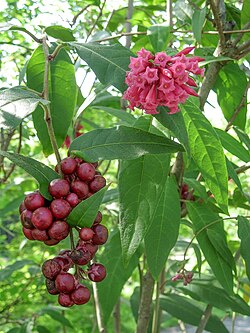
| Fruit and blossoms of Cestrum tomentosum | |
Scientific classification 
| |
| Kingdom: | Plantae |
| Clade: | Embryophytes |
| Clade: | Tracheophytes |
| Clade: | Spermatophytes |
| Clade: | Angiosperms |
| Clade: | Eudicots |
| Clade: | Asterids |
| Order: | Solanales |
| Family: | Solanaceae |
| Subfamily: | Cestroideae |
| Tribe: | Cestreae |
| Genus: | Cestrum L. |
| Species | |
|
Some 150-250, see text | |
| Synonyms | |
| |
Cestrum is a genus of — depending on authority — 150-250 species of flowering plants in the family Solanaceae. They are native to warm temperate to tropical regions of the Americas, from the southernmost United States (Florida, Texas: day-blooming cestrum, C. diurnum) south to the Bío-Bío Region in central Chile (green cestrum, C. parqui). They are colloquially known as cestrums or jessamines (probably from the word "jasmine", due to their fragrant flowers, though they are not true jasmines.).
Description
They are shrubs growing to 6–10 ft (1.8–3.0 m)12 tall. Most are evergreen; a few are deciduous12. All parts of the plants are toxic, causing severe gastroenteritis if eaten.3
Uses and ecology
Several species are grown as ornamental plants for their strongly scented flowers. Numerous cultivars have been produced for garden use, of which 'Newellii' has gained the Royal Horticultural Society's Award of Garden Merit.4 (confirmed 2017).5
Some are invasive species. Especially notorious is green cestrum (C. parqui) in Australia, where it can cause serious losses to livestock which eat the leaves (particularly of drying broken branches) unaware of their toxicity.6
C. laevigatum is employed by wajacas (shamans) of the Krahô tribe in Brazil. It is used "to see far", i.e. to aid in divination. Like the other hallucinogenic plants consumed by them, Craós wajacas consider it a potent entheogen, not to be taken by the uninitiated.7
Cestrum species are used as food by the caterpillars of several Lepidoptera species. These include the glasswing (Greta oto), the Antillean clearwing (Greta diaphanus)8 and Manduca afflicta, which possibly910 feeds only on day-blooming cestrum. It is either known or suspected that such Lepidoptera are able to sequester the toxins from the plant, making them noxious to many predators.
Cestrum species are reported as piscicidal.1112
Selected species
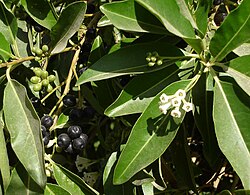

- Cestrum ambatense Francey
- Cestrum aurantiacum – orange cestrum, orange-flowering jessamine, yellow cestrum, "orange jessamine"
- Cestrum auriculatum L'Hér.
- Cestrum bracteatum Link & Otto
- Cestrum buxifolium Kunth
- Cestrum chimborazinum
- Cestrum corymbosum Schltdl.
- Cestrum daphnoides Griseb.
- Cestrum diurnum L. – Day-blooming cestrum, Day-blooming jessamine
- Cestrum ecuadorense Francey
- Cestrum elegans (Brongn. ex Neumann) Schltdl.
- Cestrum endlicheri Miers.
- Cestrum fasciculatum – early jessamine, "red cestrum"
- Cestrum humboldtii Francey
- Cestrum laevigatum Schltdl. – dama-de-noite (Brazil)
- Cestrum lanceolatum Miers 13
- Cestrum lanuginosum Ruiz & Pavón
- Cestrum latifolium Lam.
- Cestrum laurifolium L'Hér.
- Cestrum meridanum Pittier
- Cestrum mutisii Roem. & Schult.
- Cestrum nocturnum – night-blooming cestrum, night-blooming jessamine, "lady of the night", raat ki rani (South Asia)
- Cestrum pacificum
- Cestrum parqui – green cestrum, Chilean cestrum, green poisonberry
- Cestrum peruvianum Roemer & Schultes
- Cestrum petiolare Humboldt, Bonpland & Kunth
- Cestrum psittacinum Stapf
- Cestrum quitense Francey
- Cestrum roseum Humboldt, Bonpland & Kunth
- Cestrum salicifolium Jacq.
- Cestrum santanderianum Francey
- Cestrum sendtnerianum Mart. ex Sendtn.
- Cestrum sessiliflorum Schott ex Sendtn.
- Cestrum stipulatum Vell.
- Cestrum strigilatum Ruiz & Pav.
- Cestrum stuebelii Hieron.
- Cestrum thyrsoideum Kunth.
- Cestrum tomentosum L.f.
- Cestrum validum Francey
- Cestrum viridifolium Francey
References
References
- "Cestrum elegans - Plant Finder". www.missouribotanicalgarden.org. Retrieved 2026-05-12.
- "Cestrum aurantiacum - Plant Finder". www.missouribotanicalgarden.org. Retrieved 2026-05-12.
- The University of Arizona, Cochise County Master Gardeners, Cestrums (jessamine), Barbara Shelor, Nov. 1991"Common Poisonous Plants | Cochise County Master Gardeners".
- "RHS Plantfinder - Cestrum 'Newellii'". Retrieved 12 January 2018.
- "AGM Plants - Ornamental" (PDF). Royal Horticultural Society. July 2017. p. 16. Retrieved 24 January 2018.
- North West Weeds (2003): Green cestrum Archived August 20, 2006, at the Wayback Machine. Version of 2003-APR-15. Retrieved 2007-NOV-14.
- Rodrigues, Eliana; Carlini, E.A. (2006). "Plants with possible psychoactive effects used by the Krahô Indians, Brazil". Revista Brasileira de Psiquiatria. 28 (4): 277–282. doi:10.1590/s1516-44462006000400006. PMID 17242806.
- A. Sourakov; T. C. Emmel (1995). "Life history of Greta diaphana from the Dominican Republic (Lepidoptera: Nymphalidae)". Tropical Lepidoptera. 6 (2): 155–157.
- Oehlke, Bill. "Manduca afflicta afflicta man-DOO-kuhM af-FLIK-ta (Grote, 1865) Sphinx". silkmoths.
- "Eating grubs". All About Heaven.
- CS JAWALE; LB DAMA (2010). "Haematological Changes In The Fresh Water Fish, Exposed To Sub-Lethal Concentration Of Piscicidal Compounds From (Fam: Solanaceae)". National Journal of Life Sciences. 7 (1): 82–84.
- Chetan Jawale; Rambhau Kirdak; Laxmikant Dama (2010). "Larvicidal activity of Cestrum nocturnum on Aedes aegypti". Bangladesh Journal of Pharmacology. 5 (1): 39–40. doi:10.3329/bjp.v5i1.4714.
- "Cestrum lanceolatum Miers". the plant list.
Further reading
Further reading
- Diario de plantas (2007): Cestrum parqui Archived 2008-02-10 at the Wayback Machine. Version of 2007-APR-20. Retrieved 2007-NOV-14.
- Hanelt, Peter & Institute of Plant Genetics and Crop Plant Research (eds.) (2001): Cestrum. In: Mansfeld's Encyclopedia of Agricultural and Horticultural Crops (Except Ornamentals). Springer-Verlag, Berlin, Heidelberg, New York. ISBN 3-540-41017-1
- Huxley, A. (ed.) (1992): New RHS Dictionary of Gardening. Macmillan.
- Reiche, Karl Friedrich (1910): 10. Cestrum L.. In: Estudios criticos sobre la Flora de Chile 5: 372-373. PDF
- Ulloa Ulloa, Carmen & Jørgensen, Peter Møller (1993): Cestrum. In: Árboles y arbustos de los Andes del Ecuador. Aarhus University Press. ISBN 87-87600-39-0
- United States Department of Agriculture (USDA) (2007a): Germplasm Resources Information Network - Cestrum. Retrieved 2007-NOV-14.
- Jawale C.S., Dama L.B. (2010). Insecticidal potential of Cestrum sp. (Solanaceae:Solanales) against Tribolium castaneumand Tribolium confusum (Herbst)(Coleoptera- Tenebrionidae). Deccan Curr. Sci. 3(2): 155-161.