 | |
 | |
| Clinical data | |
|---|---|
| Other names | Tsepentil; N-Cyclopentyllysergamide; NCPe-LA; N-Cyclopentyl-lysergamide; LCyP; C5AL |
| Identifiers | |
| |
| PubChem CID | |
| ChemSpider | |
| Chemical and physical data | |
| Formula | C21H25N3O |
| Molar mass | 335.451 g·mol−1 |
| 3D model (JSmol) | |
| |
| |
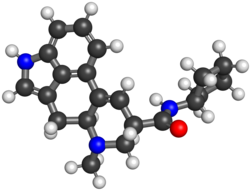
Cepentil, or Tsepentil, also known as N-cyclopentyllysergamide (NCPe-LA) or as lysergic acid cyclopentylamide (LCyP), is an analogue of LSD developed in the former Soviet Union which acts as an antagonist at serotonin receptors. It does not produce hallucinogen-like effects in animal studies, instead being described as an "energizer" by contemporary sources, suggesting an action similar to the antidementia drug hydergine, however the pharmacology of cepentil has not been studied with modern techniques.1234
See also
See also
References
References
- Votava Z, Podvalova I, Semonsky M (May 1958). "Studies on the pharmacology of D-lysergic acid cycloalkylamides". Archives Internationales de Pharmacodynamie et de Therapie. 115 (1–2): 114–30. PMID 13545891.
- Zakusov VV (January 1964). "Pharmacology and chemistry". Vestnik Akademii Meditsinskikh Nauk SSSR (in Russian). 19: 43–51. PMID 14203697.
- Usdin E, Efron DH (1972). Psychotropic Drugs and Related Compounds. National Institute of Mental Health. pp. 94–95. ASIN B002X3CDIY.
- Sankar DV (1975). LSD - A Total Study. PJD Publications. pp. 150–152. ISBN 0-9600290-3-6.