| Centotheceae | |
|---|---|
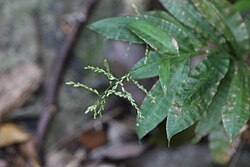
| |
| Centotheca lappacea | |
Scientific classification 
| |
| Kingdom: | Plantae |
| Clade: | Embryophytes |
| Clade: | Tracheophytes |
| Clade: | Spermatophytes |
| Clade: | Angiosperms |
| Clade: | Monocots |
| Clade: | Commelinids |
| Order: | Poales |
| Family: | Poaceae |
| Clade: | PACMAD clade |
| Subfamily: | Panicoideae |
| Tribe: | Centotheceae Ridl. (1907) |
| Genera | |
| Synonyms1 | |
|
subtribe Centothecinae Benth. (1881) | |
Centotheceae is a small tribe of grasses with six species in two genera, distributed in Africa and Asia. It belongs to a group within the subfamily Panicoideae, sometimes referred to as "centothecoid clade", which consists of the tribes Thysanolaeneae, Cyperochloeae, Centotheceae, Chasmanthieae, Zeugiteae, Tristachyidae, and Steyermarkochloeae; this clade is sister to the remaining groups within Panicoideae.1 Unlike many other clades in the subfamily Panicoideae, they use the C3 photosynthetic pathway.2
References
References
- Soreng, Robert J.; Peterson, Paul M.; Romschenko, Konstantin; Davidse, Gerrit; Zuloaga, Fernando O.; Judziewicz, Emmet J.; Filgueiras, Tarciso S.; Davis, Jerrold I.; Morrone, Osvaldo (2015). "A worldwide phylogenetic classification of the Poaceae (Gramineae)". Journal of Systematics and Evolution. 53 (2): 117–137. doi:10.1111/jse.12150. hdl:11336/25248. ISSN 1674-4918.

- Grass Phylogeny Working Group II (2012). "New grass phylogeny resolves deep evolutionary relationships and discovers C4 origins". New Phytologist. 193 (2): 304–312. doi:10.1111/j.1469-8137.2011.03972.x. hdl:2262/73271. PMID 22115274.