| Celastrus paniculatus | |
|---|---|
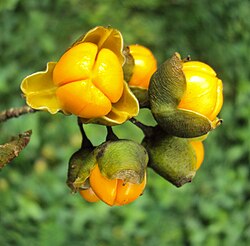
| |
| Fruits | |
Scientific classification 
| |
| Kingdom: | Plantae |
| Clade: | Embryophytes |
| Clade: | Tracheophytes |
| Clade: | Spermatophytes |
| Clade: | Angiosperms |
| Clade: | Eudicots |
| Clade: | Rosids |
| Order: | Celastrales |
| Family: | Celastraceae |
| Genus: | Celastrus |
| Species: | C. paniculatus
|
| Binomial name | |
| Celastrus paniculatus | |
| Synonyms | |
|
Celastrus dependens Wall. | |

Celastrus paniculatus is a woody liana commonly known as black oil plant, climbing staff tree, and intellect tree (Sanskrit: jyotishmati ज्योतीष्मती, Hindi: mal-kangni माल-कांगनी, Chinese: deng you teng 灯油藤).123 This climbing shrub grows throughout India at elevations up to 1,800 m (5,900 ft).14
C. paniculatus is a deciduous vine with stems up to 10 cm (3.9 in) in diameter and 6 m (20 ft) long with rough, pale brown exfoliating bark covered densely with small, elongated lenticles. The leaves are simple, broad, and oval, obovate or elliptic in shape, with toothed margins.12
Traditional medicine
Oil from the seeds is used as a traditional medicine in Indian Unani and Ayurvedic medicine.15
Poisonous relative
Celastrus paniculatus has a relative that grows in the United States that is poisonous (Celastrus orbiculatus), so identifying this plant carefully can be important.
References
References
- Premila, M. S. (2006). Ayurvedic Herbs: A Clinical Guide to the Healing Plants of Traditional Indian Medicine. New York: Haworth Press. ISBN 978-0-7890-1768-0.
- H. F. Macmillan (1989). Handbook of Tropical Plants. Columbia, Mo: South Asia Books. ISBN 978-81-7041-177-2.
- Putz, Francis E.; Mooney, Harold A. (1991). The Biology of vines. Cambridge, UK: Cambridge University Press. ISBN 978-0-521-39250-1.
- Zhixiang Zhang, Michele Funston: Celastrus, in Flora of China, Vol. 11
- Chopra, R. N. (1994). Indigenous Drugs of india. Kolkata: Academic Publishers. ISBN 978-81-85086-80-4.
External links
External links
- Caldecott, Todd (2006). Ayurveda: The Divine Science of Life. Elsevier/Mosby. ISBN 978-0-7234-3410-8. Contains a detailed monograph on Celastrus paniculatus (Jyotishmati) as well as a discussion of health benefits and usage in clinical practice.
- Bhanumathy, M.; Harish, M. S.; Shivaprasad, H. N.; Sushma, G. (Mar 2010). "Nootropic activity of Celastrus paniculatus seed". Pharmaceutical Biology. 48 (3): 324–7. doi:10.3109/13880200903127391. PMID 20645820. S2CID 26602192.
- Kanti Rekha, M K Bhan, S S Balyan and A K Dhar: Cultivation prospects of endangered species Celastrus paniculatus Willd.