| Celastrina echo | |
|---|---|
| |
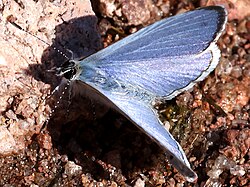
| C. echo cinerea upperside | |

| |
| C. echo cinerea underside | |
Scientific classification 
| |
| Kingdom: | Animalia |
| Phylum: | Arthropoda |
| Clade: | Pancrustacea |
| Class: | Insecta |
| Order: | Lepidoptera |
| Family: | Lycaenidae |
| Genus: | Celastrina |
| Species: | C. echo
|
| Binomial name | |
| Celastrina echo (W. H. Edwards, 1864)
| |
Celastrina echo, known generally as the echo azure or western azure, is a species of blue in the butterfly family Lycaenidae.23 Celastrina echo have been observed in mostly western regions of the United States, including California, Oregon, Arizona, New Mexico, and Montana.4
The taxonomic division of Celastrina butterflies has been a very complicated issue. Some scientists like Layberry et al. once recognized C. echo as a subspecies of C.ladon (Cramer, 1780) in western Canada.5 In 2001, Guppy and Shepard nominated C. echo to the species level.6 Currently, many scientists agree that C.echo is a distinguished species.5
The MONA or Hodges number for Celastrina echo is 4363.2.7

Subspecies
These five subspecies belong to the species Celastrina echo:
- Celastrina echo cinerea (W. H. Edwards, 1883) (Southwestern azure)
- Celastrina echo echo (W. H. Edwards, 1864) (Pacific azure)
- Celastrina echo nigrescens (J. Fletcher, 1903) (Northwestern azure)
- Celastrina echo sidara (Clench, 1944) (Rocky Mountain azure)
- Celastrina echo gozora (Boisduval, 1870)(Mexican Azure)8
Physical identification and relationship with ants
The butterflies in the Lycaenidae family in general are usually flat as larvae. The adult individuals are usually small and have hairy, ringed antenna-like tails. Their wings are mostly bright glowing blue and green. A large portion of Lycaenidae butterflies are found to have different associations with ants, either mutualistic, parasitic, or predatory.91011
C. echo in particular is usually pale blue-grey with small black spots or dashes. Based on the limited observations reported and the life history records of the other blue butterflies (Polyommatini), C. echo's known life history starts with eggs laid on the flower buds of its host plants. Attended and protected by the ants, C. echo's larvae feed on the flower buds and flowers while ants receive sugar-rich honeydew from them throughout the larval lifespan. C. echo then may pupate within ant nests.12 Some Lycaenidae species become parasites or even predator within the ant nest. The specific relationships to ants in the later life stage of C. echo are not quite clear.11
Host plants, habitat, and flight period
The C. echo larval foodplants are mainly composed of Ceanothus (California wild lilac), Spiraea (Holodiscus), Aesculus (California buckeye), Rubus (blackberries), and some legumes.1213 The adults' host plants are also very diverse. They mostly feed on nectar from plants including the larval host plants listed above, Heteromeles (toyon), Rhamnus, and several others.124
C. echo are often observed in woodlands, shrublands, and near mountain streams: places that have woody host plants they feed on.124 Depending on the moisture and relative condition of the larval hostplants, C. echo may fly in 1-2 or more broods from early spring to the fall (around February to late June, July, or even till October if there is no severe cold weather).1312
References
References
- NatureServe (1 May 2026). "Celastrina_echo Western Azure". NatureServe Explorer. Arlington, Virginia. Retrieved 2026-05-31.
- "Celastrina echo Report". Integrated Taxonomic Information System. Retrieved 2019-09-24.
- "Celastrina echo species Information". BugGuide.net. Retrieved 2019-09-24.
- Webmaster, David Ratz. "Western Azure - Montana Field Guide". fieldguide.mt.gov. Retrieved 2024-06-10.
- Schmidt, B. Christian; Layberry, Ross A. (2016-04-26). "What Azure blues occur in Canada? A re-assessment of Celastrina Tutt species (Lepidoptera, Lycaenidae)". ZooKeys (584): 135–164. Bibcode:2016ZooK..584..135S. doi:10.3897/zookeys.584.7882. ISSN 1313-2970. PMC 4857028. PMID 27199600.
- LaBar, Caitlin; Pelham, Jonathan; Kondla, Norbert (28 April 2022). "A new species of Celastrina from the northwestern United States and southwestern Canada with a lectotype designation of Lycaena pseudargiolus var. nigrescens Fletcher (Lycaenidae: Polyommatinae)" (PDF). The Taxonomic Report. 10 (3): 1–24. eISSN 2643-4806. ISSN 2643-4776.
- "North American Moth Photographers Group, Celastrina echo". Retrieved 2019-09-24.
- "Celastrina echo thumbnails". www.butterfliesofamerica.com. Retrieved 2024-06-10.
- Robbins, Robert K. (November 1981). "The "False Head" Hypothesis: Predation and Wing Pattern Variation of Lycaenid Butterflies". The American Naturalist. 118 (5): 770–775. doi:10.1086/283868. ISSN 0003-0147.
- Ueda, Shouhei; Komatsu, Takashi; Itino, Takao; Arai, Ryusuke; Sakamoto, Hironori (2016-11-03). "Host-ant specificity of endangered large blue butterflies (Phengaris spp., Lepidoptera: Lycaenidae) in Japan". Scientific Reports. 6 (1) 36364. Bibcode:2016NatSR...636364U. doi:10.1038/srep36364. ISSN 2045-2322. PMC 5093462. PMID 27808223.
- Pierce, Naomi E.; Braby, Michael F.; Heath, Alan; Lohman, David J.; Mathew, John; Rand, Douglas B.; Travassos, Mark A. (January 2002). "The Ecology and Evolution of Ant Association in the Lycaenidae (Lepidoptera)". Annual Review of Entomology. 47 (1): 733–771. doi:10.1146/annurev.ento.47.091201.145257. ISSN 0066-4170. PMID 11729090.
- "Echo Azure Celastrina echo (W.H. Edwards, 1864) | Butterflies and Moths of North America". www.butterfliesandmoths.org. Retrieved 2024-06-10.
- Orsak, Larry J. (1977). The butterflies of Orange County, California. Research series - Museum of Systematic Biology; no. 4. Irvine: Center for Pathobiology, University of California, Irvine. ISBN 978-0-9601418-1-4.
Further reading
Further reading
- Pohl, Greg; Patterson, Bob; Pelham, Jonathan (2016). Annotated taxonomic checklist of the Lepidoptera of North America, North of Mexico (Report). doi:10.13140/RG.2.1.2186.3287.