
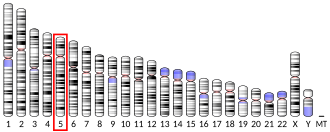






M-phase inducer phosphatase 3 is an enzyme that in humans is encoded by the CDC25C gene.5
This gene is highly conserved during evolution and it plays a key role in the regulation of cell division. The encoded protein is a tyrosine phosphatase and belongs to the Cdc25 phosphatase family. It directs dephosphorylation of cyclin B-bound CDC2 (CDK1) and triggers entry into mitosis. It is also thought to suppress p53-induced growth arrest. Multiple alternatively spliced transcript variants of this gene have been described, however, the full-length nature of many of them is not known.6
Interactions
CDC25C has been shown to interact with MAPK14,7 CHEK1,8 PCNA,9 PIN1,101112 PLK313 and NEDD4.12
References
References
- GRCh38: Ensembl release 89: ENSG00000158402 – Ensembl, May 2017
- GRCm38: Ensembl release 89: ENSMUSG00000044201 – Ensembl, May 2017
- "Human PubMed Reference:". National Center for Biotechnology Information, U.S. National Library of Medicine.
- "Mouse PubMed Reference:". National Center for Biotechnology Information, U.S. National Library of Medicine.
- Gould KL, Moreno S, Tonks NK, Nurse P (Feb 1991). "Complementation of the mitotic activator, p80cdc25, by a human protein-tyrosine phosphatase". Science. 250 (4987): 1573–6. Bibcode:1990Sci...250.1573G. doi:10.1126/science.1703321. PMID 1703321. S2CID 25037148.
- "Entrez Gene: CDC25C cell division cycle 25 homolog C (S. pombe)".
- Bulavin DV, Higashimoto Y, Popoff I J, Gaarde W A, Basrur V, Potapova O, Appella E, Fornace A J (May 2001). "Initiation of a G2/M checkpoint after ultraviolet radiation requires p38 kinase". Nature. 411 (6833). England: 102–7. doi:10.1038/35075107. ISSN 0028-0836. PMID 11333986. S2CID 4410763.
- Sanchez Y, Wong C, Thoma R S, Richman R, Wu Z, Piwnica-Worms H, Elledge S J (Sep 1997). "Conservation of the Chk1 checkpoint pathway in mammals: linkage of DNA damage to Cdk regulation through Cdc25". Science. 277 (5331). UNITED STATES: 1497–501. doi:10.1126/science.277.5331.1497. ISSN 0036-8075. PMID 9278511.
- Kawabe T, Suganuma Masashi, Ando Tomoaki, Kimura Mayumi, Hori Haruna, Okamoto Takashi (Mar 2002). "Cdc25C interacts with PCNA at G2/M transition". Oncogene. 21 (11). England: 1717–26. doi:10.1038/sj.onc.1205229. ISSN 0950-9232. PMID 11896603.
- Shen M, Stukenberg P T, Kirschner M W, Lu K P (Mar 1998). "The essential mitotic peptidyl-prolyl isomerase Pin1 binds and regulates mitosis-specific phosphoproteins". Genes Dev. 12 (5). UNITED STATES: 706–20. doi:10.1101/gad.12.5.706. ISSN 0890-9369. PMC 316589. PMID 9499405.
- Goldstrohm AC, Albrecht T R, Suñé C, Bedford M T, Garcia-Blanco M A (Nov 2001). "The transcription elongation factor CA150 interacts with RNA polymerase II and the pre-mRNA splicing factor SF1". Mol. Cell. Biol. 21 (22). United States: 7617–28. doi:10.1128/MCB.21.22.7617-7628.2001. ISSN 0270-7306. PMC 99933. PMID 11604498.
- Lu PJ, Zhou X Z, Shen M, Lu K P (Feb 1999). "Function of WW domains as phosphoserine- or phosphothreonine-binding modules". Science. 283 (5406). UNITED STATES: 1325–8. Bibcode:1999Sci...283.1325L. doi:10.1126/science.283.5406.1325. ISSN 0036-8075. PMID 10037602.
- Ouyang B, Li W, Pan H, Meadows J, Hoffmann I, Dai W (Oct 1999). "The physical association and phosphorylation of Cdc25C protein phosphatase by Prk". Oncogene. 18 (44). ENGLAND: 6029–36. doi:10.1038/sj.onc.1202983. ISSN 0950-9232. PMID 10557092.
Further reading
Further reading
- Draetta G, Eckstein J (1997). "Cdc25 protein phosphatases in cell proliferation". Biochim. Biophys. Acta. 1332 (2): M53–63. doi:10.1016/S0304-419X(96)00049-2. PMID 9141461.
- Nilsson I, Hoffmann I (2000). "Cell cycle regulation by the Cdc25 phosphatase family". Progress in Cell Cycle Research. Vol. 4. pp. 107–14. doi:10.1007/978-1-4615-4253-7_10. ISBN 978-1-4613-6909-7. PMID 10740819.
- Amini S, Khalili K, Sawaya BE (2004). "Effect of HIV-1 Vpr on cell cycle regulators". DNA Cell Biol. 23 (4): 249–60. doi:10.1089/104454904773819833. PMID 15142382.
- Kino T, Chrousos GP (2004). "Human immunodeficiency virus type-1 accessory protein Vpr: a causative agent of the AIDS-related insulin resistance/lipodystrophy syndrome?". Ann. N. Y. Acad. Sci. 1024 (1): 153–67. Bibcode:2004NYASA1024..153K. doi:10.1196/annals.1321.013. PMID 15265780. S2CID 23655886.
- Andersen JL, Planelles V (2005). "The role of Vpr in HIV-1 pathogenesis". Curr. HIV Res. 3 (1): 43–51. doi:10.2174/1570162052772988. PMID 15638722.
- Sartor H, Ehlert F, Grzeschik KH, et al. (1992). "Assignment of two human cell cycle genes, CDC25C and CCNB1, to 5q31 and 5q12, respectively". Genomics. 13 (3): 911–2. doi:10.1016/0888-7543(92)90190-4. PMID 1386342.
- Strausfeld U, Labbé JC, Fesquet D, et al. (1991). "Dephosphorylation and activation of a p34cdc2/cyclin B complex in vitro by human CDC25 protein". Nature. 351 (6323): 242–5. Bibcode:1991Natur.351..242S. doi:10.1038/351242a0. PMID 1828290. S2CID 4372756.
- Galaktionov K, Beach D (1992). "Specific activation of cdc25 tyrosine phosphatases by B-type cyclins: evidence for multiple roles of mitotic cyclins". Cell. 67 (6): 1181–94. doi:10.1016/0092-8674(91)90294-9. PMID 1836978. S2CID 9659637.
- Sadhu K, Reed SI, Richardson H, Russell P (1990). "Human homolog of fission yeast cdc25 mitotic inducer is predominantly expressed in G2". Proc. Natl. Acad. Sci. U.S.A. 87 (13): 5139–43. Bibcode:1990PNAS...87.5139S. doi:10.1073/pnas.87.13.5139. PMC 54277. PMID 2195549.
- Re F, Braaten D, Franke EK, Luban J (1995). "Human immunodeficiency virus type 1 Vpr arrests the cell cycle in G2 by inhibiting the activation of p34cdc2-cyclin B". J. Virol. 69 (11): 6859–64. doi:10.1128/JVI.69.11.6859-6864.1995. PMC 189600. PMID 7474100.
- Zwicker J, Gross C, Lucibello FC, et al. (1995). "Cell cycle regulation of cdc25C transcription is mediated by the periodic repression of the glutamine-rich activators NF-Y and Sp1". Nucleic Acids Res. 23 (19): 3822–30. doi:10.1093/nar/23.19.3822. PMC 307297. PMID 7479023.
- Di Marzio P, Choe S, Ebright M, et al. (1996). "Mutational analysis of cell cycle arrest, nuclear localization and virion packaging of human immunodeficiency virus type 1 Vpr". J. Virol. 69 (12): 7909–16. doi:10.1128/JVI.69.12.7909-7916.1995. PMC 189735. PMID 7494303.
- Strausfeld U, Fernandez A, Capony JP, et al. (1994). "Activation of p34cdc2 protein kinase by microinjection of human cdc25C into mammalian cells. Requirement for prior phosphorylation of cdc25C by p34cdc2 on sites phosphorylated at mitosis". J. Biol. Chem. 269 (8): 5989–6000. doi:10.1016/S0021-9258(17)37560-9. PMID 8119945.
- Zheng XF, Ruderman JV (1993). "Functional analysis of the P box, a domain in cyclin B required for the activation of Cdc25". Cell. 75 (1): 155–64. doi:10.1016/S0092-8674(05)80092-3. PMID 8402895. S2CID 45351149.
- Taviaux SA, Demaille JG (1993). "Localization of human cell cycle regulatory genes CDC25C to 5q31 and WEE1 to 11p15.3-11p15.1 by fluorescence in situ hybridization". Genomics. 15 (1): 194–6. doi:10.1006/geno.1993.1032. PMID 8432534.
- Honda R, Ohba Y, Nagata A, et al. (1993). "Dephosphorylation of human p34cdc2 kinase on both Thr-14 and Tyr-15 by human cdc25B phosphatase". FEBS Lett. 318 (3): 331–4. doi:10.1016/0014-5793(93)80540-B. PMID 8440392. S2CID 30754963.
- Booher RN, Holman PS, Fattaey A (1997). "Human Myt1 is a cell cycle-regulated kinase that inhibits Cdc2 but not Cdk2 activity". J. Biol. Chem. 272 (35): 22300–6. doi:10.1074/jbc.272.35.22300. PMID 9268380.
- Sanchez Y, Wong C, Thoma RS, et al. (1997). "Conservation of the Chk1 checkpoint pathway in mammals: linkage of DNA damage to Cdk regulation through Cdc25". Science. 277 (5331): 1497–501. doi:10.1126/science.277.5331.1497. PMID 9278511.
External links
External links
- Human CDC25C genome location and CDC25C gene details page in the UCSC Genome Browser.