
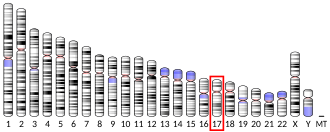



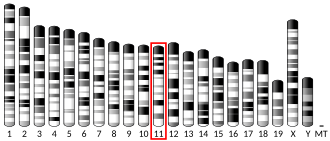


Chemokine (C-C motif) ligand 3 (CCL3) also known as macrophage inflammatory protein 1-alpha (MIP-1-alpha) is a protein that in humans is encoded by the CCL3 gene.5
Function
CCL3 is a cytokine belonging to the CC chemokine family that is involved in the acute inflammatory state in the recruitment and activation of polymorphonuclear leukocytes6 through binding to the receptors CCR1, CCR4 and CCR5.5
Sherry et al. (1988) demonstrated 2 protein components of MIP1, called by them alpha (CCL3, this protein) and beta (CCL4).75
CCL3 produces a monophasic fever of rapid onset whose magnitude is equal to or greater than that of fevers produced with either recombinant human tumor necrosis factor or recombinant human interleukin-1. However, in contrast to these two endogenous pyrogens, the fever induced by MIP-1 is not inhibited by the cyclooxygenase inhibitor ibuprofen and CCL3 may participate in the febrile response that is not mediated through prostaglandin synthesis and clinically cannot be ablated by cyclooxygenase.8
Interactions
CCL3 has been shown to interact with CCL4.9 Attracts macrophages, monocytes and neutrophils.
References
References
- ENSG00000277632, ENSG00000274221 GRCh38: Ensembl release 89: ENSG00000278567, ENSG00000277632, ENSG00000274221 – Ensembl, May 2017
- GRCm38: Ensembl release 89: ENSMUSG00000000982 – Ensembl, May 2017
- "Human PubMed Reference:". National Center for Biotechnology Information, U.S. National Library of Medicine.
- "Mouse PubMed Reference:". National Center for Biotechnology Information, U.S. National Library of Medicine.
- "Entrez Gene: CCL3 chemokine (C-C motif) ligand 3".
- Wolpe SD, Davatelis G, Sherry B, Beutler B, Hesse DG, Nguyen HT, Moldawer LL, Nathan CF, Lowry SF, Cerami A (1988). "Macrophages secrete a novel heparin-binding protein with inflammatory and neutrophil chemokinetic properties". The Journal of Experimental Medicine. 167 (2): 570–81. doi:10.1084/jem.167.2.570. PMC 2188834. PMID 3279154.
- Sherry B, Tekamp-Olson P, Gallegos C, Bauer D, Davatelis G, Wolpe SD, Masiarz F, Coit D, Cerami A (1988). "Resolution of the two components of macrophage inflammatory protein 1, and cloning and characterization of one of those components, macrophage inflammatory protein 1 beta". The Journal of Experimental Medicine. 168 (6): 2251–9. doi:10.1084/jem.168.6.2251. PMC 2189160. PMID 3058856.
- Davatelis G, Wolpe SD, Sherry B, Dayer JM, Chicheportiche R, Cerami A (1989). "Macrophage inflammatory protein-1: a prostaglandin-independent endogenous pyrogen". Science. 243 (4894 Pt 1): 1066–8. Bibcode:1989Sci...243.1066D. doi:10.1126/science.2646711. PMID 2646711.
- Guan E, Wang J, Norcross MA (Apr 2001). "Identification of human macrophage inflammatory proteins 1alpha and 1beta as a native secreted heterodimer". The Journal of Biological Chemistry. 276 (15): 12404–9. doi:10.1074/jbc.M006327200. PMID 11278300.
External links
External links
- Human CCL3 genome location and CCL3 gene details page in the UCSC Genome Browser.
Further reading
Further reading
- Menten P, Wuyts A, Van Damme J (Dec 2002). "Macrophage inflammatory protein-1". Cytokine & Growth Factor Reviews. 13 (6): 455–81. doi:10.1016/S1359-6101(02)00045-X. PMID 12401480.
- Muthumani K, Desai BM, Hwang DS, Choo AY, Laddy DJ, Thieu KP, Rao RG, Weiner DB (Apr 2004). "HIV-1 Vpr and anti-inflammatory activity". DNA and Cell Biology. 23 (4): 239–47. doi:10.1089/104454904773819824. PMID 15142381.
- Joseph AM, Kumar M, Mitra D (Jan 2005). "Nef: "necessary and enforcing factor" in HIV infection". Current HIV Research. 3 (1): 87–94. doi:10.2174/1570162052773013. PMID 15638726.
- Zhao RY, Elder RT (Mar 2005). "Viral infections and cell cycle G2/M regulation". Cell Research. 15 (3): 143–9. doi:10.1038/sj.cr.7290279. PMID 15780175.
- Zhao RY, Bukrinsky M, Elder RT (Apr 2005). "HIV-1 viral protein R (Vpr) & host cellular responses". The Indian Journal of Medical Research. 121 (4): 270–86. PMID 15817944.
- Li L, Li HS, Pauza CD, Bukrinsky M, Zhao RY (2006). "Roles of HIV-1 auxiliary proteins in viral pathogenesis and host-pathogen interactions". Cell Research. 15 (11–12): 923–34. doi:10.1038/sj.cr.7290370. PMID 16354571.