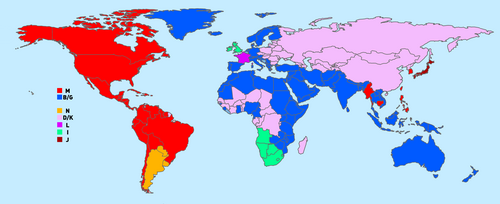
CCIR System N is an analog broadcast television system introduced in 1951 and adopted by Argentina, Paraguay, and Uruguay, paired with the PAL color system (PAL-N) since 1980.123
It employs the 625 line/50 field per second waveform of CCIR Systems B/G, D/K, and I, but on a 6 MHz channel with a chrominance subcarrier frequency of 3.582056 MHz245 (similar to NTSC).
Specifications
The general System N specifications are listed below:64

- Frame rate: 25 Hz
- Interlace: 2/1
- Field rate: 50 Hz
- Lines/frame: 625
- Line rate: 15.625 kHz
- Visual bandwidth: 4.2 MHz
- Vision modulation: Negative
- Preemphasis: 75 μs
- Sound modulation: FM
- Sound offset: +4.5 MHz
- Channel bandwidth: 6 MHz
See also
See also
Notes and references
- Sony Corporation (2014). "Help Guide | On TV color systems". www.sony-asia.com.
- Iazbec; Soria; Tulli; Gonzalez (1999). Estudio de las tecnicas de transcodificacion de señales de television PAL-B / PAL-N (in Spanish). Vol. 10. Centro de Informacion Tecnologica. pp. 341–349.
- Trappe, Raffael Amadeus (2005). "Worldwide TV Systems (NTSC, PAL, and SECAM)". Paradiso-Design. Archived from the original on 2023-04-19. Retrieved 2023-11-05.
- Pemberton, Alan (30 August 2012). "World Analogue Television Standards and Waveforms - CCIR Transmission Systems". Pembers' Ponderings. Archived from the original on 2012-08-30.
- Recommendation ITU-R BT.470-6 -Conventional Television Systems (PDF). ITU-R. 1998.
- Reference Data for Radio Engineers, ITT Howard W.Sams Co., New York, 1977, section 30