中国社会科学院 | |||||||
 | |||||||
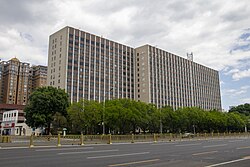 CASS headquarters | |||||||
| Abbreviation | CASS | ||||||
|---|---|---|---|---|---|---|---|
| Formation | May 7, 1977 (1977-05-07) | ||||||
| Type | Think tank | ||||||
| Headquarters | South Middle Ring Road, Wangjing Area, Chaoyang District | ||||||
| Location | |||||||
| Coordinates | 39°54′28″N 116°25′34″E / 39.9078°N 116.4262°E / 39.9078; 116.4262 | ||||||
Party Secretary and President | Gao Xiang | ||||||
Parent organization | State Council of China | ||||||
| Subsidiaries | China Social Sciences Press | ||||||
| Website | cssn | ||||||
| Chinese name | |||||||
| Simplified Chinese | 中国社会科学院 | ||||||
| Traditional Chinese | 中國社會科學院 | ||||||
| |||||||
The Chinese Academy of Social Sciences (CASS) is a state research institute and think tank of the People's Republic of China. It is a ministry-level institution under the State Council. The CASS is the top academic institution and comprehensive research center for philosophy and social sciences research in China.
The CASS was founded in May 1977. Its predecessor was the Department of Philosophy and Social Sciences of the Chinese Academy of Sciences. The main research objects of the Academy of Social Sciences are the language, philosophy, law, economy, religion, ethnicity, archaeology, history and literature of China and other countries in the world. The Academy of Social Sciences is divided into 6 academic departments and 37 research institutes.
History
The predecessor of the Chinese Academy of Social Sciences was the Department of Philosophy and Social Sciences of the Chinese Academy of Sciences, established in 1955.1 The Division of Philosophy and Social Sciences of the Chinese Academy of Sciences, the predecessor of CASS, elected 61 members of the academy.2
The CASS was established in May 1977 based on splitting the Department of Philosophy and Social Sciences from the Chinese Academy of Sciences, with the aim of promoting the development of philosophy and social sciences, under the instruction of Deng Xiaoping.3: 86–87 The first president was Hu Qiaomu.3: 87 2
In 1979, CASS Vice President Huan Xiang led the first Chinese delegation of social scientists to travel to the United States.3: 88
In August, 2006, the first batch of 47 members and 95 honorary members of the Chinese Academy of Social Sciences were selected.42 Subsequent elections were held in:567
- 2010: 10 new members, 38 Honorary Members
- 2014: 4 new members
- 2018: 12 new members
- 2024: 9 new members.
Up to 2024, a total of 82 members had been selected from the entire academy (as of March 2022, there were 133 honorary members).82
Members
The Membership of the Chinese Academy of Social Sciences (Chinese: 中国社会科学院学部委员) and Honorary Membership of the Chinese Academy of Social Sciences (Chinese: 中国社会科学院荣誉学部委员) are the highest academic titles within CASS, and are lifelong honors. The members are active scholars, while honorary members are retired scholars. They are elected for different academic divisions of the Chinese Academy of Social Sciences every four years.82910
Selection and Evaluation
The selection processes include:68210
- Nomination by members and affiliated units,
- Review and recommendation by the candidate evaluation committee,
- Public announcement,
- Evaluation by external experts,
- Final review and election by the academic assembly,
- Approval by the academy party committee.
- Significant academic achievements
- National or international recognition
- Integrity and scholarly conduct
- Contributions to the development of philosophy and social sciences in China
The Election is carried out every two to four years. Unlike the selection of academicians for the Chinese Academy of Sciences and the Chinese Academy of Engineering, the members and honorary members are selected only from within the Chinese Academy of Social Sciences, with no participation from universities or other social science circles.1011
CASS members do not enjoy any special treatment in terms of material benefits.8
Honorary Members
Honorary Members are:
- Retired senior scholars
- Individuals with long-term, distinguished academic service
- Scholars whose influence is widely recognized.
The honorary members were elected by members and the honorary members selection committee and approved by the Chinese Academy of Social Sciences administrative meeting. They do not participate in administrative functions but retain lifetime recognition. Honorary members and members of the Chinese Academy of Social Sciences have an academic status roughly equivalent to academicians of the Chinese Academy of Sciences and the Chinese Academy of Engineering.42
Structure
The CASS is a ministry-level institution under the State Council.121314 As of 2012, CASS has over 3,200 resident scholars.15 As of November 2020, the CASS has 6 university departments, 42 research institutes, 6 functional departments, 5 directly affiliated institutions, and 3 directly affiliated companies.16 Of its functional departments, five are focused on research.17
CASS houses the Graduate School of Chinese Academy of Social Sciences, which later became the University of Chinese Academy of Social Sciences.18
The Institute of Taiwan Studies at CASS is under the control of the Fifteenth Bureau of the Ministry of State Security.192021
The Dictionary Editing Office of the Institute of Linguistics edits Xiandai Hanyu Cidian and the Xinhua Dictionary.2223 The China Social Sciences Press was established in June 1978 under the auspices of the CASS,24 and has published over 8,000 books since its inception.25
The CASS has the following internal structure:2627
Internal organization
- General Office
- Bureau of Scientific Research Management (General Office of Academic Divisions)
- Personnel Bureau
- Bureau of International Cooperation (Hong Kong, Macao, and Taiwan Office)
- Administrative Bureau of Finance, Infrastructure Construction and Assets
- Party Committee of the Organization (Office of the Leading Group for Party Group Inspection Work)
- Bureau of Work for Veteran Cadres
Directly affiliated institutions
Directly affiliated research units
|
|
|
|
|
|
Directly affiliated colleges and universities
- University of Chinese Academy of Social Sciences (Graduate School of Chinese Academy of Social Sciences)
Other directly affiliated institutions
- Chinese Academy of Social Sciences Library (Survey and Data Center)
- Social Sciences in China Press
- Chinese Academy of Social Sciences Service
- Center for Cultural Development and Promotion
- Office of Guiding Group for China’s Local Chronicles Compilation (State Local Chronicles Museum, Local Chronicles Publishing House)
Directly affiliated enterprise units
- China Social Sciences Press
- Social Sciences Academic Press
- Chinese Corporation for Promotion of Humanities (China Economic and Technical Consulting Corporation)
- China-run publishing and media group
Activities
Every quarter, CASS hosts a high-level seminar to which it invites officials from other developing countries to discuss topics including governance in China, poverty alleviation, and socio-economic development.28
According to Chen Daoyin, a former professor at the Shanghai University of Political Science and Law, CASS "is not so much an academic institution but a body to formulate party ideology to support the leadership."29 CASS employees periodically submit observations of colleagues' behavior to inspection teams, especially of colleagues who criticize the Chinese Communist Party in private.30
List of CCP Committee Secretaries and presidents
| English name | Chinese name | Took office | Left office | Ref. |
|---|---|---|---|---|
| Hu Qiaomu | 胡乔木 | 1977 | 1982 | |
| Ma Hong | 马洪 | 1982 | 1985 | |
| Hu Qiaomu | 胡乔木 | 1985 | 1988 | |
| Hu Sheng | 胡绳 | 1988 | 1998 | 31 |
| Li Tieying | 李铁映 | March 1998 | January 2003 | 32 |
| Chen Kuiyuan | 陈奎元 | January 2003 | April 2013 | 33 |
| Wang Weiguang | 王伟光 | April 2013 | March 2018 | 34 |
| Xie Fuzhan | 谢伏瞻 | March 2018 | May 2022 | 35 |
| Shi Taifeng | 石泰峰 | May 2022 | December 2022 | 36 |
| Gao Xiang | 高翔 | December 2022 | Incumbent | 29 |
See also
See also
References
References
- "哲学社会科学部独立始末" [The Genesis and Evolution of the Division of Philosophy and Social Sciences]. Chinese Academy of Sciences (in Chinese). Archived from the original on 2023-10-07. Retrieved 2020-11-24.
- Li Wenji (2024-09-24). "中国社科院学部委员怎么选" [How are members of the Chinese Academy of Social Sciences selected]. The Paper (in Chinese).
- Minami, Kazushi (2024). People's Diplomacy: How Americans and Chinese Transformed US-China Relations during the Cold War. Ithaca, NY: Cornell University Press. ISBN 9781501774157. JSTOR 10.7591/jj.23338323.
- Zhang Lei, ed. (2006-08-02). "中国社会科学院首批47名学部委员正式产生" [The first batch of 47 members of the Chinese Academy of Social Sciences has been officially selected]. China News Service (in Chinese).
- "关于2018年中国社会科学院学部委员增选结果的公告" [Announcement Regarding the Results of the 2018 Election of New Members of the Chinese Academy of Social Sciences]. 中国社会科学网 (China Social Sciences Website) (in Chinese). Archived from the original on 2018-12-29. Retrieved 2018-12-29.
- "中国社会科学院2024年新当选学部委员公告" [Announcement of Newly Elected Members of the Chinese Academy of Social Sciences in 2024]. China Social Sciences Network (in Chinese). 2024-09-20. Archived from the original on 2025-07-19. Retrieved 2026-05-03.
- "中国社会科学院学部委员正式候选人公示" [Announcement of Official Candidates for Membership of the Chinese Academy of Social Sciences]. China Social Sciences Magazine (in Chinese). China Social Sciences Net. 2024-07-25. Archived from the original on 2025-12-21. Retrieved 2026-05-03.
- "9位知名學者新當選 中國社科院學部委員怎麼選?" [Nine renowned scholars were newly elected as members of the Chinese Academy of Social Sciences. How are they selected?]. China Internet Information Center (in Chinese). 2024-09-24.
- General Office of the Chinese Academy of Social Sciences, ed. (2007). 中国社会科学院学部纪念册 [Commemorative Album of the Chinese Academy of Social Sciences] (in Chinese). Beijing: Economic Management Press. p. 45. ISBN 978-7-80207-806-2.
- "中国社会科学院学部委员增选工作实施细则" [Detailed Rules for the Election of Members of the Chinese Academy of Social Sciences] (in Chinese). Chinese Academy of Social Sciences. 2016.
- "只在中国社科院内部产生 (Produced only within the Chinese Academy of Social Sciences)". Qianjiang Evening News (in Chinese). 2006-08-04. Archived from the original on 2025-04-02. Retrieved 2026-05-03.
- Shambaugh, David (30 September 2002). "China's International Relations Think Tanks: Evolving Structure and Process". The China Quarterly. 171 (171). Cambridge University Press: 579. doi:10.1017/S0009443902000360. JSTOR 4618770. S2CID 154801635.
- Sleeboom-Faulkner, Margaret (16 March 2007). "Regulating Intellectual Life in China: The Case of the Chinese Academy of Social Sciences". The China Quarterly. 189 (189). Cambridge University Press: 83–99. doi:10.1017/S0305741006000816. JSTOR 20192737. S2CID 144020816.
- "The New Great Leap Forward: Think Tanks with Chinese Characteristics" (Papers Series). CIGI. 6 September 2017. p. 10. Archived from the original on 19 September 2020. Retrieved 26 August 2020.
- 历史沿革 (in Chinese (China)), Chinese Academy of Social Sciences, retrieved 2010-07-14
{{citation}}: CS1 maint: deprecated archival service (link) - "组织机构". cass.cssn.cn. Archived from the original on 2021-01-11. Retrieved 2020-11-26.
- Faligot, Roger (2019). Chinese Spies: From Chairman Mao to Xi Jinping. Oxford University Press. p. 280. ISBN 978-1-78738-096-7. OCLC 1142330107.
- "Milestones". UCASS. Archived from the original on 18 November 2022. Retrieved 28 October 2021.
- Mattis, Peter; Brazil, Matthew (2019-11-15). Chinese Communist Espionage: An Intelligence Primer. Annapolis: Naval Institute Press. ISBN 978-1-68247-304-7. OCLC 1117319580.
- Barss, Edward J. (2022-01-14). Chinese Election Interference in Taiwan (1 ed.). London: Routledge. doi:10.4324/9781003157434. ISBN 978-1-003-15743-4. OCLC 1273727799. S2CID 245973725.
- Hsiao, Russell (2023-08-23). "Personnel Changes at the PRC's Organs for Taiwan Intelligence Analysis". Global Taiwan Institute. Archived from the original on 2023-11-03. Retrieved 2023-09-04.
- 中国社会科学院语言研究所词典编辑室, ed. (1 September 2016). 现代汉语词典(第七版) [A Dictionary of Current Chinese] (Seventh ed.). Beijing: The Commercial Press. ISBN 978-7-100-12450-8.
- Language Institute, Chinese Academy of Social Sciences (2020). 新华字典 (Xinhua Dictionary) (in Chinese) (12th ed.). Beijing: The Commercial Press. ISBN 978-7-100-17093-2.
- Gao Guogan (1985). Directory of Chinese Newspapers and Publications. Modern Press. ISBN 978-0-582-97819-5.
- 潘衍习 [Pan Yanxi] (2008-11-17), 中国社科出版社三十年硕果累累 [China Social Sciences Press' accumulated achievements of thirty years], People's Daily, archived from the original on 2011-07-21, retrieved 2010-07-14
- "中国社会科学院职能配置、内设机构和人员编制规定" [Regulations on Functional Allocation, Internal Organizational Structure, and Staffing Quotas of the Chinese Academy of Social Sciences]. gov.cn (in Chinese). State Council of the People's Republic of China. Archived from the original on 2025-04-06. Retrieved 2025-04-08.
- "组织机构" [Organization]. Chinese Academy of Social Sciences. Archived from the original on 19 August 2022. Retrieved 8 April 2025.
- Meng, Wenting (2024). Developmental Peace: Theorizing China's Approach to International Peacebuilding. Ibidem. Columbia University Press. p. 109. ISBN 9783838219073.
- Yu, Verna (2023-01-16). "History revisited: what the isolationist Qing dynasty tells us about Xi Jinping's China". The Guardian. ISSN 0261-3077. Retrieved 2026-05-24.
- "Xi Jinping wants to stifle thinking at a top Chinese think-tank". The Economist. September 26, 2024. ISSN 0013-0613. Archived from the original on 2024-09-27. Retrieved 2024-09-27.
- "Hu Sheng 胡绳". China Vitae. Archived from the original on 2018-09-29. Retrieved 2025-04-13.
- "Chinese Biography of Li Tieying". Archived from the original on 13 December 2013. Retrieved 18 April 2012.
- "王伟光任中国社科院院长党组书记" [Wang Weiguang Appointed President and Party Secretary of the Chinese Academy of Social Sciences]. People's Daily (in Chinese). 2013-04-26. Archived from the original on 2014-02-21. Retrieved 2024-07-25.
- Huang Xiaohua (黄晓华) (26 April 2013). "王伟光任中国社科院院长" [Wang Weiguang Appointed President of the Chinese Academy of Social Sciences]. Ta Kung Pao (in Chinese). Archived from the original on 25 May 2013. Retrieved 12 May 2022.
- "谢伏瞻出任中国社会科学院院长" [Xie Fuzhan Appointed President of the Chinese Academy of Social Sciences]. People's Daily (in Chinese). 22 March 2018. Archived from the original on 22 March 2018. Retrieved 22 March 2018.
- "内蒙古自治区党委主要负责同志职务调整" [Personnel Adjustments for Key Leaders of the Inner Mongolia Autonomous Region Party Committee]. Xinhua News Agency (in Chinese). Archived from the original on 2022-04-30. Retrieved 2022-04-30.