| Car | |
|---|---|
| Pū, Pu | |
| Pronunciation | [puː] |
| Native to | India |
| Region | Nicobar Islands |
Native speakers | 37,000 (2005)1 |
| Latin script | |
| Language codes | |
| ISO 639-3 | caq |
| Glottolog | carn1240 |
| ELP | Car Nicobarese |
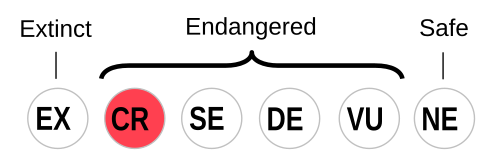 Pū is classified as Critically Endangered according to the UNESCO Atlas of the World's Languages in Danger2 | |
Car Car | |
| Coordinates: 9°11′N 92°46′E / 9.19°N 92.77°E / 9.19; 92.77 | |
Car (Pū) is the most widely spoken Nicobarese language of the Nicobar Islands in the Bay of Bengal.
Although a member of the Austroasiatic language family, it is typologically much more akin to nearby Austronesian languages such as Nias and Acehnese, with which it forms a linguistic area.3 Car is a VOS language and somewhat agglutinative.4 There is a quite complicated verbal suffix system with some infixes, as well as distinct genitive and "interrogative" cases for nouns and pronouns.5
Phonology
Consonants
| Labial | Alveolar/ Retroflex |
Palatal | Velar | Glottal | |
|---|---|---|---|---|---|
| Plosive | p | t | c | k | ʔ |
| Nasal | m | n | ɲ | ŋ | |
| Fricative | f v | s | h | ||
| Tap | ɾ ɽ | ||||
| Approximant | l | j |
- The alveolar flap can typically be pre-stopped. Before a voiceless consonant, its pre-articulation is voiceless as [ᵗɾ], and elsewhere it is voiced [ᵈɾ].
Vowels
| Front | Central | Back | |
|---|---|---|---|
| Close | i | ɨ | u |
| Close-mid | e | ɤ | o |
| Open-mid | ɛ | ə | ɔ |
| Open | (æ) | a |
- /æ/ only occurs in English loanwords.
- Vowel sounds are also typically short when occurring before an /h/.6
Morphology
Shared morphological alternations: the old AA causative has two allomorphs, prefix ha- with monosyllabic stems, infix -um- in disyllabic stems (note: *p > h onset in unstressed σ).
- ɲa - 'to eat' / haɲaː 'to feed'
- pɯɲ - 'to cry' / hapɯɲ-ɲɔː 'to make cry'
- kucik - 'be palatable' / kumcik 'to taste'
- kale - 'brave' / kumle 'bravery'
Vocabulary
Paul Sidwell (2017)7 published in ICAAL 2017 conference on Nicobarese languages.
| Word | Car | proto-Nicobarese |
|---|---|---|
| hot | taɲ | *taɲ |
| four | fɛːn | *foan |
| child | kuːn | *kuːn |
| lip | (minuh) | *manuːɲ |
| dog | ʔam | *ʔam |
| night | hatəːm | *hatəːm |
| male | koːɲ | *koːɲ |
| ear | naŋ | *naŋ |
| one | heŋ | *hiaŋ |
| belly | (ʔac) | *ʔac |
| sun | (tavuːj) | - |
| sweet | (pacaːka) | - |
| overflow | tareːci | *roac |
| nose | mɛh | *moah |
| breast | tɛh | *toah |
| to cough | ʔɛhɛ | *ʔoah |
| arm | kɛl | *koal |
| in, inside | ʔɛl | *ʔoal |
| elbow | sikɔŋ | *keaŋ |
References
References
- Car at Ethnologue (18th ed., 2015) (subscription required)
- Atlas of the World's Languages in Danger (Report) (3rd ed.). UNESCO. 2010. p. 31.
- Cysouw, Michael; Quantitative explorations of the world-wide distribution of rare characteristics, or: the exceptionality of north-western European languages Archived 2009-05-14 at the Wayback Machine; pp. 11-12
- WALS: Nicobarese
- Whitehead, Rev. G.; Dictionary of the Car (Nicobarese) language; published 1925 by American Baptist Mission Press; pp. xxvi-xxxii
- Sidwell, Paul (2015). Car Nicobarese. The Handbook of Austroasiatic Languages: Leiden: Brill. pp. 1231–1240.
{{cite book}}: CS1 maint: publisher location (link) - Sidwell, Paul. 2017. "Proto-Nicobarese Phonology, Morphology, Syntax: work in progress". International Conference on Austroasiatic Linguistics 7, Kiel, Sept 29-Oct 1, 2017.