| Pink corydalis | |
|---|---|
| |
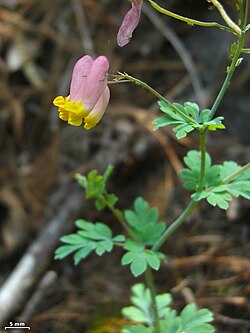
| Great Smoky Mountains, North Carolina | |
Scientific classification 
| |
| Kingdom: | Plantae |
| Clade: | Embryophytes |
| Clade: | Tracheophytes |
| Clade: | Spermatophytes |
| Clade: | Angiosperms |
| Clade: | Eudicots |
| Order: | Ranunculales |
| Family: | Papaveraceae |
| Subfamily: | Fumarioideae |
| Tribe: | Fumarieae |
| Subtribe: | Corydalinae |
| Genus: | Capnoides Mill. |
| Species: | C. sempervirens
|
| Binomial name | |
| Capnoides sempervirens | |
| Synonyms | |
|
Corydalis glauca Pursh | |
Capnoides sempervirens, the harlequin corydalis,1 rock harlequin,2 pale corydalis or pink corydalis, is an annual or biennial plant native to rocky woodland and burned or disturbed places in northern North America. Capnoides sempervirens is the only species in the genus Capnoides.
- Name(s) brought to synonymy
- Capnoides elegans Kuntze, a synonym for Corydalis elegans
Description
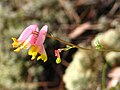
Plants are 20–80 cm (7.9–31.5 in) tall. Both stems and leaves are glaucous. Leaves are 1–3 cm (0.39–1.18 in) in length, twice pinnately divided, usually segmented into 3 lobes and sometimes 4. Flowers are tubular, pink with a yellow tip, 1–1.7 cm (0.39–0.67 in) long, grouped into dangling clusters. Seeds are black and shiny, about 1 mm (0.039 in) wide, held tightly together in long thin cylindrical pods.
Flowers bloom from May to September. Often growing out of areas disturbed by fire. Native from Newfoundland to Alaska and south into the eastern United States.3
Gallery
-
-
 Illustration from The Botanical Magazine Vol. 5, 1792 (as Fumaria glauca)
External links
External links
- Flora of North America — map
- Connecticut Botanical Society Archived 2007-04-26 at the Wayback Machine
References
References
- BSBI List 2007 (xls). Botanical Society of Britain and Ireland. Archived from the original (xls) on 2015-06-26. Retrieved 2014-10-17.
- NRCS. "Corydalis sempervirens". PLANTS Database. United States Department of Agriculture (USDA). Retrieved 17 January 2016.
- Kershaw, Linda (2002). Ontario Wildflowers. Canada: Lone Pine Publishing. p. 33. ISBN 1-55105-285-7.