| Callicebus | |
|---|---|
| |
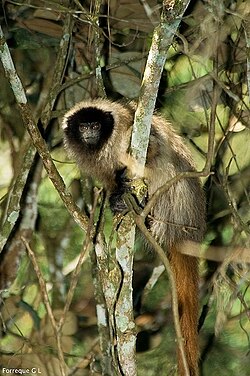
| Atlantic titi (Callicebus personatus) | |
Scientific classification 
| |
| Kingdom: | Animalia |
| Phylum: | Chordata |
| Class: | Mammalia |
| Infraclass: | Placentalia |
| Order: | Primates |
| Family: | Pitheciidae |
| Subfamily: | Callicebinae |
| Genus: | Callicebus Thomas, 1903 |
| Type species | |
| Simia personatus É. Geoffroy, 1812
| |
| Species | |
|
Callicebus barbarabrownae | |
Callicebus is a genus of monkeys known as titi monkeys.
Historically, titis were monogeneric, comprising only the genus Callicebus Thomas, 1903. Owing to the great diversity found across titi monkey species, a new genus-level taxonomy was recently proposed that recognises three genera within the subfamily Callicebinae; Cheracebus Byrne et al., 2016 for the species of the torquatus group (Widow titis); Plecturocebus Byrne et al., 2016 for the Amazonian and Chaco titis of the moloch and donacophilus groups; and Callicebus Thomas, 1903 sensu stricto, for species of the Atlantic Forest personatus group.1
In 2014, a previously unknown orange Callicebus was spotted in the Peruvian Amazon; it has not been determined whether this constitutes a color variant or a new species.2
Species
There are 5 species in this genus:
- Barbara Brown's titi monkey, Callicebus barbarabrownae
- Coimbra Filho's titi monkey, Callicebus coimbrai
- Coastal black-handed titi monkey, Callicebus melanochir
- Black-fronted titi monkey, Callicebus nigrifrons
- Atlantic titi monkey, Callicebus personatus

References
References
- Byrne, Hazel; Rylands, Anthony B.; Carneiro, Jeferson C.; Alfaro, Jessica W. Lynch; Bertuol, Fabricio; da Silva, Maria N. F.; Messias, Mariluce; Groves, Colin P.; Mittermeier, Russell A. (2016-01-01). "Phylogenetic relationships of the New World titi monkeys (Callicebus): first appraisal of taxonomy based on molecular evidence". Frontiers in Zoology. 13: 10. doi:10.1186/s12983-016-0142-4. ISSN 1742-9994. PMC 4774130. PMID 26937245.
- Vriesendorp, Corine (27 March 2015). "Possible New Primate Discovered in Peru". Field Museum of Natural History. Retrieved 6 February 2022.