

In mathematics, the cake number, denoted by Cn, is the maximum of the number of regions into which a 3-dimensional cube can be partitioned by exactly n planes. The cake number is so called because one may imagine each partition of the cube by a plane as a slice made by a knife through a cube-shaped cake. It is the 3D analogue of the lazy caterer's sequence.
The values of Cn for n = 0, 1, 2, ... are given by 1, 2, 4, 8, 15, 26, 42, 64, 93, 130, 176, 232, ... (sequence A000125 in the OEIS).
General formula
If n! denotes the factorial, and we denote the binomial coefficients by
and we assume that n planes are available to partition the cube, then the n-th cake number is:1
Properties
The cake numbers are the 3-dimensional analogue of the 2-dimensional lazy caterer's sequence. The difference between successive cake numbers also gives the lazy caterer's sequence.1
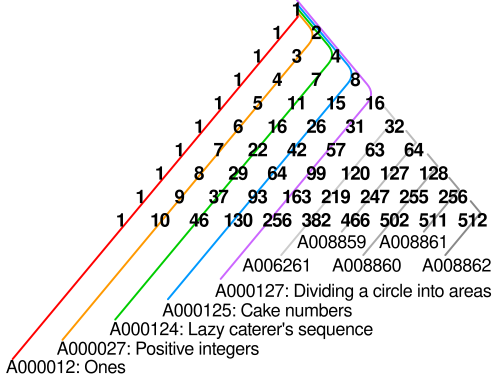
The fourth column of Bernoulli's triangle (k = 3) gives the cake numbers for n cuts, where n ≥ 3.

The sequence can be alternatively derived from the sum of up to the first 4 terms of each row of Pascal's triangle:2
- kn
0 1 2 3 Sum 0 1 — — — 1 1 1 1 — — 2 2 1 2 1 — 4 3 1 3 3 1 8 4 1 4 6 4 15 5 1 5 10 10 26 6 1 6 15 20 42 7 1 7 21 35 64 8 1 8 28 56 93 9 1 9 36 84 130
Other applications
In n spatial (not spacetime) dimensions, Maxwell's equations represent different independent real-valued equations.
See also
See also
- Dividing a circle into areas (Moser's circle problem)
- Lazy caterer's sequence
- Pizza theorem
References
References
- Yaglom, A. M.; Yaglom, I. M. (1987). Challenging Mathematical Problems with Elementary Solutions. Vol. 1. New York: Dover Publications.
- (sequence A000125 in the OEIS)
External links
External links
- Eric Weisstein. "Space Division by Planes". MathWorld. Retrieved January 14, 2021.
- Eric Weisstein. "Cake Number". MathWorld. Retrieved January 14, 2021.