
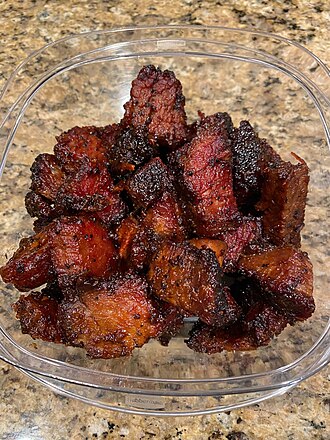
Burnt ends are pieces of meat cut from the "point" half of a smoked brisket.1
Kansas City style burnt ends are usually served chopped with sauce either on top or on the side. A "proper" burnt end should display a modest amount of "bark" or char on at least one side. Burnt ends can be served alone (sometimes smothered in barbecue sauce) or in sandwiches, as well as in a variety of other dishes, including baked beans2 and French fries.
The origin of Burnt Ends is credited to the Kansas City restaurant Arthur Bryant's and its namesake pitmaster. Kansas City native Calvin Trillin is credited with popularizing burnt ends through his references to the burnt ends at Bryant's in his work.3 In a 1972 article he wrote for Playboy about Arthur Bryant's restaurant in Kansas City,4 he wrote: "The main course at Bryant's, as far as I'm concerned, is something that is given away free – the burned edges of the brisket. The counterman just pushes them over to the side and anyone who wants them helps himself. I dream of those burned edges. Sometimes, when I’m in some awful, overpriced restaurant in some strange town, trying to choke down some three-dollar hamburger that tastes like a burned sponge, a blank look comes over me: I have just realized that at that very moment, someone in Kansas City is being given those burned edges for free.”
References
References
- Bonjwing Lee (July 8, 2014). "The Burnt Ends of Kansas City: A Guided Tour". The Eater. Retrieved August 8, 2020.
- Peter Meehan (March 7, 2007). "The Big Apple May Never Be Known as the Big Sparerib, but It's Smokin'". New York Times. Retrieved April 16, 2018.
- "Burnt Legend: The Story of Burnt Ends". PBS. Archived from the original on July 14, 2017. Retrieved August 8, 2020.
- Calvin Trillin (April 1972). "No! One of the Worlds' Foremost Authorities on Ribs, Cheeseburger, French Fries and Frosty Malts Takes a Gourmet Tour of Kansas City". Playboy. pp. 108, 110, 209, 210 – via scan of original article shared by Full Custom Gospel BBQ.