Billboard Utilising Graffitists Against Unhealthy Promotions | |
 | |
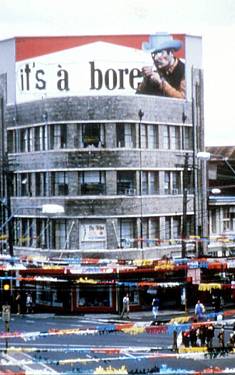 A Marlboro billboard that has been altered to read “it’s a bore”, North Sydney | |
| Abbreviation | BUGA UP |
|---|---|
| Predecessor |
|
| Formation | October 1979 (1979-10) |
| Founders |
|
| Founded at | Sydney |
| Purpose | Anti-smoking |
| Location | |
| Methods | Billboard hijacking using graffiti |
| Field | Subvertising |
Key people |
|
Publication | B.U.G.A.U.P. |
| Website | bugaup |
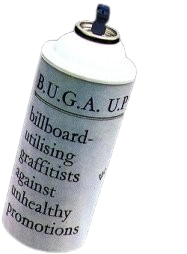
Billboard Utilising Graffitists Against Unhealthy Promotions, or B.U.G.A.U.P. (alternatively, BUGA-UP or BUGA UP) is an Australian subvertising artistic movement thay plays on the phrase "bugger up". It practices billboard hijacking using détournement or modification with graffiti of such billboard advertising that promotes something that is deemed unhealthy. At the time of it's formation, smoking in Australia was common and cigarette advertising was largely unregulated, leading to an increase rate due to popular campaigns such as Paul Hogan's Winfield ad series.1
History
The movement started in inner-city Sydney in October 1979, later spreading to Melbourne, Hobart, Adelaide and Perth. It has been active ever since, although its peak of activity was in the late 1970s and early-mid 1980s. It was aimed mainly at cigarette and alcohol advertising, often blanking out letters and adding others to promote their view that the product is unhealthy. Cola and soft drink ads were also targeted.
The movement did not formalize itself as a group with memberships or meetings. Graffitists "joined" by signing the BUGA-UP name to their work. Their graffiti spread rapidly across Australia and then overseas.
Many of the members came from professional and university-educated backgrounds. A founding member was Bill Snow, who first started to alter tobacco billboards with graffiti, and continued to be active in anti-smoking and littering campaigns. Together, Snow, Ric Bolzan and Geoff Coleman coined the acronym BUGA-UP and began adding it to the altered billboards, to link the graffiti to a movement rather than the random activity of individuals.
Former New South Wales politician Arthur Chesterfield-Evans was a member of BUGA-UP before entering politics.2 Other well-known BUGA-UP members were the late Lord Bloody Wog Rolo, Peter Vogel, and Fred Cole.
Impact
The Cancer Council of Western Australia states that the BUGA-UP campaign of the mid-1980s "radicalised the advertising debate and made it suddenly more respectable for previously conservative medical associations and colleges to rattle the legislative cage".3
Former Daily News reporter Joanne Fowler states that prior to the BUGA-UP campaigns of the 1980s, journalists were unwilling to publish articles critical of the tobacco industry because they were seen to be mundane.4 Almost all forms of tobacco advertising were made illegal in Australia in 1992.5
References
References
- "Battle of the brands - AdNews". www.adnews.com.au. Retrieved 4 May 2026.
- "Arthur Chesterfield-Evans". Australian Democrats. Archived from the original on 14 June 2005. Retrieved 21 August 2019.
- The Cancer Council Western Australia Archived 23 September 2019 at the Wayback Machine The progress of tobacco control in Western Australia: achievements, challenges and hopes for the future. page iv
- The Cancer Council Western Australia Archived 23 September 2019 at the Wayback Machine The progress of tobacco control in Western Australia: achievements, challenges and hopes for the future. page 71
- Tobacco Advertising Prohibition Act 1992 (Cth)
- Civil Disobedience and Tobacco Control: The Case of BUGA UP
- B.U.G.A. U.P. : Autumn catalogue 1980, National Library of Australia
- Buga-up on Trial, National Library of Australia
- "Bugga Up (Smoking History)", George Negus Tonight, ABC TV
- "No ifs, no butts – these boys were tough", Sydney Morning Herald, 12 October 2002
- "Fred Cole", Sydney Morning Herald, 16 March 2009
- "BUGA-UP interview", How to Make Trouble and Influence People, 2009 Archived 3 February 2018 at the Wayback Machine
- "BUGA UP – You've come a long way, baby", Overland, 23 August 2012