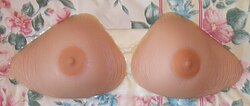
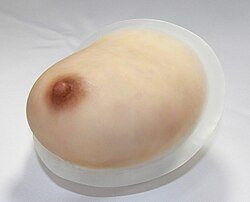
Breast prostheses are breast forms intended to look like breasts. They are often used after mastectomy or lumpectomy procedures or before feminizing HRT, but may also be used by for aesthetic purposes. There are a number of materials and designs; although, the most common construction is gel (silicone or water-based) in a plastic film meant to feel similar to a person's skin.1 There are many types of ready made breast prostheses including full or standard prostheses, partial prostheses such as shell prostheses, and stick on prostheses.2 Customized options are also available from specialty shops, which are moulded to fit an individual's chest by taking an impression of the breast(s).3 The areola and nipple may be replicated as part of the breast form or as separate nipple prosthesis.4 Breast prostheses come in varieties that are designed to either be held in a pocket in a mastectomy bra or attached to the skin via adhesive or other methods and worn with a standard bra.5 There are many factors to consider when selecting breast prostheses such as different types and the care they require, insurance coverage, and psychosocial effects.672
Uses
External breast prostheses are commonly used in people who have undergone surgical treatment for breast cancer such as a mastectomy or lumpectomy. They have a variety of physical benefits such balance,8 as well as psychological benefits such as improved self-confidence.9 Outside of post-surgical uses, prosthetics are also used to create the appearance of breasts.
Mastectomy
Breast prostheses are most commonly used after a mastectomy, usually a consequence of cancer. They are often molded to mimic the shape of a person's breast and can either be used temporarily or for long-term use as an alternative to, or prior to surgical breast reconstruction. Depending on the type of mastectomy performed, progress of post-operative healing, and other factors, surgeons will determine the time when a person can start to use a prosthesis. A prescription may be required for breast prostheses and mastectomy bras for insurance purposes.10
Up to 90% of people use a prosthetic after surgery, temporarily or permanently.
Attachable breast prostheses
Attachable breast prostheses can be used as an alternative to post-mastectomy bras. Attachable breast prostheses can be attached to the skin with adhesives and can be worn with a regular bra.10
Lumpectomy
After a lumpectomy or a quadrantectomy, breast prostheses can help to accommodate for the missing tissue. Examples of breast prostheses after partial breast tissue removal include partial breast prosthesis and attachable breast prostheses (also known as a contact prostheses).11
Partial breast prosthesis are created in materials such as silicone, foam, or fiber.
Attachable breast prostheses are secured directly onto the body. Attachable prostheses can be custom made as a partial breast shape, as well as in full sizes. These prostheses, unlike the partial ones, move independent of a bra and can be worn with a regular bra.1012
Breast enhancement
Transgender and cross-dressing
Many pre or non-hormonal trans women and people who cross-dress use breast prostheses in order to create the illusion of breasts. There are also nonbinary people who use breast prostheses.
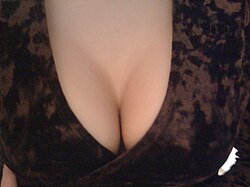
Full frontal cleavage tops are also available, mainly marketed to the transgender community. They incorporate a pair of breast prostheses in a one-piece skin coloured garment that is designed to provide the illusion of natural cleavage. Such garments have the disadvantage of having a visible top edge at the neck. The edges of the breast prostheses are often distinguishable through the thin outer cover.
Psychosocial effects
After a lumpectomy or mastectomy, both physical and psychological health of people can be affected as an outcome of tissue removal.13 A breast prosthesis is an alternative post-surgical option to breast reconstruction to aid with these consequences. Breast tissue removal can cause people to have an altered center of gravity, and could have negative impacts on posture as well as balance.14 A prosthesis may help to correct balance and posture deficiencies caused by tissue removal. Additionally, partial or full loss of a breast can result in loss of self-esteem for some people. Breast prostheses can be used to lessen the insecurity.15
Types
Styles
- Full/standard prosthesis goes directly onto the breast wall and is used in people who have had all breast tissue removed. Size, shape and skin tone can be customized.2
- Partial prosthesis contain two layers of silicone with a thin layer of film to gently adhere to the breast.16 Unlike a full prosthesis, this can be used in situations where part of the breast has been removed. It is worn over the breast tissue inside the bra to create a fuller appearance and fill the breast outline.210
- A Shell prosthesis is a soft shell of made of silicon is placed around a smaller breast to match the size of the larger one. They are typically made to have a polyester front with a cotton backing and are lightweight.16
- Stick-on prosthesis sticks onto the skin and can be either full or partial. Strapless clothing can be worn with this prosthesis if the clothing can provide some support.2
- A Custom-made prosthesis is customized for color, size, and contour. Silicon and latex materials are normally used.5
Shapes
Non-customised prostheses are made of different shapes to suit the extent of breast tissue removal or the shape of a person's chest. Asymmetric breast forms incorporate an extension towards the armpit to replicate the shape of the tail of Spence, while symmetric "triangle" or "teardrop" prostheses do not incorporate that extension.
Weight
Silicone breasts come in a variety of weights to fit the needs of the user and are typically designed to have the same weight as natural breasts. Lightweight forms that are about 20-40% lighter than the standard form do exist.16
History
Breast prostheses in the 1800s were made of rubber. On 27 January 1874, a U.S. patent for a "breast pad" was issued to Frederick Cox (No. US 146805).17 His design consisted of rubber pads filled with air encased in cotton. Later in 1885, Charles L. Morehouse received US patent 326915 for his "Breast-Pad", made of natural rubber and inflatable with air at normal pressure.18 Newer designs such as that of Laura Wolfe's in 1904 parted with the air-filled design, which was prone to punctures, in favor of down feather and silk floss filling.19
While breast forms were mainly sold for post-surgical purposes, over time the aesthetic potential of these prosthetics was explored. Breast form development increased in the mid 1900s as more companies began to sell and market a variety of breast forms with new materials. Eventually, marketing for breast prosthetics expanded to target people other than cisgender women looking for a surgical prosthetic or cosmetic enhancement. Some companies created branded products for trans and non-binary people.20
References
References
- US 7766963B2, Aldo A. Laghi, "External breast prosthesis", issued 2005-09-08, assigned to Alps Intellectual Property Management LLC Archived 2024-04-14 at the Wayback Machine
- "Prosthesis styles". Breast Cancer Now. 2015-06-09. Archived from the original on 2020-09-29. Retrieved 2020-08-05.
- "Choosing a Prosthesis After Breast Cancer Surgery | Michigan Medicine". www.uofmhealth.org. Archived from the original on 2020-06-19. Retrieved 2020-07-31.
- "Prostheses". www.cancer.org. Archived from the original on 2020-07-29. Retrieved 2020-07-31.
- "Prosthetics: An Alternative to Reconstruction". Breastcancer.org. 2019-03-07. Archived from the original on 2020-08-03. Retrieved 2020-07-31.
- Jetha (2017). "Women experiences of using external breast prosthesis after mastectomy". Asia-Pacific Journal of Oncology Nursing. 4 (3): 250–258. doi:10.4103/apjon.apjon_25_17. PMC 5473097. PMID 28695172.
- "What to Know About Mastectomy Clothing: Bras, Swimsuits and Insurance". Dana-Farber Cancer Institute. 2014-12-05. Archived from the original on 2020-09-25. Retrieved 2020-08-05.
- "Breast Prosthetics & Mastectomy Bra FAQ | Seattle Cancer Care Alliance". www.seattlecca.org. Archived from the original on 2019-11-18. Retrieved 2020-07-31.
- Lu, Zhenqi (February 2019). "Physical and Psychological Effects of Different Temperature-controlled Breast Prostheses on Patients With Breast Cancer - Full Text View - ClinicalTrials.gov". clinicaltrials.gov. Archived from the original on 2021-04-04. Retrieved 2020-07-31.
- "Post-Mastectomy Prosthesis". www.hopkinsmedicine.org. 19 November 2019. Archived from the original on 2024-07-26. Retrieved 2020-07-31.
- "TLC: Hair Loss and Mastectomy Products". www.cancer.org. Archived from the original on 2024-07-26. Retrieved 2020-07-31.
- "Choosing a Prosthesis After Breast Cancer Surgery | Cigna". www.cigna.com. Archived from the original on 2020-09-24. Retrieved 2020-08-04.
- Jetha (2017). "Women experiences of using external breast prosthesis after mastectomy". Asia-Pacific Journal of Oncology Nursing. 4 (3): 250–258. doi:10.4103/apjon.apjon_25_17. PMC 5473097. PMID 28695172.
- "Breast Prosthesis". Jay Ann Intimates. Archived from the original on 2020-08-04. Retrieved 2020-08-03.
- "Psychological Effects of Mastectomy – Breast Cancer". Cope with Cancer. 2016-05-05. Retrieved 2020-08-03.
- "Breast prostheses". Cancer Council Victoria. June 1, 2017. Archived from the original on August 14, 2020. Retrieved August 3, 2020.
- [1], "Improvement in breast-pads", issued 1874-01-27 Archived 2024-07-26 at the Wayback Machine
- "Patent Images".
- [2], "Artificial breast.", issued 1904-11-04
- "A Brief History of Breast Forms". Trans Tool Shed. 23 December 2019. Archived from the original on 2020-09-27. Retrieved 2020-08-03.