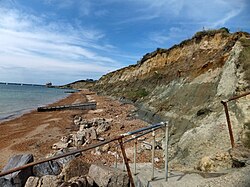
Brambles Chine is a chine in Colwell Bay, Isle of Wight, England notable for its geology. After years of erosion, a path down to the beach near Brambles Chine was destroyed, but rebuilt in 2023.1
The chine is accessible from the coastal path. A slipway is where the chine bed used to be.2
Name
Named from a place called Brambles on Andrew's Map of 1769, and perhaps associated with Bramblehill (1608), the origin of the name is from Lazarus Bramble, a master mariner from Yarmouth that owned the chine in 1648. The word chine is from Old English cinu (fissure, ravine).3
There is a self-catering holiday village and a park near the chine with the same name.4
Location
It is located in Colwell Bay, near the villages of Freshwater and Totland. There is a small, unnamed copse of trees surrounding the chine. In the bay, there are two other chines: Linstone Chine to the north, and Colwell Chine to the south.5
The geology consists of the sands and clays of the Headon Hill Formation.6 It was one of the areas investigated in the 17th Century by Robert Hooke.7
References
References
- "Revamped Brambles Chine pathway offers direct access to West Wight beach". OnTheWight.com.
- "NW Coast Chines". islandrivers.org.uk. Retrieved 2026-01-13.
- Mills, A.D (1996). The Place-Names of the Isle of Wight. Shaun Tyas.
- "Brambles Chine Holidays". www.brambleschineholidays.co.uk. Retrieved 2025-11-04.
- Club, Saturday Walkers. "Great Britain Road Atlas - SWC". Saturday Walkers Club. Retrieved 2025-11-04.
- West, Ian. "Colwell Bay, Isle of Wight". Wessex Coast Geology. University of Southampton.
- "Isle of Wight Geology: Geology and Robert Hooke". IWHistory. Retrieved 4 November 2025.